


The new Avalon reporting is not just about CrownX encryption. It shows how credential theft, remote access, recovery pressure, and ransomware can be bundled into one modular intrusion system.
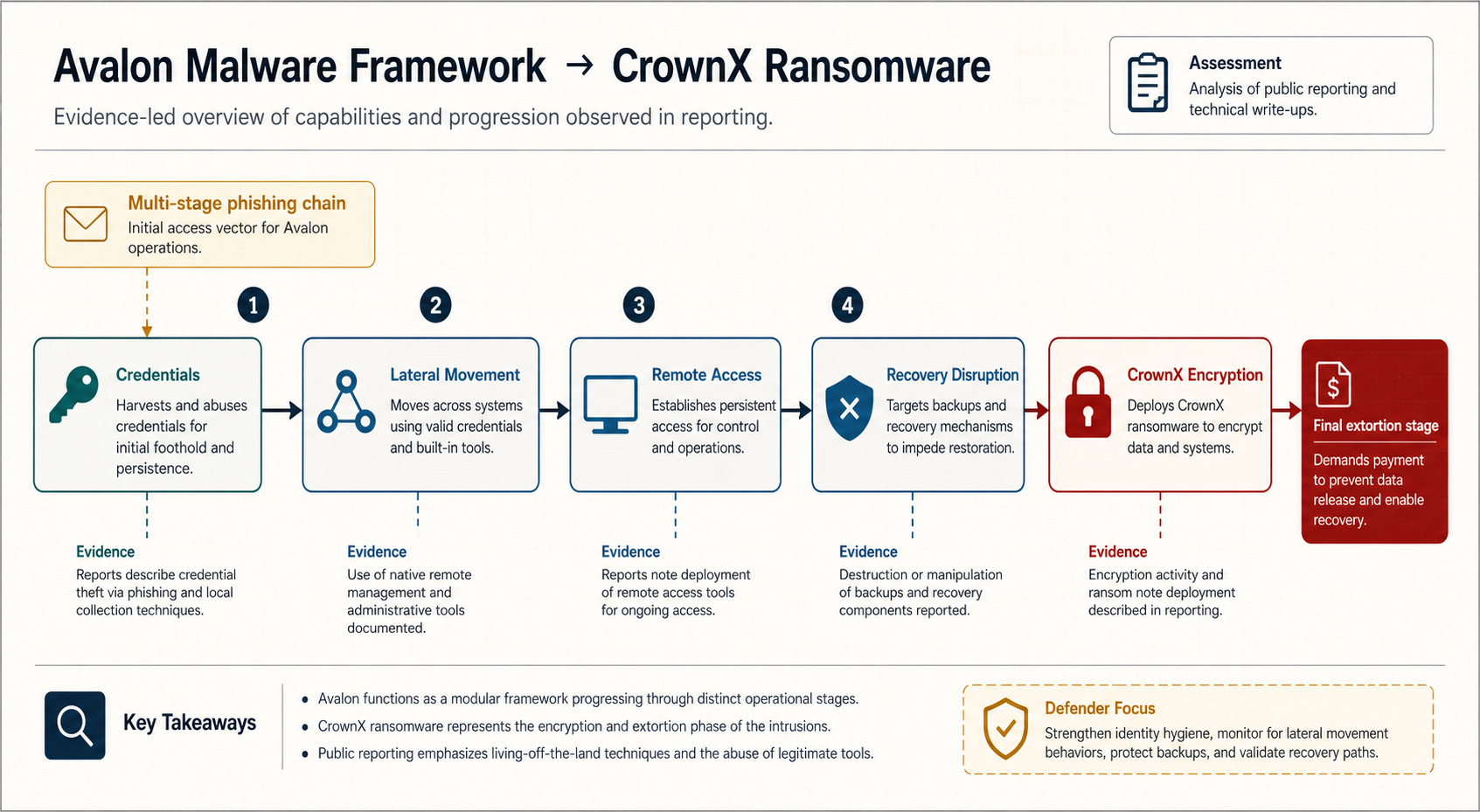
Avalon is a useful ransomware story because the ransomware is only the last visible stage.
The sharper signal is the shape of the framework around it: phishing delivery, credential collection, remote access, lateral movement, recovery disruption, anti-forensic cleanup, and then CrownX encryption.
That turns the incident from an endpoint malware problem into an operating model problem.
The Hacker News, citing Blackpoint Cyber researchers Nevan Beal and Sam Decker, reports that Avalon is a previously undocumented modular malware framework distributed through a multi-stage phishing chain. Its ransomware component is internally named CrownX, but the reporting makes clear that the damage can begin well before the ransom note appears.
The Ransom Note Is Late
CrownX is the part that makes the intrusion obvious.
It encrypts files tied to business operations, software development, engineering, data storage, and virtual infrastructure. It also delivers a ransom note with payment pressure and deadline timers, according to the reporting.
But the important sequence starts earlier.
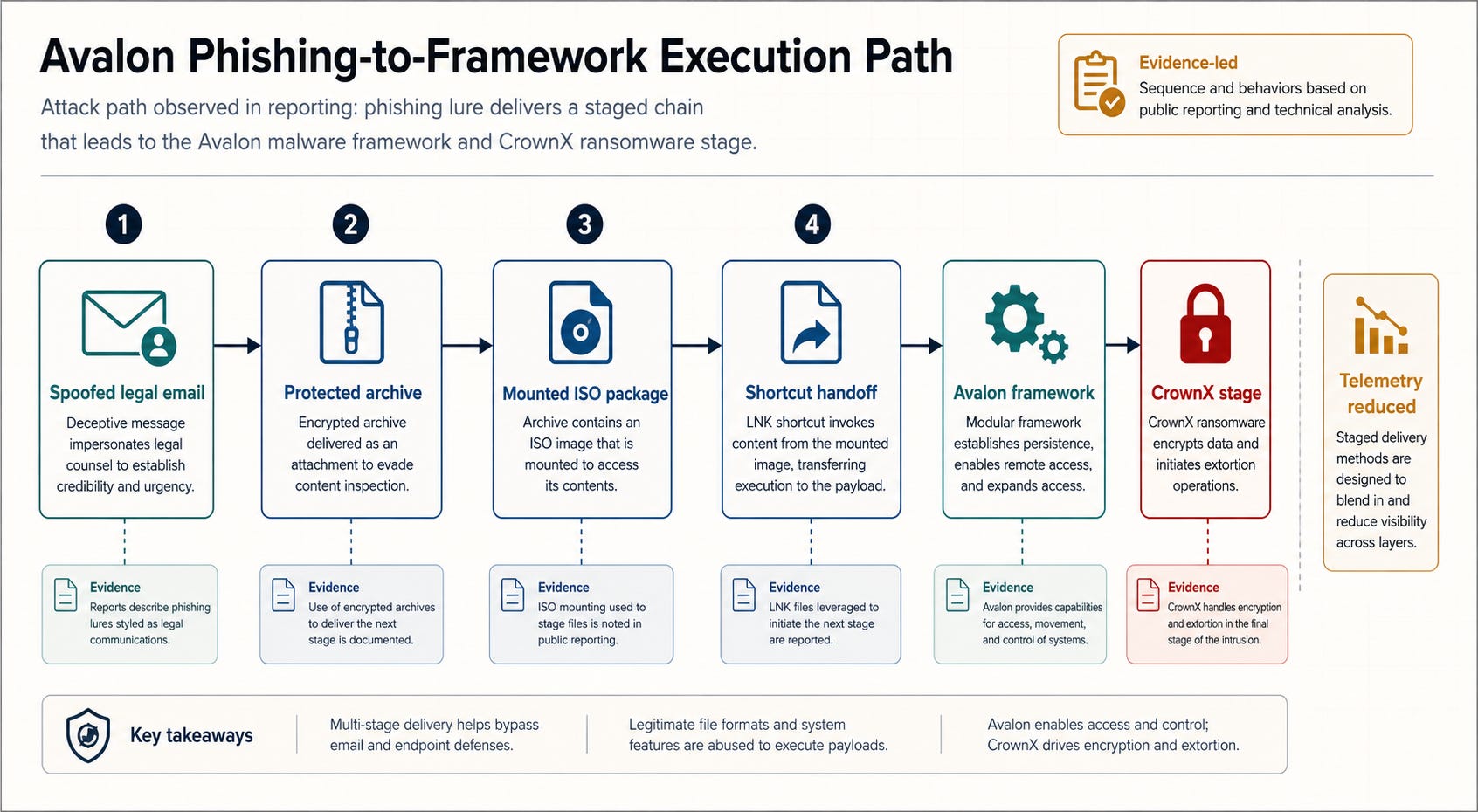
Blackpoint's researchers described a spoofed legal document email that directed recipients to a password-protected archive on Proton Drive. The malicious content was placed inside an ISO image rather than attached directly, reducing the chance of detection at the email layer. A document-themed Windows shortcut inside the mounted image then triggered a staged sequence that eventually deployed Avalon.
That delivery path matters because it keeps the first move looking like document handling.
By the time CrownX appears, Avalon has already had the opportunity to collect identity material, establish control, weaken recovery, and reduce visibility.
Avalon Wants The Whole Intrusion Surface
The Hacker News summary describes Avalon as a framework with credential collection, lateral movement, remote access, recovery disruption, and ransomware execution under one umbrella.
That is the part worth taking seriously.
Single-purpose malware asks one defensive question: did the payload run? Avalon asks several at once: what credentials were exposed, what remote access was established, what systems were prioritized, what telemetry was reduced, and whether backup or recovery paths were touched before encryption.
The reported credential collection is broad. Avalon can harvest browser credentials, cookies, history, and bookmarks from Chromium-based browsers and Firefox. It also targets cryptocurrency wallet applications, collaboration tools, VPN clients, Windows Credential Manager material, SSH known hosts, saved RDP connections, Wi-Fi profiles, and Group Policy Preferences cpassword artifacts.
That list should not be read as trivia.
It means response cannot assume the blast radius stops at encrypted files. If those data classes were accessible on the affected host, they may become the next access path.
The Evasion Layer Is A Visibility Problem
The reporting says Avalon includes a defense-evasion subsystem intended to reduce detection and adapt around controls present on the host.
That does not mean every environment will see the same behavior. It does mean defenders should treat missing telemetry as a signal to investigate, not as comfort.
Avalon's staged chain reportedly loads an embedded .NET assembly and interferes with Event Tracing for Windows to reduce forensic visibility before downloading the next-stage payload over HTTPS. The framework also includes methods meant to conceal execution from several security tools.
The practical lesson is simple: do not wait for a clean malware alert to define the incident.
Look for the pattern around it. An unusual protected archive, mounted disk-image activity, suspicious shortcut execution, unexpected build tooling behavior, browser credential access, new remote access, recovery interference, and cleanup attempts are more useful together than any single event by itself.
The sequence is the detection object.
That is where detection has to be more sequence-aware.
Recovery Is Part Of The Attack Path
Avalon is not framed only as a theft tool or only as a locker.
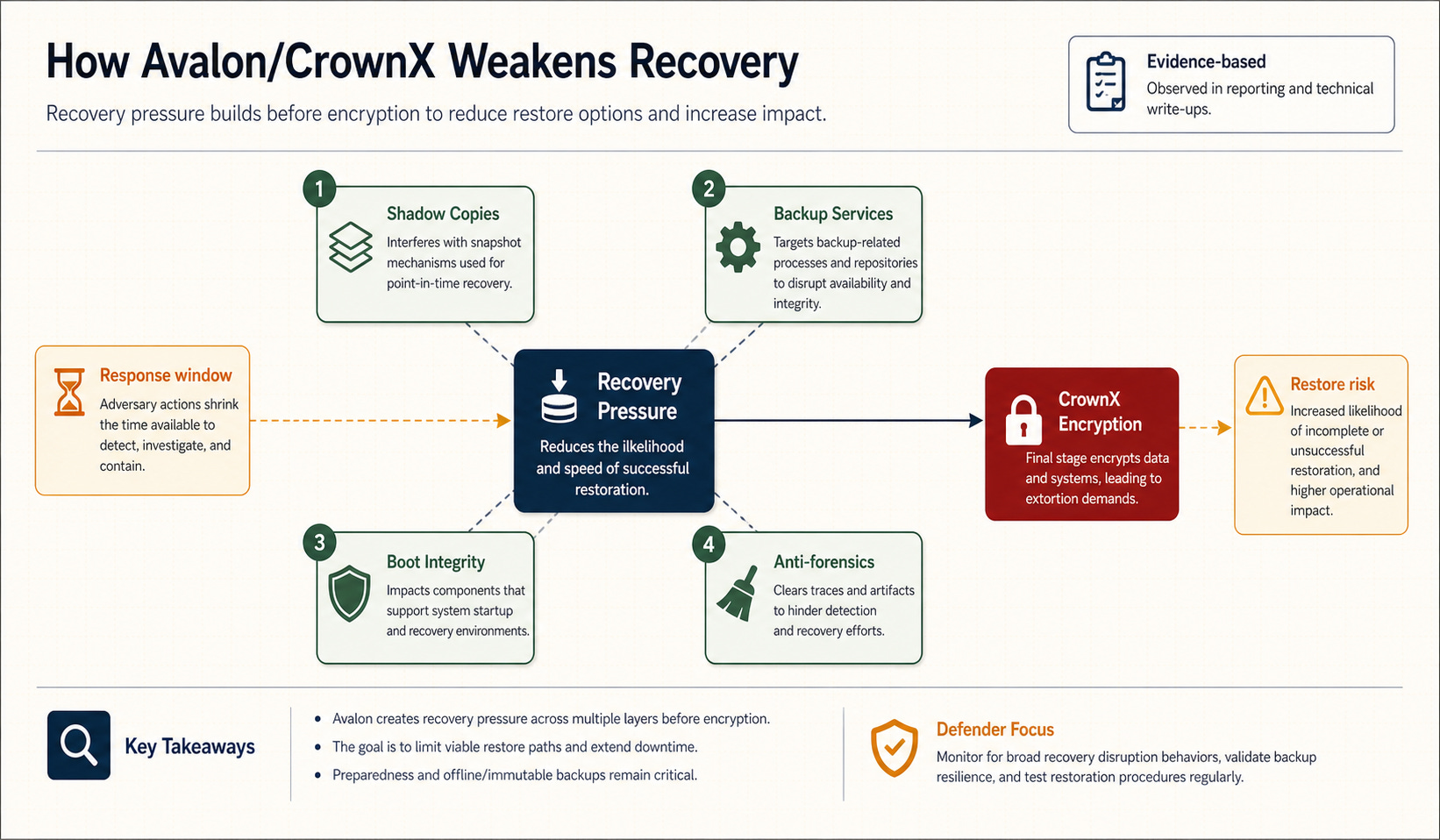
The reporting says the framework can terminate the Volume Shadow Copy Service, delete shadow copies, remove traces of artifacts, and interact with disk structures in ways that could damage partition information, boot records, or other critical areas of the drive.
Those are recovery-pressure behaviors.
They are designed to narrow the defender's options before and during the extortion phase. If restoration paths are weakened, the ransom note has more leverage.
This is why backup validation cannot be an annual audit item.
For an Avalon-style intrusion, defenders need to know which backup repositories are reachable from compromised identities, whether shadow-copy deletion or backup-service disruption alerts are working, and whether restore procedures are tested from clean, isolated copies.
The goal is not to admire the ransomware. The goal is to make the final stage less decisive.
The AI Detail Is About Scale, Not Magic
The Hacker News article also notes Blackpoint's assessment that Avalon shows signs of AI-assisted development.
That point is easy to overstate.
The reporting does not need Avalon to be elegant or novel in every component. The concern is that AI assistance may lower the cost of assembling many useful functions into one workable framework, even when tradecraft and operational security are uneven.
That is a scale problem.
If less skilled actors can stitch together credential theft, evasion, remote access, reconnaissance, recovery disruption, and encryption more quickly, defenders should expect more "good enough" intrusion frameworks. They may be messy. They may still be dangerous.
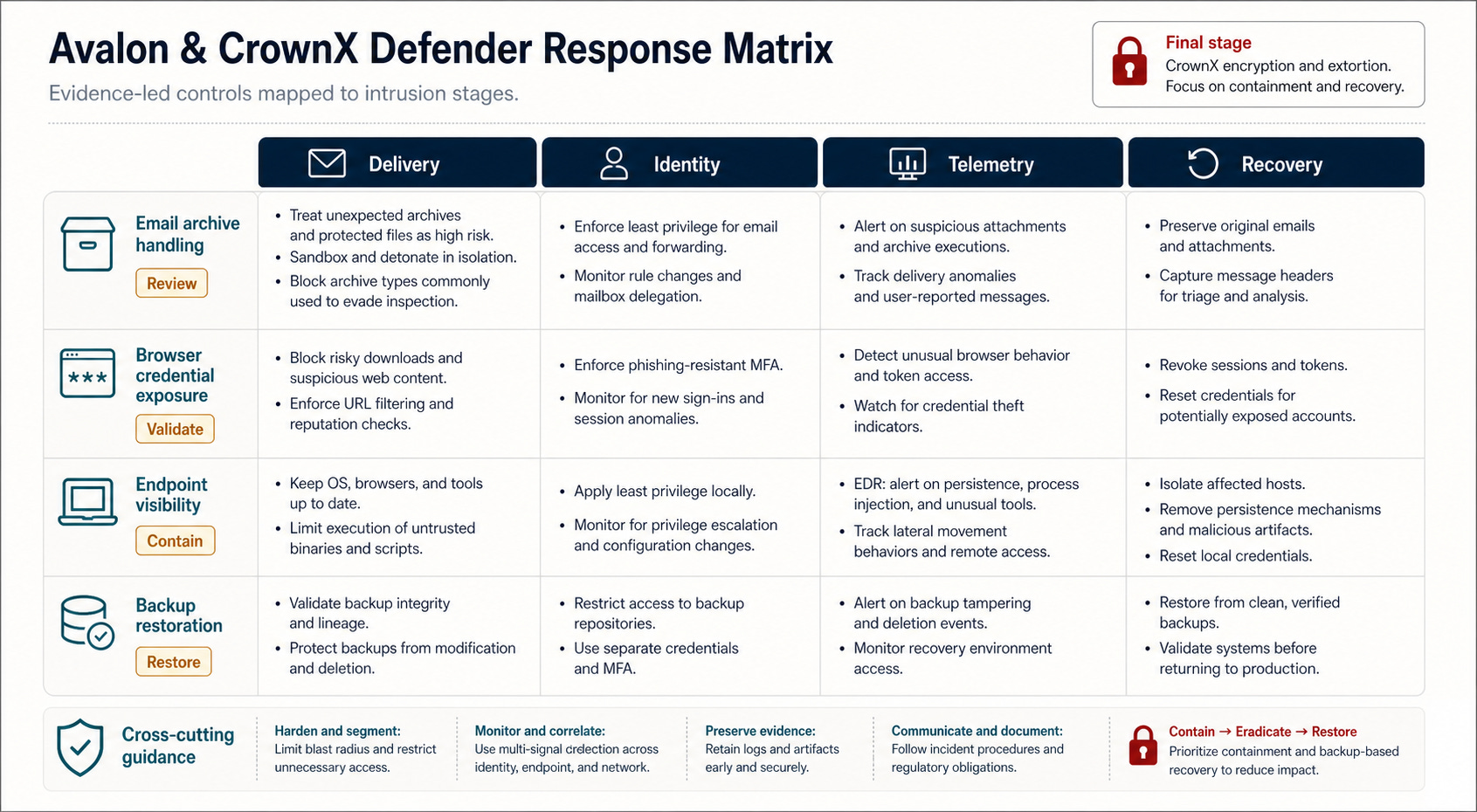
The control response should stay grounded: harden email and archive handling, restrict execution from mounted disk images and untrusted shortcuts, watch for credential-store access, review remote-access creation, preserve telemetry early, and isolate recovery infrastructure from ordinary domain compromise.
The Control Move Is To Connect The Chain
Avalon should push teams away from payload-only thinking.
The question is not just whether CrownX encryption ran. It is whether the environment can see the chain that leads there.
Start with delivery. Treat unexpected protected archives and disk-image attachments as high risk, especially when they arrive through legal, invoice, or document review lures.
Move to identity. Assume exposed browser credentials, cookies, VPN material, saved RDP connections, and collaboration tokens may matter after compromise. Rotate and revoke based on host exposure, not just on confirmed use.
Then validate visibility. If ETW, endpoint telemetry, logs, or security tooling appear impaired, preserve evidence quickly and widen the timeline.
Finally, test recovery as an adversary-facing control. Backup repositories, restore accounts, shadow-copy monitoring, recovery environments, and rebuild procedures should be treated as part of the attack surface, not as a separate disaster-recovery worksheet.
Avalon is not important because every function is new.
It is important because the functions are packaged together in the order an extortion intrusion needs them.
That is the defender's clearest read: stop treating ransomware as the first event. In this case, ransomware is the receipt.