


The WebLogic name can point an application inventory toward the backend. CVE-2026-21962 affects the web tier.
On August 24, the US Cybersecurity and Infrastructure Security Agency added CVE-2026-21962 to its Known Exploited Vulnerabilities catalog. Oracle's CVE record places the flaw in Oracle HTTP Server and the WebLogic Server Proxy Plug-in for Apache HTTP Server and Microsoft IIS—the HTTP-facing layer that forwards requests toward WebLogic-managed applications.
That boundary turns the response into an ownership and mapping problem. Finding every backend domain with a WebLogic label is not the same as finding every web tier that loads the affected plug-in.
The component most likely to disappear in an application-centric inventory sits directly in the request path.
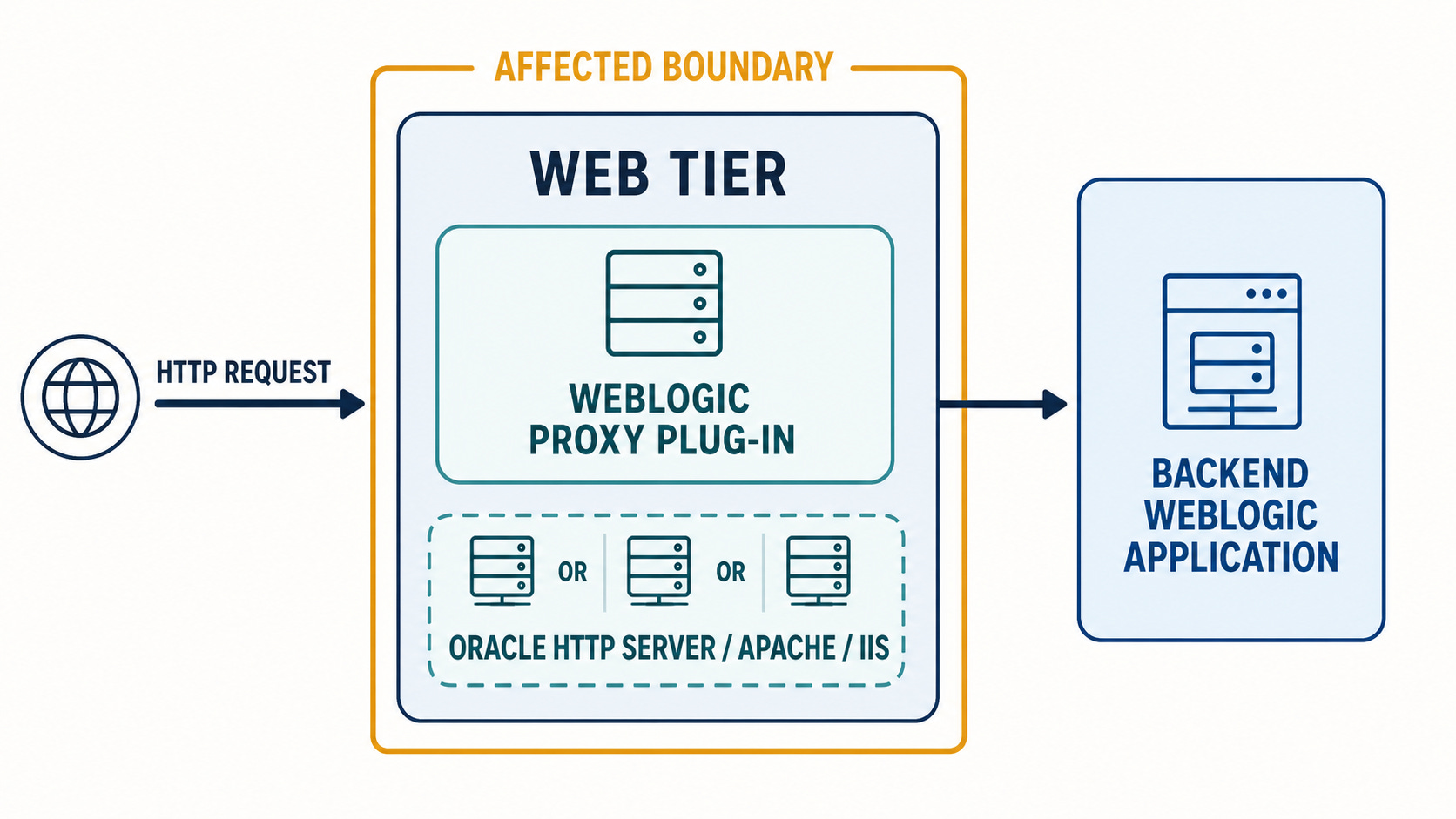
The affected scope is Oracle HTTP Server and the WebLogic proxy plug-in in Apache or IIS. The backend application remains downstream and outside the bracket.
Map the web tier to its owners
The affected versions listed by Oracle are 12.2.1.4.0, 14.1.1.0.0, and 14.1.2.0.0; Oracle's note limits the affected IIS plug-in to 12.2.1.4.0.
This is an inventory problem before it is a patching problem. A software inventory that records only the backend application, business service, or WebLogic domain may not show which Apache or IIS front ends load the proxy plug-in. Ownership can be split across web, middleware, application, and infrastructure teams while the vulnerable request path belongs to all of them.
The first question is therefore not “Do we run WebLogic?” It is: Which internet-facing or internally reachable HTTP tiers load this plug-in, which applications sit behind them, and who can prove their patch state?
The public evidence is urgent—and narrow
SecurityWeek reported the KEV addition on August 25. CISA requires federal civilian agencies to mitigate the flaw by August 27, three days after the catalog change. Oracle had already addressed it in the January 2026 Critical Patch Update.
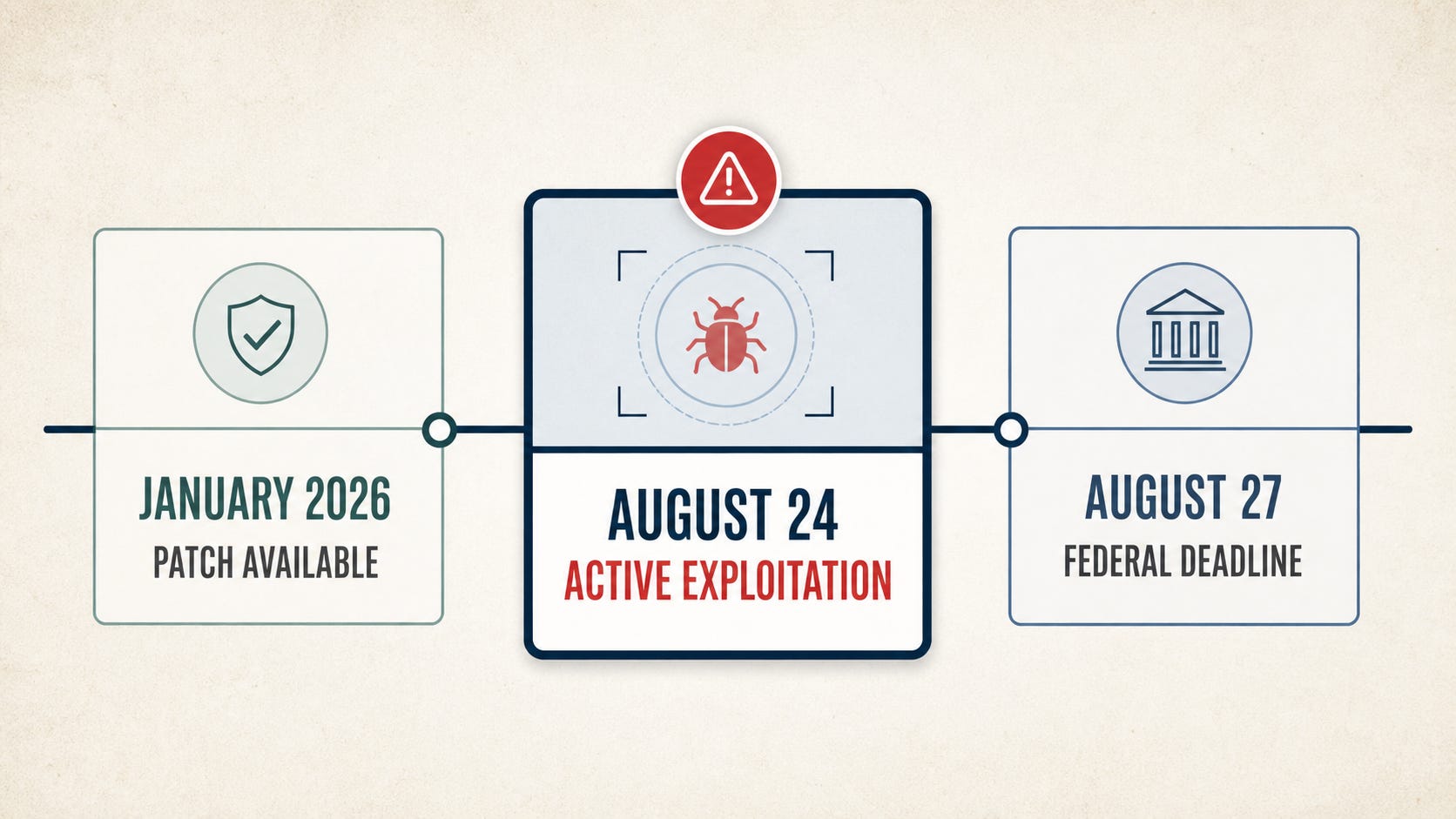
The vulnerability was patched months ago. The fresh event is CISA's active-exploitation determination and compressed federal deadline.
CISA's catalog does not identify an actor, victim, campaign, or exploitation technique. It also lists known ransomware use as unknown. “Known exploited” is enough to move remediation forward; it is not permission to invent a campaign around the entry.
The public record supports a narrow, high-confidence statement: exploitation exists, affected software is defined, a vendor fix exists, and CISA has set an accelerated deadline for covered federal civilian systems. It does not establish how many organizations were targeted, whether data was taken in any specific incident, or whether ransomware followed.
Urgency does not require embellishment.
Critical means data access and change—not outage
Oracle scores CVE-2026-21962 at 10.0. Its vector describes network access, low attack complexity, no required privileges, no user interaction, and a scope change. The stated security impact is high for confidentiality and integrity, with no availability impact in the CVSS vector.
Oracle says successful exploitation can allow unauthorized access to critical or all plug-in-accessible data, as well as unauthorized creation, deletion, or modification of critical data.
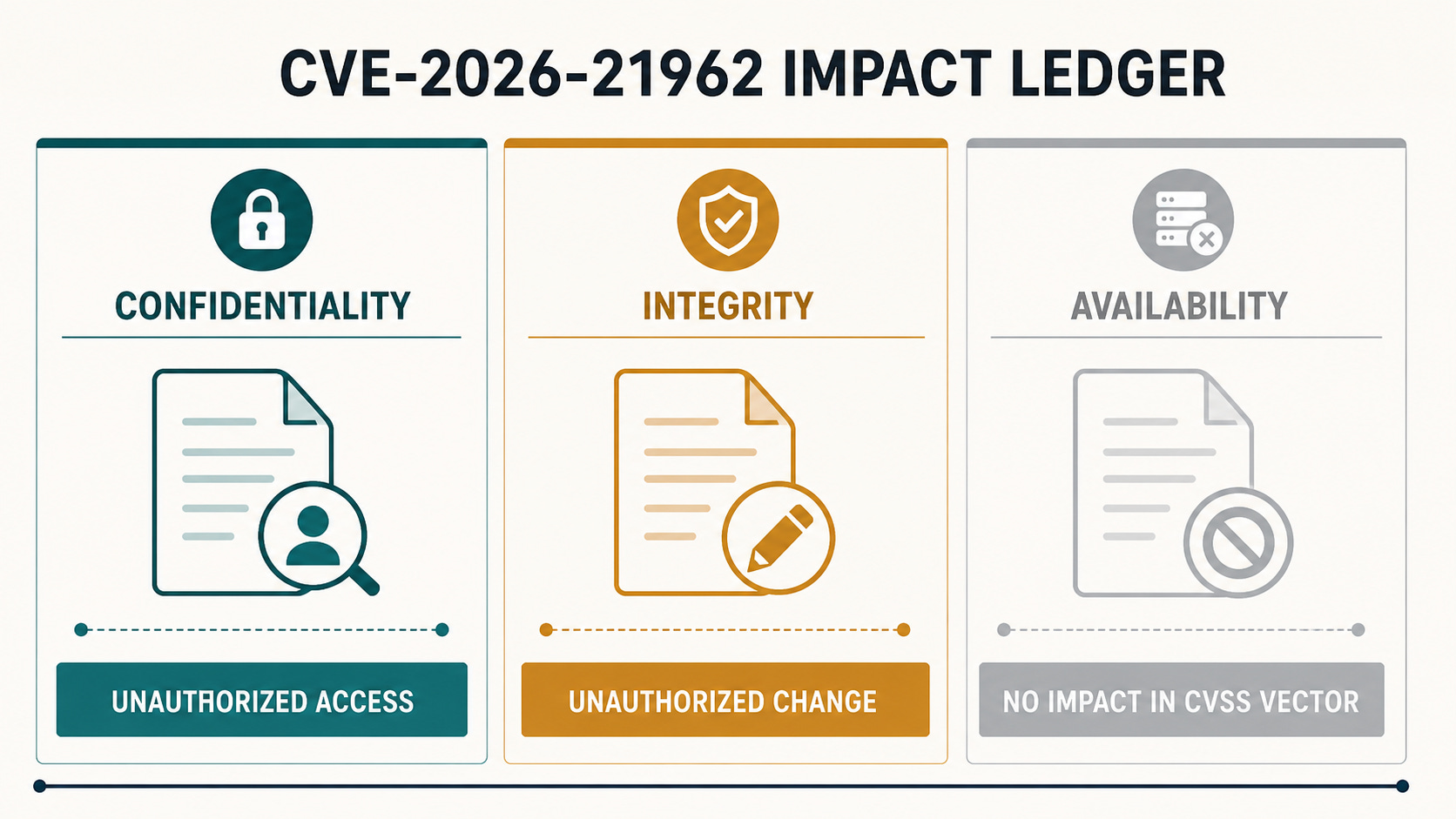
Oracle's vector covers unauthorized data access and change. It does not document an outage or a named victim.
That changes triage. Teams should not wait for a service interruption to indicate compromise. A healthy process and a responsive login page do not demonstrate that the data boundary behind the proxy remained trustworthy.
Review should focus on evidence of unexpected access and change: HTTP request records, proxy and web-server logs, administrative and deployment changes, backend access patterns, and integrity checks for data the exposed path could reach. The public sources do not provide a universal IOC set, so absence of one specific address, filename, or payload cannot close the question.
Verify the plug-in on every web tier
The January advisory makes the patch available; it does not prove that every relevant node received it. Middleware estates accumulate exceptions: a front end excluded from an update window, a disaster-recovery node left behind, an old plug-in copied into a newer web tier, or a server rebuilt from an outdated image.
That is why a useful response produces evidence at the component level.
Identify every Oracle HTTP Server, Apache, and IIS tier that loads the WebLogic proxy plug-in.
Map each tier to its reachable backend applications, exposure, owner, and business function.
Verify the installed fix against Oracle's current patch documentation, rather than inferring it from the WebLogic domain version alone.
Review relevant access and change evidence for the period in which the component was exposed.
Isolate, mitigate, or retire any instance whose state cannot be established within the required window.
CISA's required action is similarly direct: apply vendor mitigations, follow the applicable federal cloud guidance, or discontinue use if mitigations are unavailable. Private organizations are not bound by the federal due date, but the evidence behind the KEV entry is still a rational reason to move this flaw ahead of unexploited backlog.
Close each exposed instance
A compressed deadline can produce a weak closure ritual: scan, see fewer detections, mark complete. This case needs each affected instance tied to a verified fix, review record, and named owner.
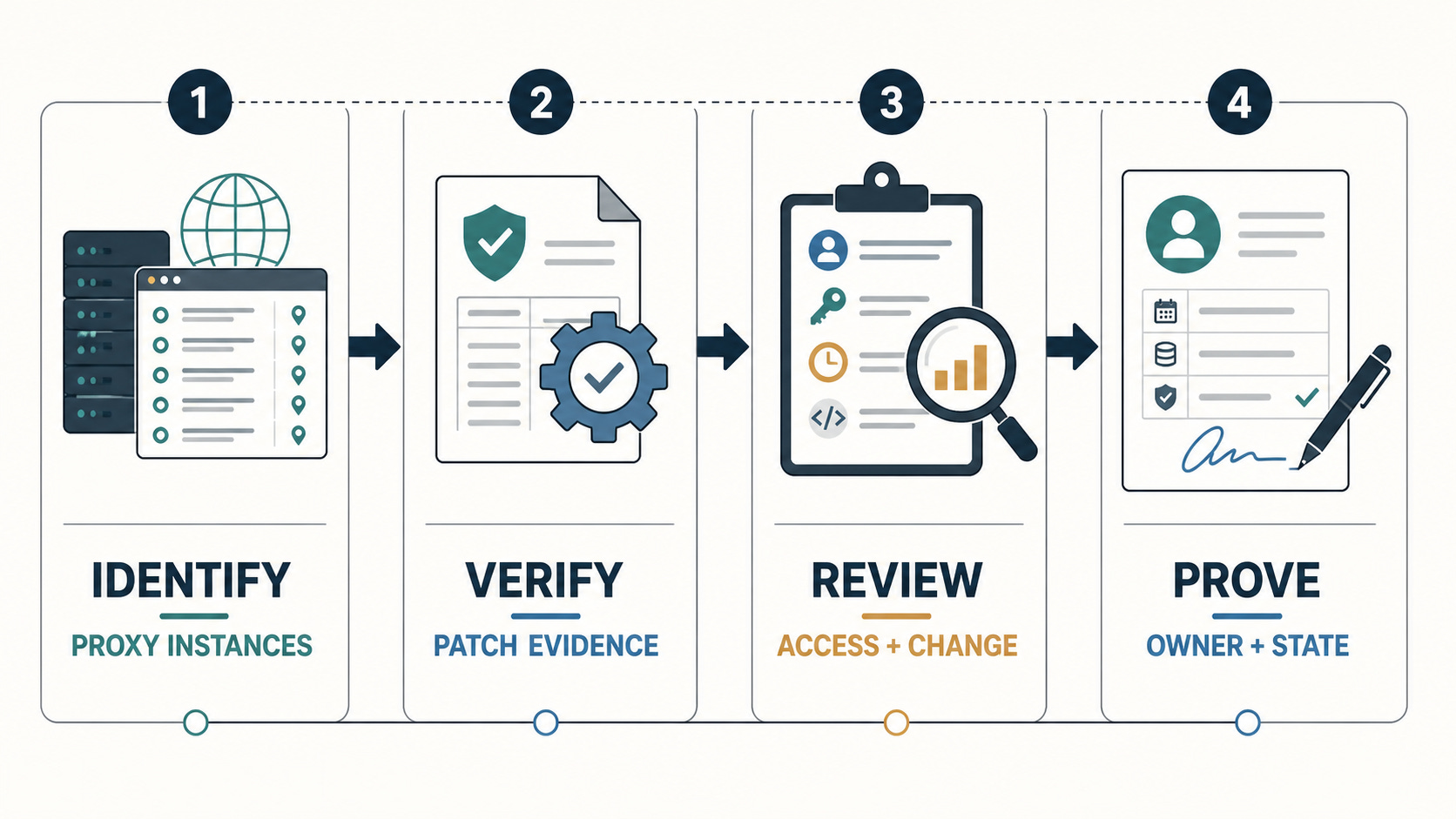
Closure connects the component, its fix, the access review, and a documented decision. A clean scanner result is one input, not the whole record.
If compromise indicators emerge, patching is no longer the finish line. The affected data paths, administrator credentials, application secrets, and downstream systems need incident-response scoping based on what the exposed tier could reach. That decision should follow records from the environment, not assumptions about a generic WebLogic deployment.
The affected layer is narrower than the application label. The inventory work has to be more precise.