


A healthy grid can hide a long local outage.
The Department for Energy Security and Net Zero confirmed to BBC News that a cyberattack affected a small-scale generator and said the wider energy system was never at risk. The BBC, citing the Telegraph, reported that the attack took place in July and the site was shut for four days.
Neither the government nor the National Cyber Security Centre identified the site or disclosed how the intrusion worked. The claim that the hackers were affiliated with the Iranian regime also came from the Telegraph's reporting, not from a public UK government attribution.
System-wide continuity did not erase the site's operational loss.
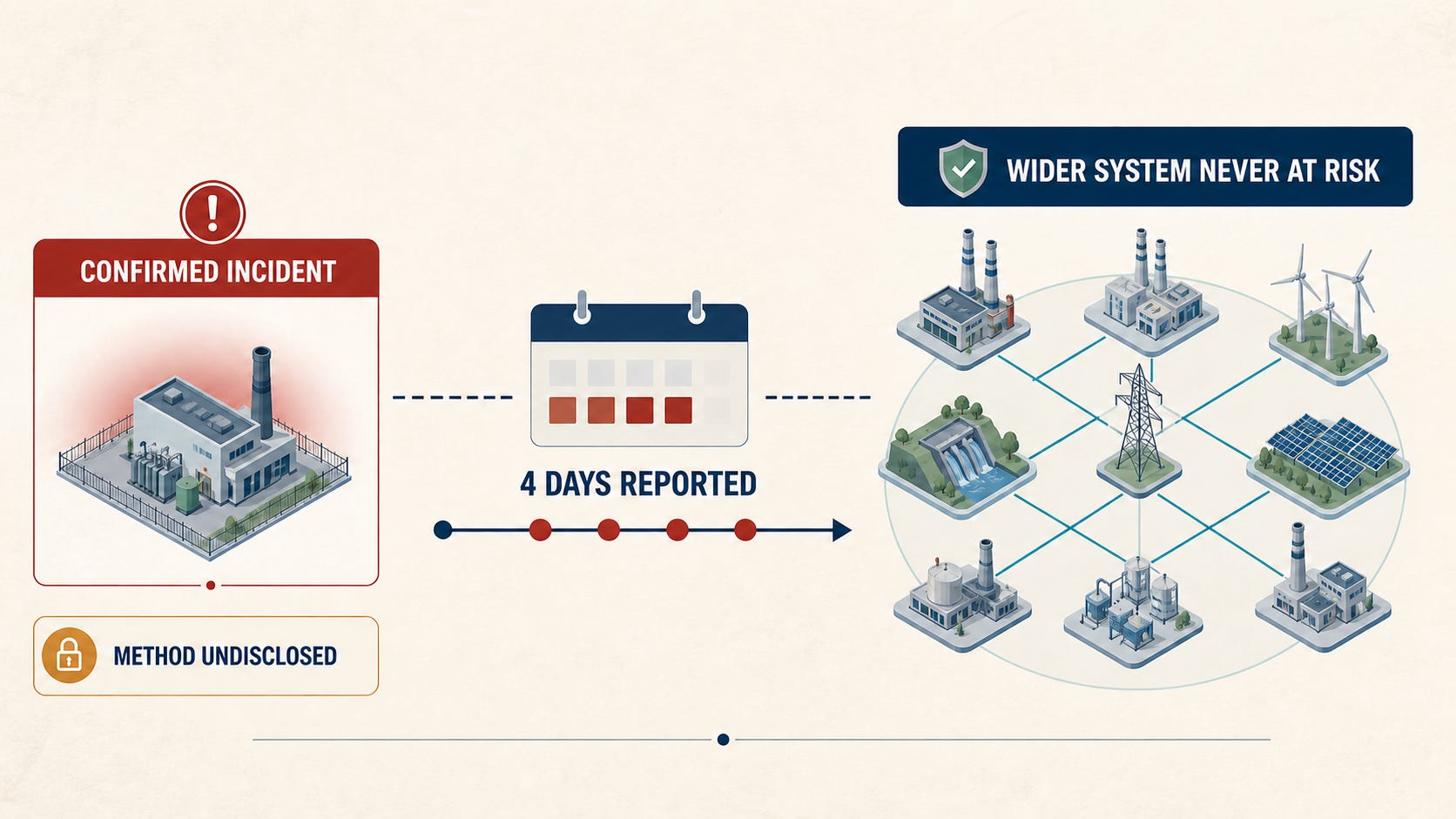
The government confirmed the incident and said the wider system was not at risk. The duration was reported; the intrusion method remains undisclosed.
Four days can disappear inside a healthy grid
The BBC described the affected site as a small power plant and quoted DESNZ calling it a small-scale generator. It was not an essential service such as a large power station, the report said. Smaller gas generators can provide short-term power when needed, so a single site can stop without creating a national electricity emergency.
That is good news for grid continuity. It does not restore the four days for the operator.
A four-day interruption can still mean lost generation, recovery cost, contract exposure, equipment checks, and a difficult decision about when the site is safe to restart. The public reporting does not quantify any of those effects, so they should not be assigned to this victim as facts. They are the questions an operator must be able to answer when cyber risk becomes operational downtime.
A contained impact is still an impact. The containment boundary simply tells us where to measure it.
Keep confirmation, reporting and absence separate
The public evidence has three confidence levels.
DESNZ confirmed that a cyberattack affected a small-scale generator and that the wider energy system was never at risk. The Telegraph, as relayed by the BBC, reported a four-day shutdown and Iran-linked responsibility. The site, initial access vector, affected systems, containment sequence, and restoration evidence have not been disclosed.
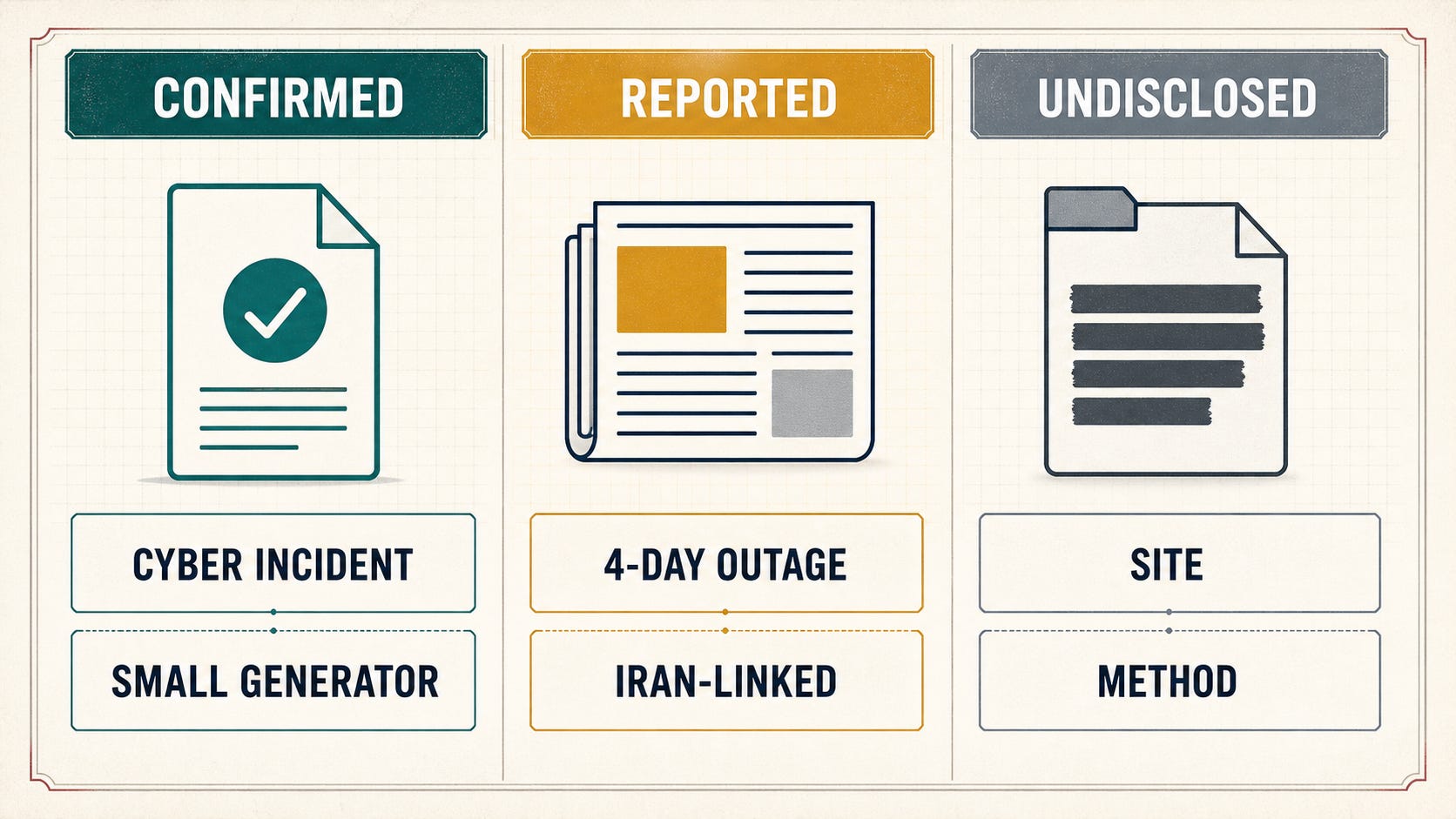
“Iran-linked” and “four-day outage” belong in the reported column. They should not be silently upgraded to government-confirmed findings.
This boundary prevents two common analytical errors. The first is to turn a press attribution into an official assessment. The second is to fill the technical vacuum with a familiar story—ransomware, remote access, a third-party compromise, or a vulnerability—without evidence.
None of those paths can be ruled in or out from the material made public. There is also no public basis for saying whether the shutdown was forced by the attacker, chosen as a safety measure, or extended by investigation and recovery work.
Unknown is not a weakness in the analysis. It is the correct label for evidence that has not been published.
The attack path is a black box
The sequence can be drawn only at a high level: a cyber incident occurred, an operational shutdown followed, and the reported duration was four days. Anything placed between those points would be speculation.
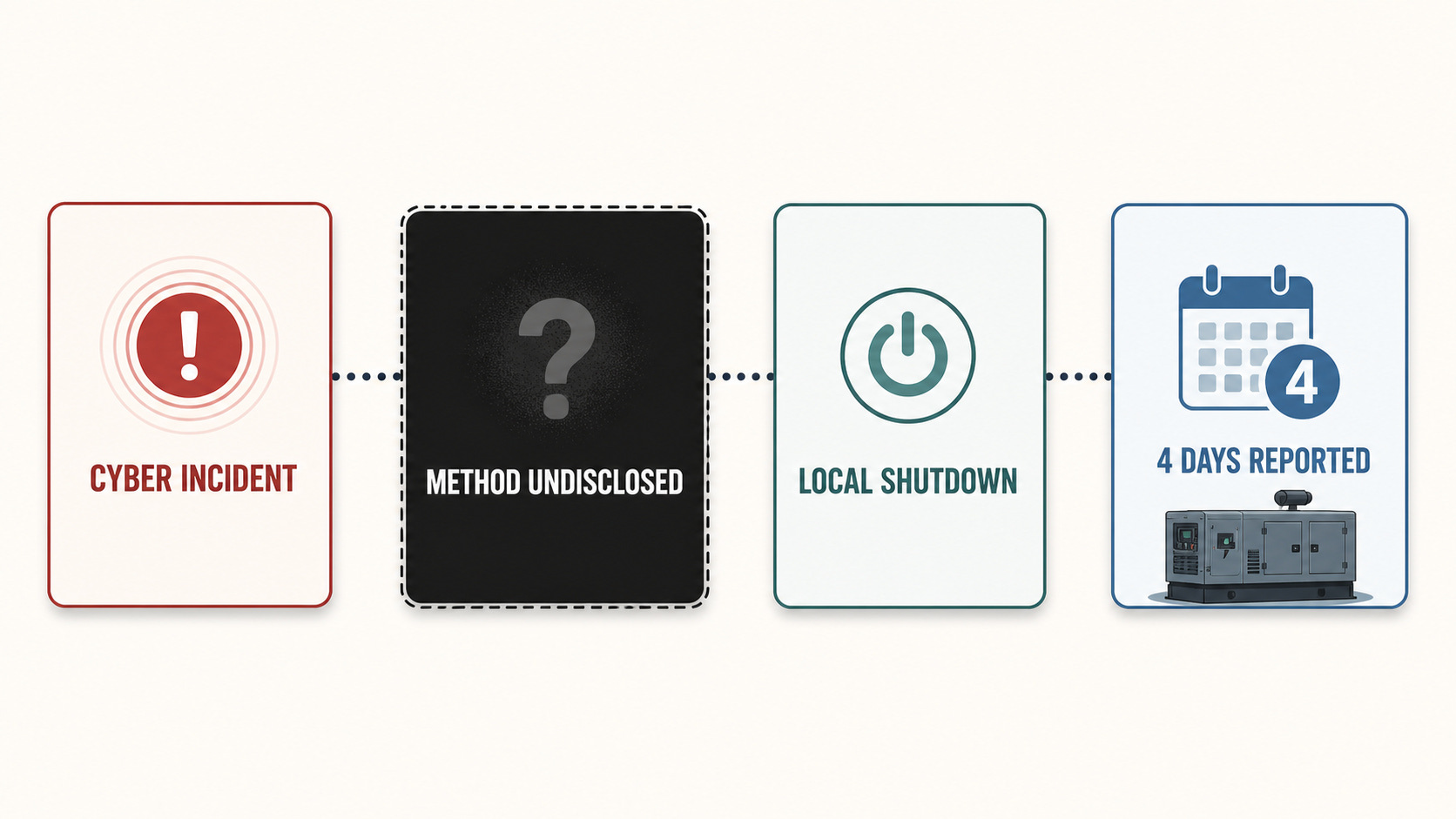
The missing middle is deliberate. Public reporting does not identify the entry point, affected technology, or mechanism that led to the shutdown.
That does not leave other generators with nothing to do. It changes the unit of preparation from a guessed indicator to evidence the operator controls.
Maintain an authoritative inventory of operational technology, remote-access paths, dependencies, owners, and recovery material. Preserve authentication records, administrative changes, network telemetry, system logs, and known-good configurations. The NCSC's OT guidance specifically ties recovery to the availability and integrity of architecture records, inventories, configuration files, logs, alerts, backups, and other operational information.
Those records can establish what changed even when public reporting offers no IOC, malware family, or patch to hunt.
Smaller operators sit inside a larger visibility problem
Ofgem and DESNZ have already described the policy gap. Their whole-system cyber regulation work says existing NIS rules apply to the most critical operators above defined thresholds, while many organizations that will matter to a more distributed energy system are outside formal requirements. The stated direction is baseline resilience for all licensees and proportionate additional requirements for the most significant operators.
This incident does not prove that the unnamed generator fell outside NIS scope; its identity, capacity, and regulatory status are not public. It does show why system impact cannot be the only lens. A site can suffer meaningful disruption while the network absorbs the loss.
The UK's 2026–2030 energy cyber security strategy calls for a whole-system view of dependencies, high-impact failure points, risk concentration, tested response and recovery plans, and broader oversight proportionate to risk. The generator incident turns that policy language into a practical question: Which smaller assets can disappear for days without becoming visible as a grid emergency?
Return to service is an evidence decision
Small does not mean simple during containment. In an operational environment, disconnecting a system, powering it down, or restoring it too early can affect safety, evidence, and production at the same time.
The NCSC's disruptive-incident guidance tells organizations to establish incident command, assess the current operational state, identify critical functions and dependencies, review backups, and balance containment against business impact, safety, and investigation. It also warns that rushing restoration before understanding attacker activity can increase the risk of re-compromise.
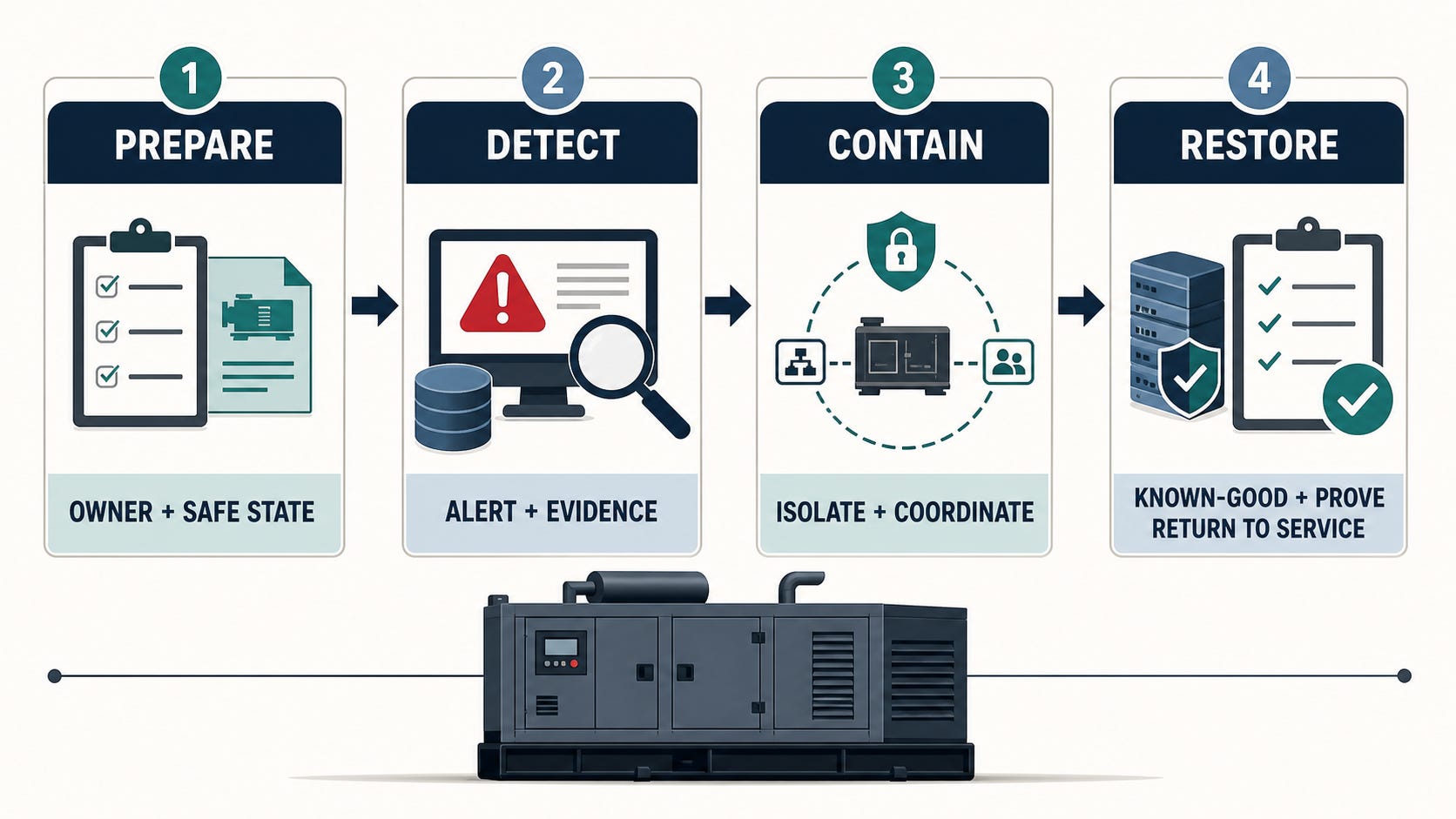
Preparation defines the owner and safe state. Restoration begins from known-good evidence and ends only when operations can prove readiness.
For a generator operator, that discipline becomes four concrete gates:
Prepare: name the operational owner, document the safe state, map dependencies, and test access to recovery material.
Detect: preserve logs and alerts across IT, remote access, and OT before volatile evidence disappears.
Contain: coordinate isolation with engineering and safety owners instead of treating shutdown as a purely IT action.
Restore: rebuild from trusted configurations, validate identities and access paths, and record the evidence supporting return to service.
The final gate is not “the grid coped.” It is “this site is understood, clean enough to operate, and able to prove it.”
Four days is long enough to expose the difference.