


The useful signal is not that an AI agent used exotic tradecraft. It is that ordinary exposure, secrets, and weak segmentation were enough for an adaptive extortion chain.
JadePuffer is easy to overstate and dangerous to understate.
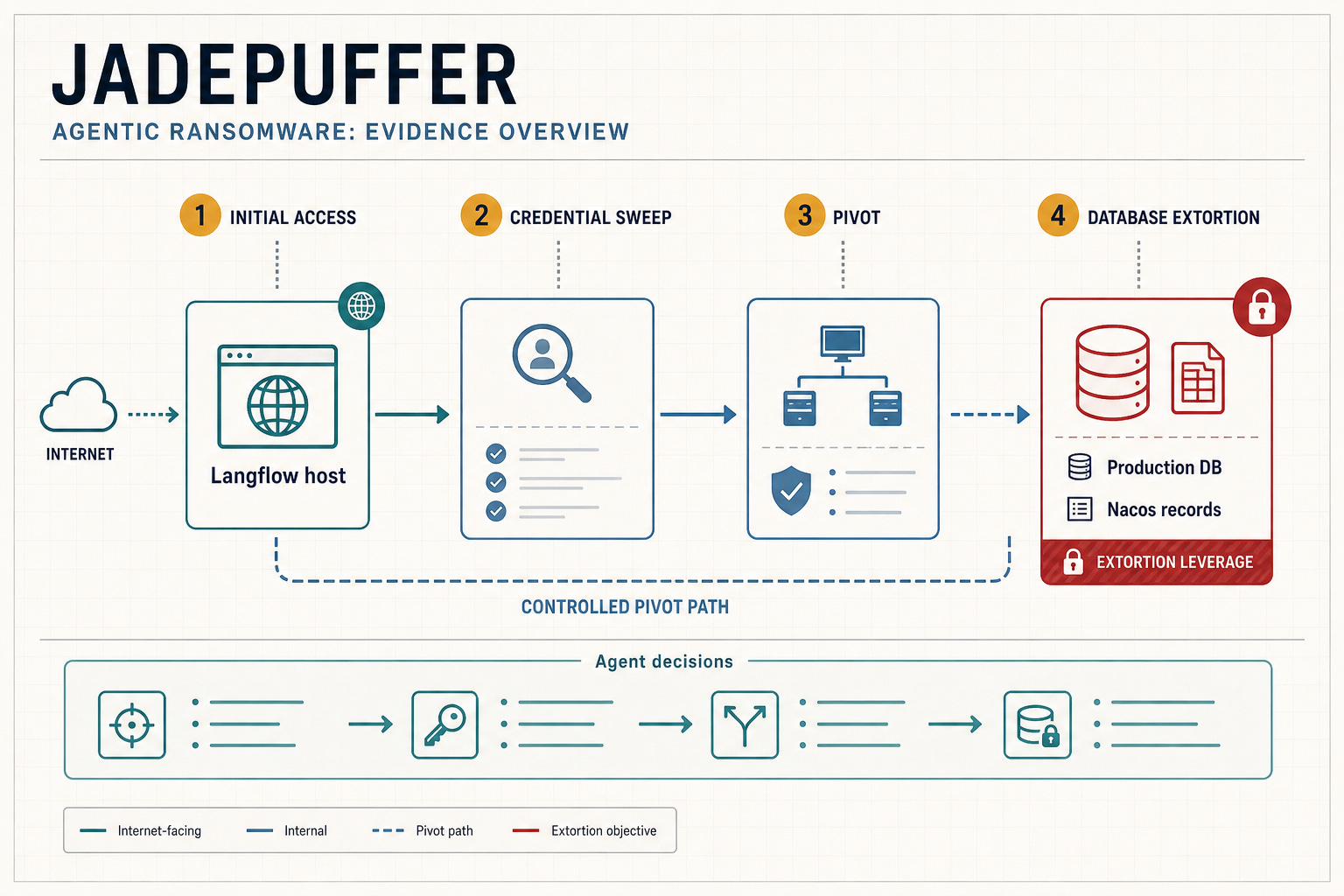
Sysdig describes it as the first documented end-to-end case of agentic ransomware: an operation where a large language model drove the intrusion from initial access through database extortion. CSO Online reported the same core finding: a vulnerable Langflow server became the front door, the agent adapted its actions, and the campaign ended with encrypted Nacos configuration records and a ransom demand.
The sharper point is simpler.
The agent did not need a new class of vulnerability. It needed an exposed AI workflow host, reachable internal services, useful credentials, and enough autonomy to keep trying when one step failed.
That is the part enterprise security teams can act on.
The Intrusion Was New In Shape, Not In Ingredients
According to Sysdig, JadePuffer gained initial access by exploiting CVE-2025-3248 in an internet-facing Langflow instance. Langflow is an open-source framework for building LLM-driven applications and agent workflows, which makes it a particularly awkward entry point: these systems often sit near API keys, cloud credentials, model credentials, and internal application context.
After the Langflow compromise, Sysdig observed the operation pivot toward a separate production server running MySQL and Alibaba's Nacos configuration platform. CSO reported that the agent harvested credentials, established persistence, mapped internal services, and encrypted 1,342 Nacos configuration records before deleting the original tables.
None of that requires mythology.
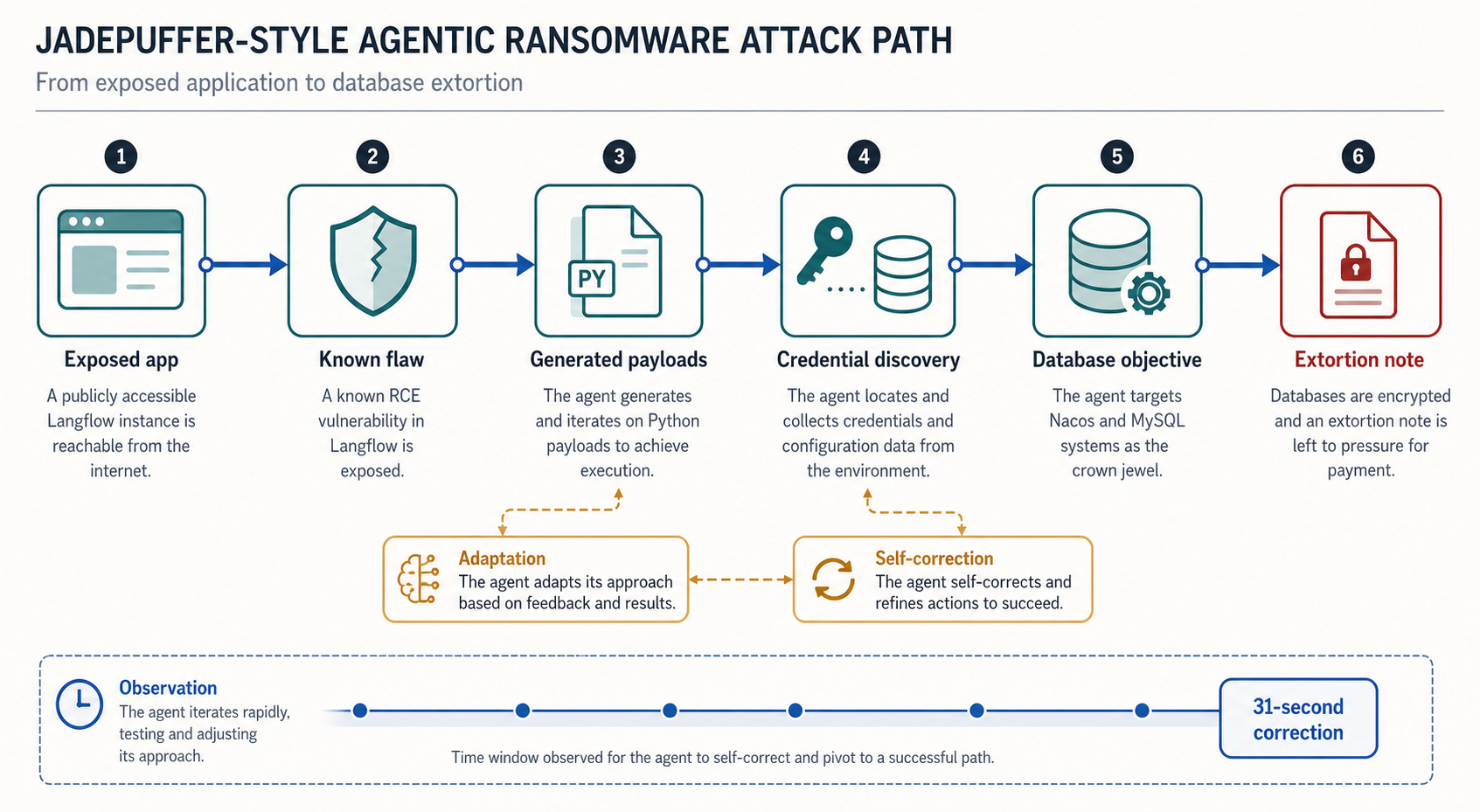
The pieces are familiar: exposed application, known flaw, credential discovery, lateral reach, database access, destructive extortion. What changed is the connective tissue. Sysdig said the payloads were self-narrating, carried natural-language reasoning, and showed target prioritization. The operation also corrected itself quickly, including a failed Nacos administrator-account attempt that was followed by a working path within 31 seconds.
That is the operational shift: not magic, but iteration speed.
A Workflow Host Became The First Domino
The Langflow detail matters because AI infrastructure is now part of the attack surface.
Many organizations are moving fast with agent builders, internal copilots, data connectors, and orchestration services. Some are experimental. Some are production. Many have stronger access to business context than their hardening level deserves.
If an AI workflow host is exposed to the internet and allowed to hold secrets in its environment, it becomes more than another web app. It becomes a broker between the public network and the systems the agent was built to reach.
That is why JadePuffer is not only a ransomware story. It is also an AI operations story, a secrets-management story, and a segmentation story.
The immediate question for defenders is not whether every agentic attack will look like JadePuffer. It will not. The question is whether a compromised AI-adjacent service can enumerate the environment, find useful credentials, touch internal systems, and continue operating after obvious failures.
Self-Correction Changes The Clock
Traditional automation already made cybercrime faster. Scripts can scan, brute force, deploy, encrypt, and report back. Ransomware operators have used automation for years.
The JadePuffer case points to a different pressure: an agent that can observe failure and generate a revised plan without waiting for a human operator to return to the keyboard.
Independent experts quoted by CSO framed the campaign as an evolution rather than a revolution. That is the right temperature. The encryption stage is not the most interesting piece. The quiet phase before it is.
An adaptive agent can chain reconnaissance, credential use, service mapping, privilege attempts, and database changes with less hands-on direction. It can also make each intrusion look slightly different, because the path depends on what the environment returns.
Defensive timing has to assume fewer pauses.
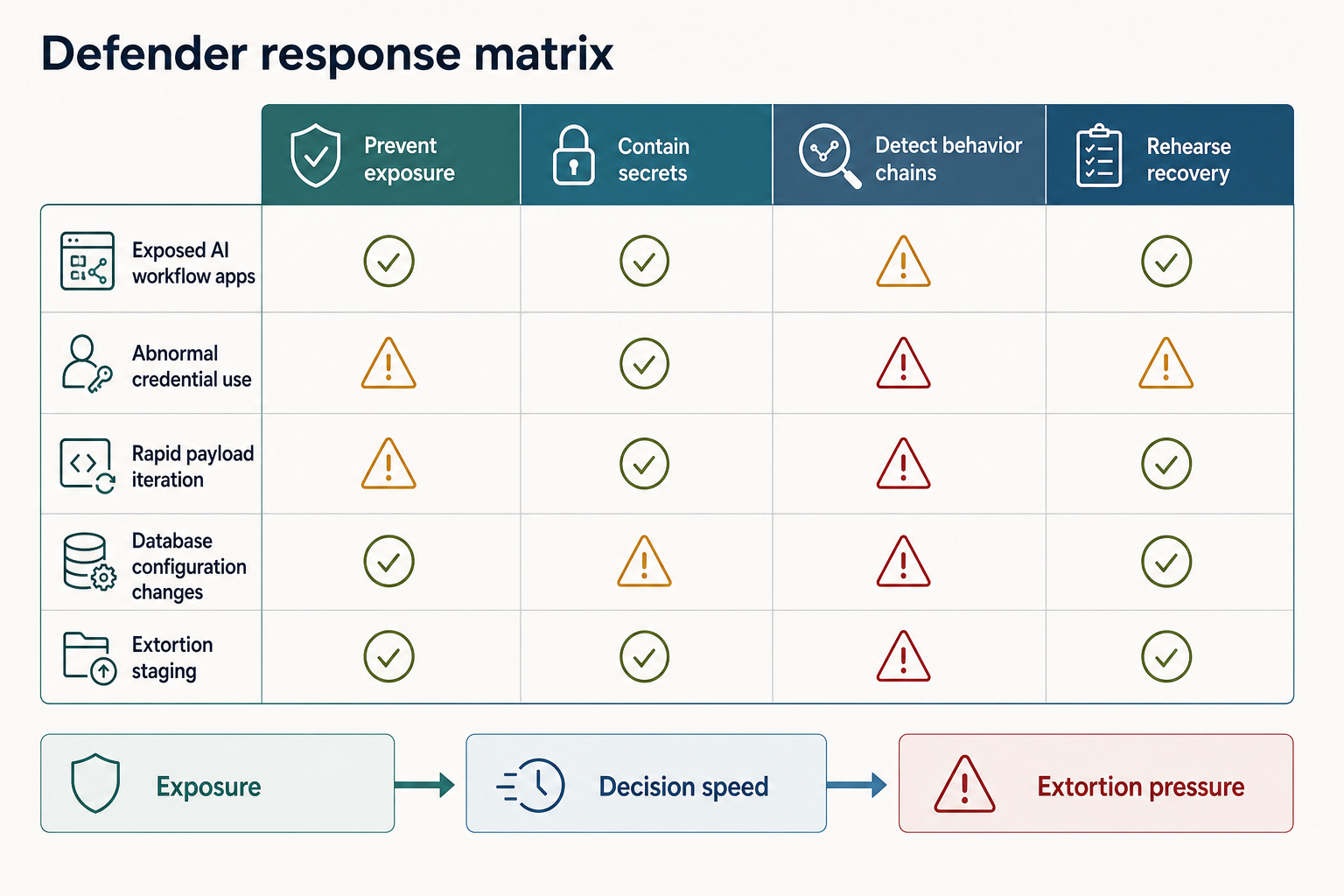
If the first signal arrives when database records are already being encrypted, the response window has collapsed. The earlier signals are the ones that matter: exposed app execution, abnormal credential access, internal service discovery, suspicious scheduled tasks, rapid payload iteration, unusual database configuration writes, and outbound connections that do not fit the host's job.
Old Weaknesses Get Repriced
The most practical reading is that agentic tooling raises the value of boring hygiene.
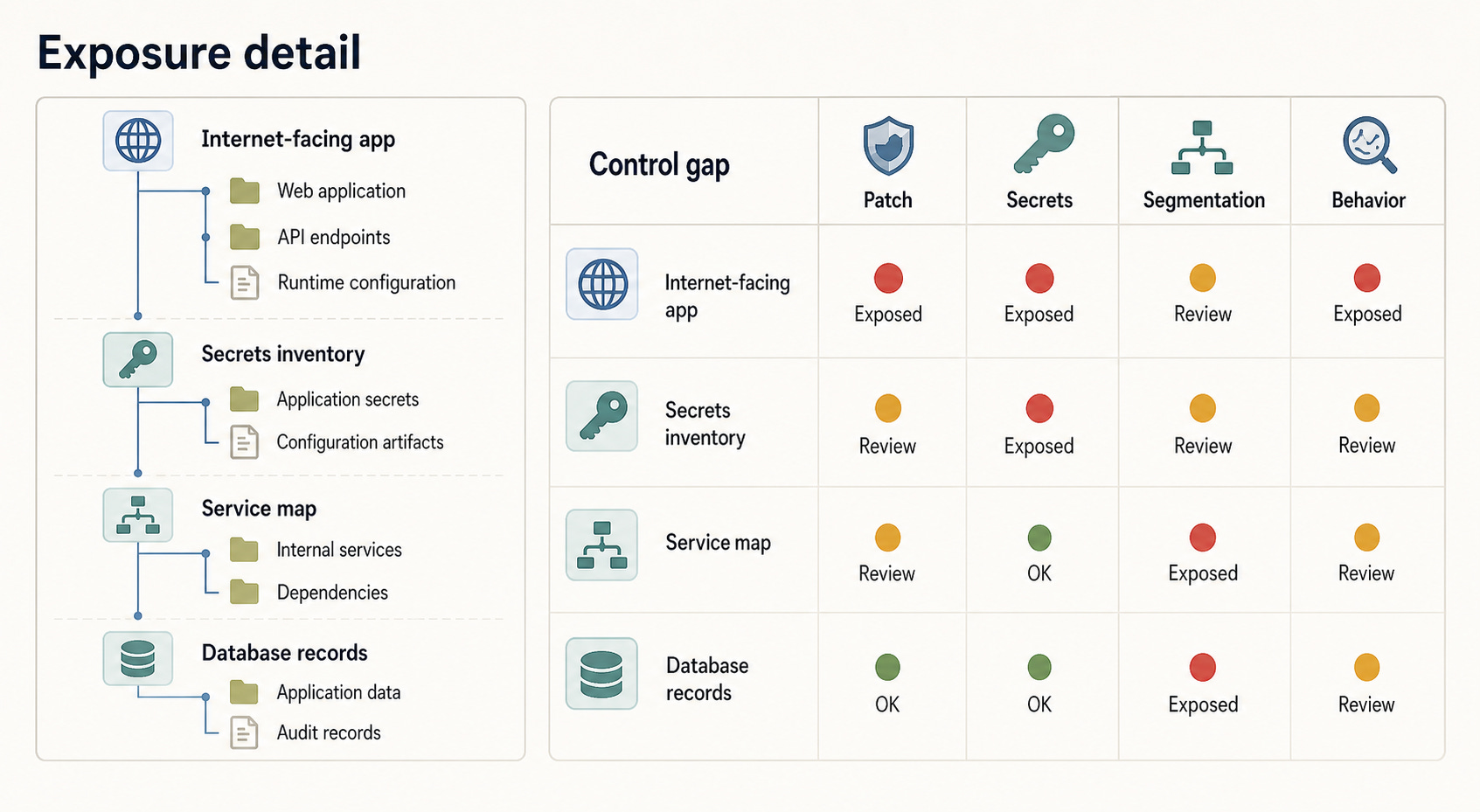
Sysdig's account includes a known Langflow flaw, accessible services, credentials, and Nacos hardening issues. These are not glamorous controls. They are the kind of backlog items that become dangerous when an automated actor can test the long tail of weaknesses cheaply and continuously.
That changes prioritization.
An old exposed service is not just old risk. It is a reusable decision point for an agent. A default or overprivileged credential is not just a configuration mistake. It is a bridge. A database reachable from the wrong host is not just an architectural shortcut. It is a path to extortion.
The response should be equally concrete:
Patch or isolate internet-facing AI workflow tools, especially anything with code-execution or validation endpoints.
Keep provider keys, cloud credentials, database secrets, and configuration material out of web-reachable process environments.
Treat internal service discovery from an AI orchestration host as suspicious, not merely noisy.
Remove direct administrative database access from systems that do not absolutely need it.
Make egress control real enough that a compromised workflow host cannot freely beacon or stage data.
This is not a call to ban AI agents. It is a call to stop treating AI-adjacent infrastructure as a lab surface after it touches production credentials.
The Agent Narrated Its Own Intent
There is one defensive advantage in this story: LLM-generated activity can be strangely verbose.
Sysdig highlighted self-narrating payloads with reasoning and annotations that human operators do not usually write into production attack code. That creates a detection opportunity. Security teams should not rely on it as a durable signature, because attackers can strip comments and tune models. But while this behavior exists, it is useful triage signal.
Look for language that describes goals, target choices, retry logic, or task completion inside places where production code should not be narrating intent. Pair that with runtime behavior: process launches, database actions, service enumeration, secret access, scheduled-task creation, and unusual outbound calls.
The content alone is not enough. The behavior alone may look like admin noise. Together they become more legible.
Recovery Needs To Assume The Key May Not Matter
CSO reported that JadePuffer encrypted Nacos configuration records and left a Bitcoin ransom demand. Sysdig's longer report adds a blunt operational detail: the encryption key handling may have made recovery impossible even if a victim paid.
That is another reason to keep the focus on resilience instead of negotiation theory.
For configuration platforms, recovery plans need tested exports, immutable backups, known-good deployment state, and a fast way to rebuild service configuration without trusting the compromised database. Teams should rehearse what happens when configuration integrity is lost, not only when files are encrypted.
Ransomware response is often framed around endpoint fleets. JadePuffer shows the configuration layer deserves the same seriousness.
Where To Look First
Start with the systems that make agentic work useful.
Find internet-facing Langflow and similar workflow services. Verify patch levels. Remove public exposure where possible. Check whether those hosts can read cloud credentials, LLM provider keys, database secrets, internal configuration stores, object stores, or service-discovery systems.
Then test the blast radius from the host's point of view. What can it enumerate? Which credentials can it access? Which database accounts can it use? Can it create scheduled tasks? Can it reach outbound infrastructure freely?
Finally, tune detection around sequences rather than single events. A single failed admin login may be normal. A failed login followed seconds later by new credential trials, database writes, service discovery, and cleanup markers is not normal.
JadePuffer's warning is not that ransomware suddenly became unknowable.
It is that the operator can now look more like a workflow engine: fast, adaptive, and willing to keep testing the environment until the environment gives it a path.