


A zero-day campaign against Oracle PeopleSoft is now a workforce identity problem for Nissan employees across the Americas.
Nissan's latest breach disclosure is not limited to whether employee data may have been exposed.
It is where that data lived.
Nissan says the incident is tied to Oracle PeopleSoft, the enterprise system it uses for employee information, payroll, tax administration, and personnel records. That shifts the risk from a narrow software incident into something larger: a third-party enterprise platform compromise can become a payroll, identity, and workforce-trust event almost immediately.
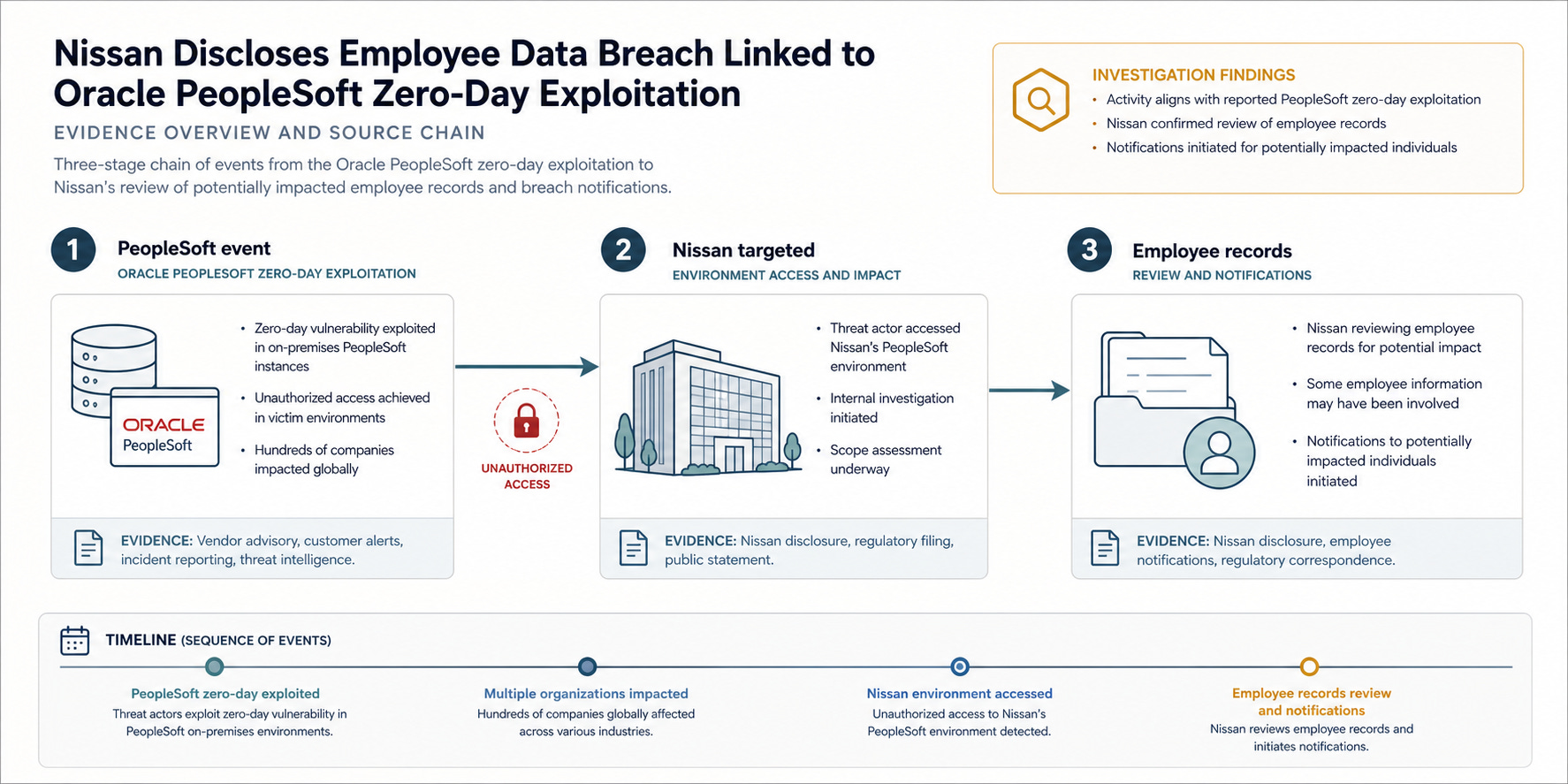
According to BleepingComputer, Nissan warned current and former employees that attackers exploited an Oracle PeopleSoft vulnerability in a broader data theft campaign previously linked to ShinyHunters. The disclosure says Nissan was specifically targeted and that the company is still assessing the full impact.
For defenders outside Nissan, the useful signal is clear: a business-application incident can force payroll and identity-control decisions before the final breach scope is settled.
The Business System Became The Incident
PeopleSoft is not a random application buried in the corner of the estate. For many organizations, it sits close to the data employees depend on: payroll, tax records, HR workflows, benefits, and identity-adjacent administrative data.
That is why this disclosure matters.
Nissan says the investigation is still early and the company has not finalized the full scope. But the categories under review are sensitive by design. The affected information may include employee contact information, banking details, Social Security numbers, Social Insurance Numbers, national identification numbers, financial and tax information, and dependent or beneficiary information.
The reported geography is broad. BleepingComputer says the incident is believed to affect current and former Nissan employees in the United States, Canada, Mexico, and Brazil.
This is the uncomfortable shape of modern enterprise risk: an application compromise can quickly become an employee identity problem even when customer-facing systems are not the headline.
The PeopleSoft Thread
BleepingComputer ties the Nissan disclosure to a wider set of Oracle PeopleSoft data theft attacks first reported earlier in June. The reporting says threat actors exploited a zero-day vulnerability in PeopleSoft instances and stole data.
Oracle later disclosed a critical PeopleSoft PeopleTools vulnerability, tracked as CVE-2026-35273, and released emergency mitigations. BleepingComputer also reports that Mandiant confirmed exploitation of that vulnerability as a zero-day in data theft attacks between May 27 and June 9.
That does not mean every detail of the Nissan impact is settled.
This is not just a single-company anomaly. Business applications with privileged data access can become collection points when a vulnerability is exploited at scale.
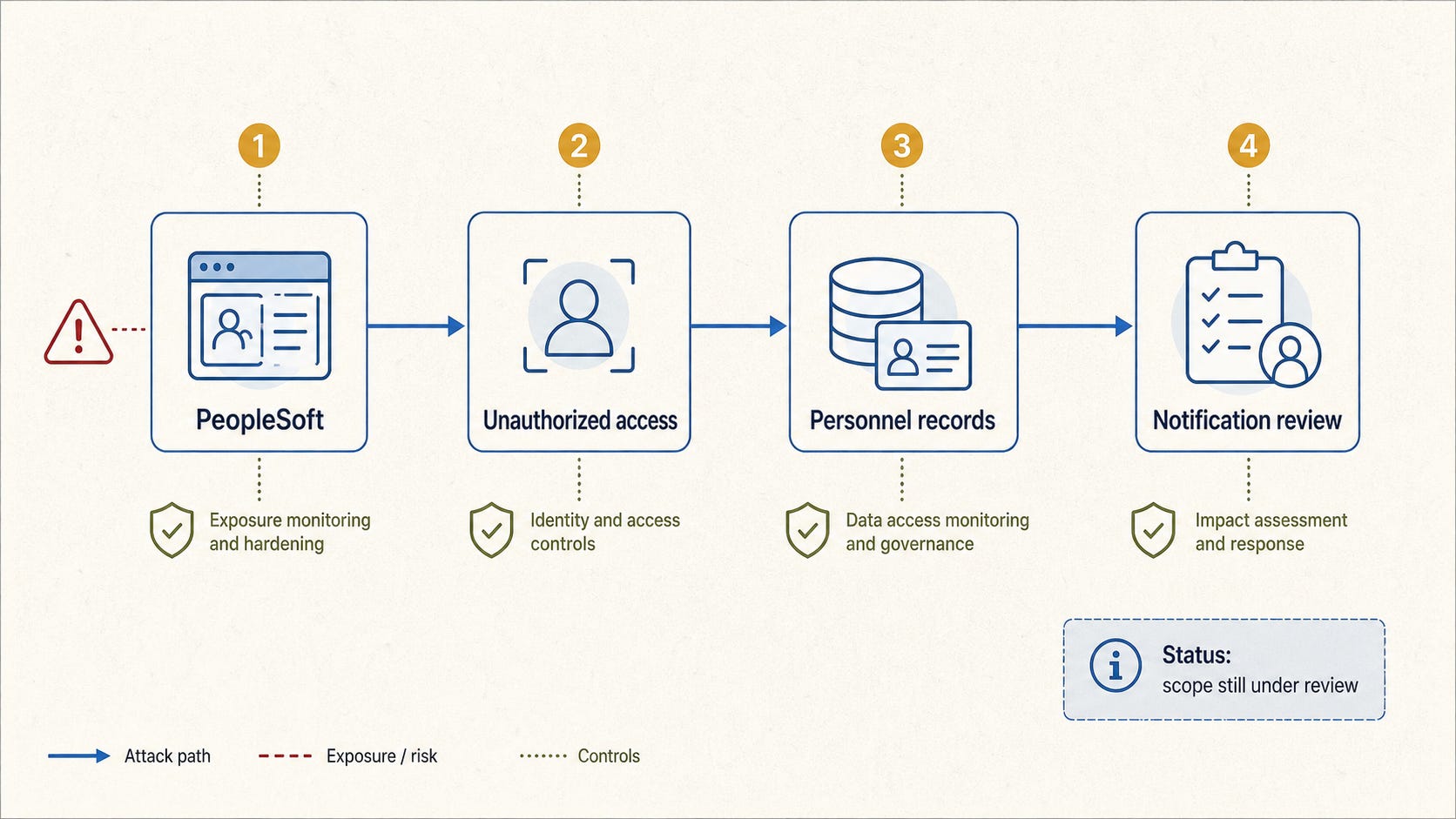
The reported ShinyHunters connection adds extortion context, but it should not distract from the more operational point. The named group matters less to most defenders than the system class, the data class, and the control failures attackers can turn into leverage.
The Data Is Identity-Heavy
Nissan has not said every listed data type was definitely exposed for every person. That caveat matters.
But the possible categories are enough to make this a high-friction employee-risk event. Contact data supports targeting. Banking and payroll-related details raise fraud concerns. Government identifiers can affect long-term identity exposure. Dependent and beneficiary information widens the human blast radius beyond the employee alone.
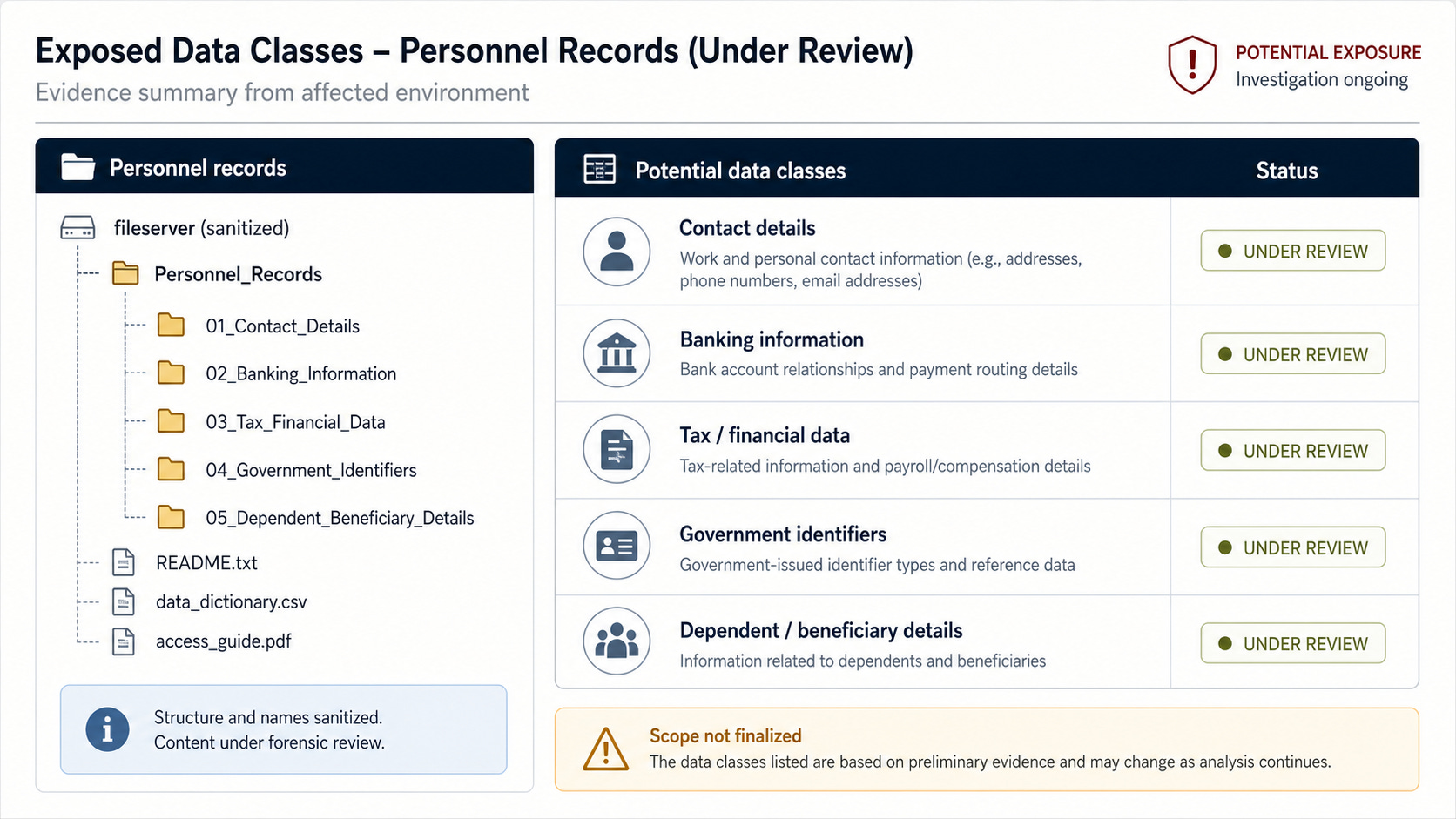
The sensitive data model of HR systems makes containment harder after compromise.
Once a personnel system is in play, the organization has to answer more than whether unauthorized access happened. It has to answer which workflows can still be trusted, which records may have been touched, who needs notice, and what compensating controls should stay in place until the review is complete.
Payroll Is Now A Security Boundary
Nissan's reported response is worth paying attention to because it focuses on workflow restriction, not just notification.
BleepingComputer says Nissan activated incident response, brought in external cybersecurity experts, secured affected systems, and worked with Oracle on the issue. The company also said it took steps to end unauthorized access and prevent further disclosure of employee information.
The operationally important control move is around payroll.
As an additional precaution, Nissan is reportedly restricting access to employee pay slips and direct deposit changes to company network computers or secured VPN connections while it adds identity verification before processing payroll requests.
That is exactly the kind of post-breach control security teams should expect from an HR-system incident. When employee banking or payroll-adjacent data may be exposed, the next risk is not theoretical. It is account takeover, payroll redirection, social engineering, and fraudulent change requests.
This is where security and HR operations have to stop pretending they are separate systems.
The Vendor Question Cannot Wait
The Oracle layer is not background detail. It is central to the risk model.
When a core enterprise application is implicated in a zero-day campaign, defenders need more than a patch-status screenshot. They need a live operating picture across vendor advisories, incident notifications, identity logs, privileged access, data export paths, and business-process restrictions.
In practice, that means asking blunt questions:
Which PeopleSoft instances were exposed or reachable during the reported exploitation window?
Which service accounts, administrators, and integrations had access to personnel records?
Which payroll, benefits, and tax workflows can change employee financial outcomes?
Which data exports, reports, or batch jobs touched the affected record sets?
Which employee-facing actions should be restricted until scope is validated?
Those questions are not exploit steps. They are governance steps.
Before Sensitive Workflows Reopen
The strongest move after an HR platform data theft incident is to treat identity, payroll, and notification as one response track.
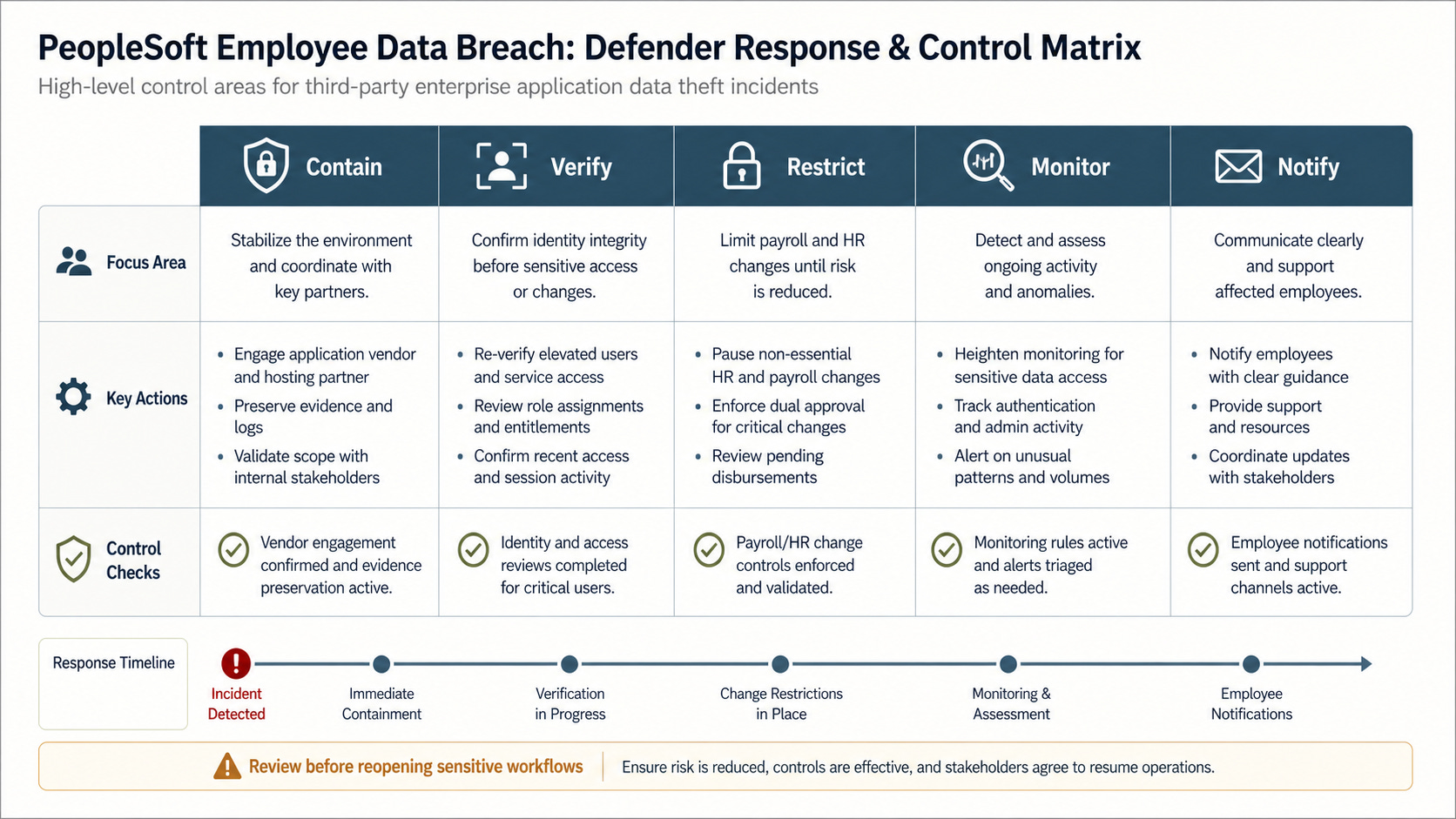
Contain the affected environment. Verify privileged access. Restrict payroll and direct-deposit changes. Monitor sensitive-data access and authentication anomalies. Notify employees with clear guidance when the record review supports it.
The timing matters too. Sensitive workflows should not reopen simply because a system is back online. They should reopen when the organization can show that access was reviewed, risky changes are controlled, and employees are not being pushed into a fraud window without support.
The Nissan disclosure points to the same control problem.
The breach is not only about a vulnerability. It is about the business process attached to the vulnerable system.
If the system holds workforce identity and payroll data, the incident response has to protect workforce identity and payroll decisions, not just servers.