


The reassuring line in the Police National Legal Database's breach notice is that there is no evidence passwords or other security credentials were compromised.
The rest of the notice explains why that is not the end of the identity risk.
PNLD says names, organisations, and work email addresses belonging to police officers, staff, criminal justice professionals, government partners, and customers were compromised and published on the dark web. Some names and email addresses belonging to people who had previously submitted questions through Ask the Police were also published.
A stolen password opens an account. A stolen institutional identity helps an attacker make the next request believable.
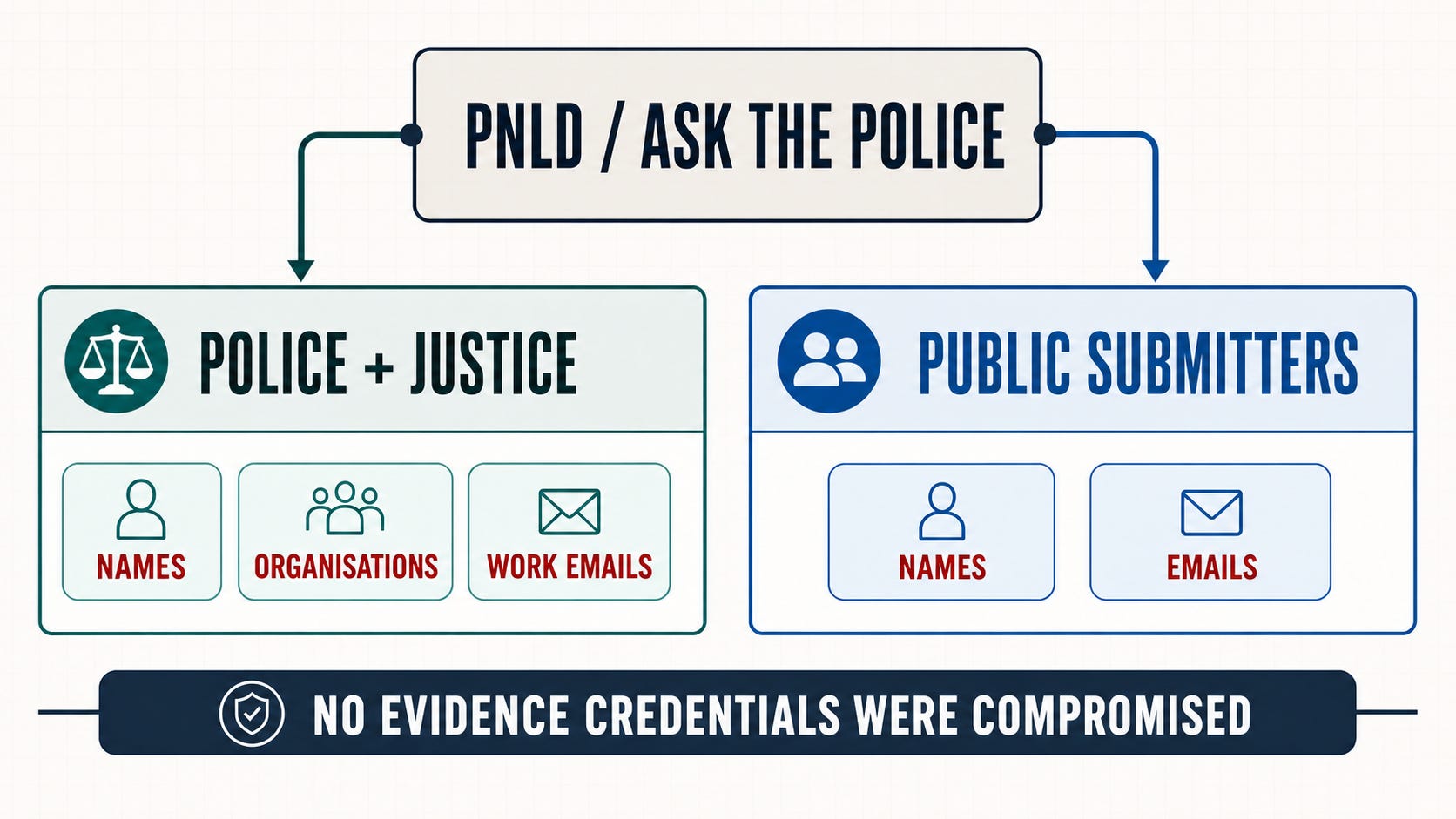
The confirmed exposure is contact and affiliation data. PNLD reports no evidence that passwords or other security credentials were compromised.
A directory can be operational data
PNLD identified the incident on Sunday, July 26. It says affected organisations were contacted, the Information Commissioner's Office was notified, and the National Crime Agency and specialist cybersecurity organisations are assisting the investigation.
The notice gives no victim count, intrusion start, dwell time, data volume, or confirmed access method. Those gaps rule out claims about the incident's full scale or mechanics.
PNLD's 2025–26 annual summary reports a service metric labeled 108,429 Police Registrations and support for all 43 Home Office police forces in England and Wales. PNLD does not define that metric as unique active users. It is not the number of breached records or affected people.
The disclosed field set is narrower than credentials, but it is still useful for targeting. A name paired with a police or justice organisation and a work email address can help an adversary choose a credible sender identity, subject line, escalation path, or password-reset pretext. That is an assessment of likely abuse, not evidence that such follow-on attacks have already occurred.
Two exposed groups, two different risks
For professionals, names and affiliations can make a fraudulent message look less random and more like routine inter-agency traffic.
The Ask the Police cohort presents a different problem. PNLD says some people who previously submitted a question had their names and email addresses published. PNLD has not said question text was published. The disclosed association with a police information service may itself be sensitive—and it can support a tailored message pretending to follow up on an earlier inquiry.
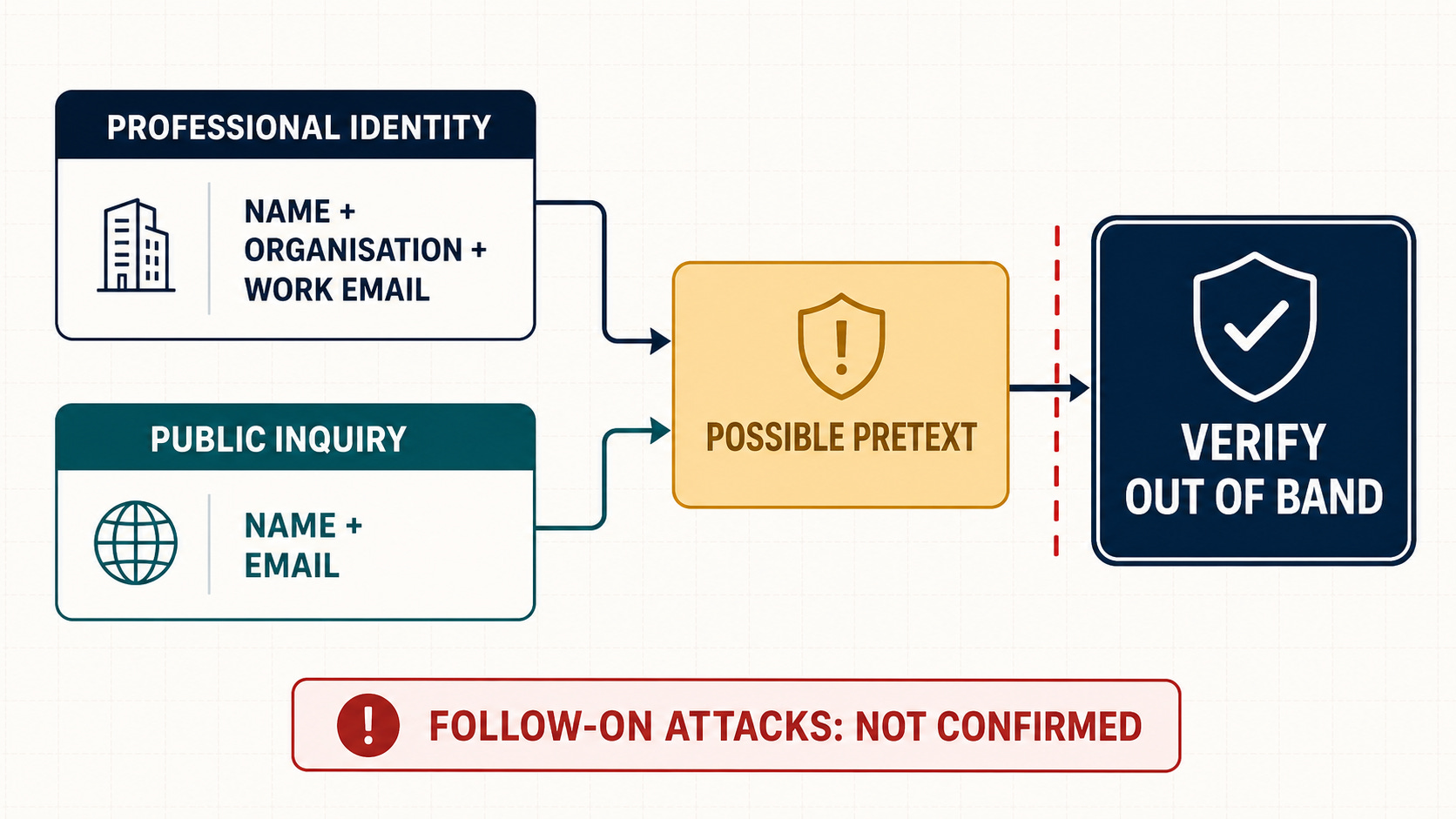
The two cohorts need different communications, but both benefit from stronger verification when an unexpected message claims official context.
PNLD also draws an important boundary: it is not a crime-recording system and does not hold confidential information about victims, witnesses, or offenders. That statement should remain intact. The breach should not be inflated into an exposure of police case records without evidence.
The campaign clue is not a root-cause finding
Security Affairs and The Hacker News report that the extortion group ExfilSquad listed PNLD on July 26. PNLD has not publicly attributed the incident to that group.
A separate VenariX investigation provides useful campaign context. Researchers reviewed samples tied to 11 of 15 organisations claimed by ExfilSquad and found structures consistent with Microsoft Dataverse across all 11. In one case involving Houston's public-service portal, VenariX confirmed that records were accessible without authentication and were consistent with data published by the group.
The researchers assess overly broad anonymous access in public Power Pages portals as a likely route for at least part of the campaign. Microsoft documents that table permissions and web roles govern access to Dataverse records. Its Power Pages Web API overview says the API follows table permissions through the associated web role.
But the boundary is decisive: VenariX did not confirm the same route for every claimed victim, and the public reporting does not identify a PNLD-specific endpoint, permission, log entry, or access path. The Power Pages pattern is a hypothesis to investigate, not the established cause of the PNLD breach.
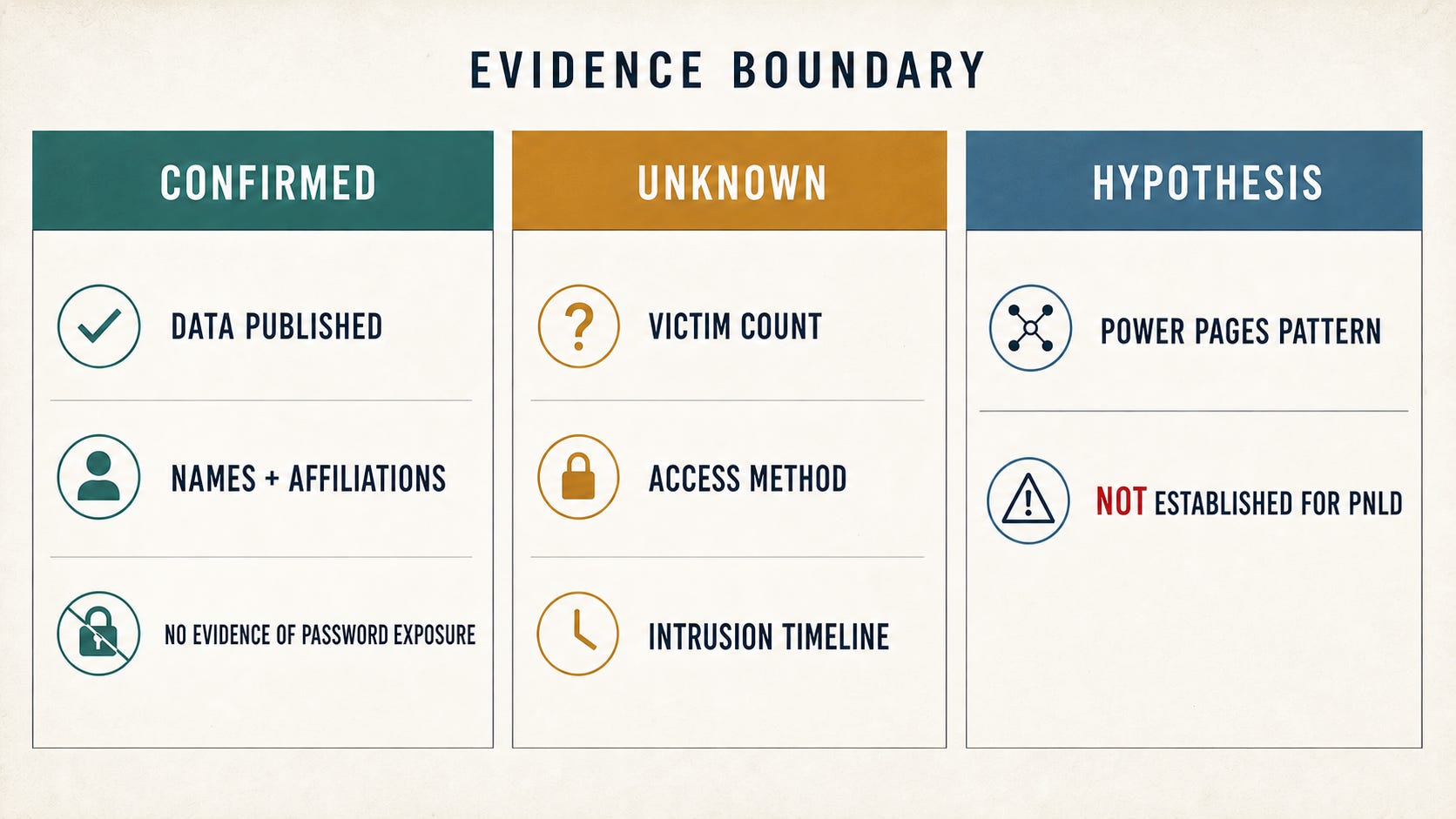
Confirmed facts, open questions, and campaign-level hypotheses belong in separate columns until PNLD or investigators publish more evidence.
Move the controls to the identity boundary
A blanket password reset should not be the primary response based only on this notice. Forensics should determine whether password resets, session invalidation, or token revocation are warranted. The confirmed exposure already requires controls that make leaked identity context less useful.
Harden sign-in against convincing lures. Require phishing-resistant MFA where possible and investigate unexpected prompts instead of treating a denied login as the end of the event.
Raise the bar for help-desk recovery. A name, organisation, role context, or work email address can no longer function as meaningful proof of identity. Use device-bound or out-of-band checks that are not derived from directory data.
Watch for impersonation infrastructure. Monitor lookalike domains, display-name spoofing, newly registered domains, and unusual mail flows targeting affected teams.
Give each cohort specific guidance. Professionals need a known channel for verifying cross-agency requests. Ask the Police users should receive guidance that does not repeat or expose the subject of their earlier question.
Audit public data portals if you operate them. Review anonymous web roles, table permissions, web API exposure, legacy data feeds, and logs for bulk access. Microsoft's anonymous-access governance control can block unauthenticated reading while preserving public form submission, but this is a campaign-informed control—not proof of PNLD's root cause.
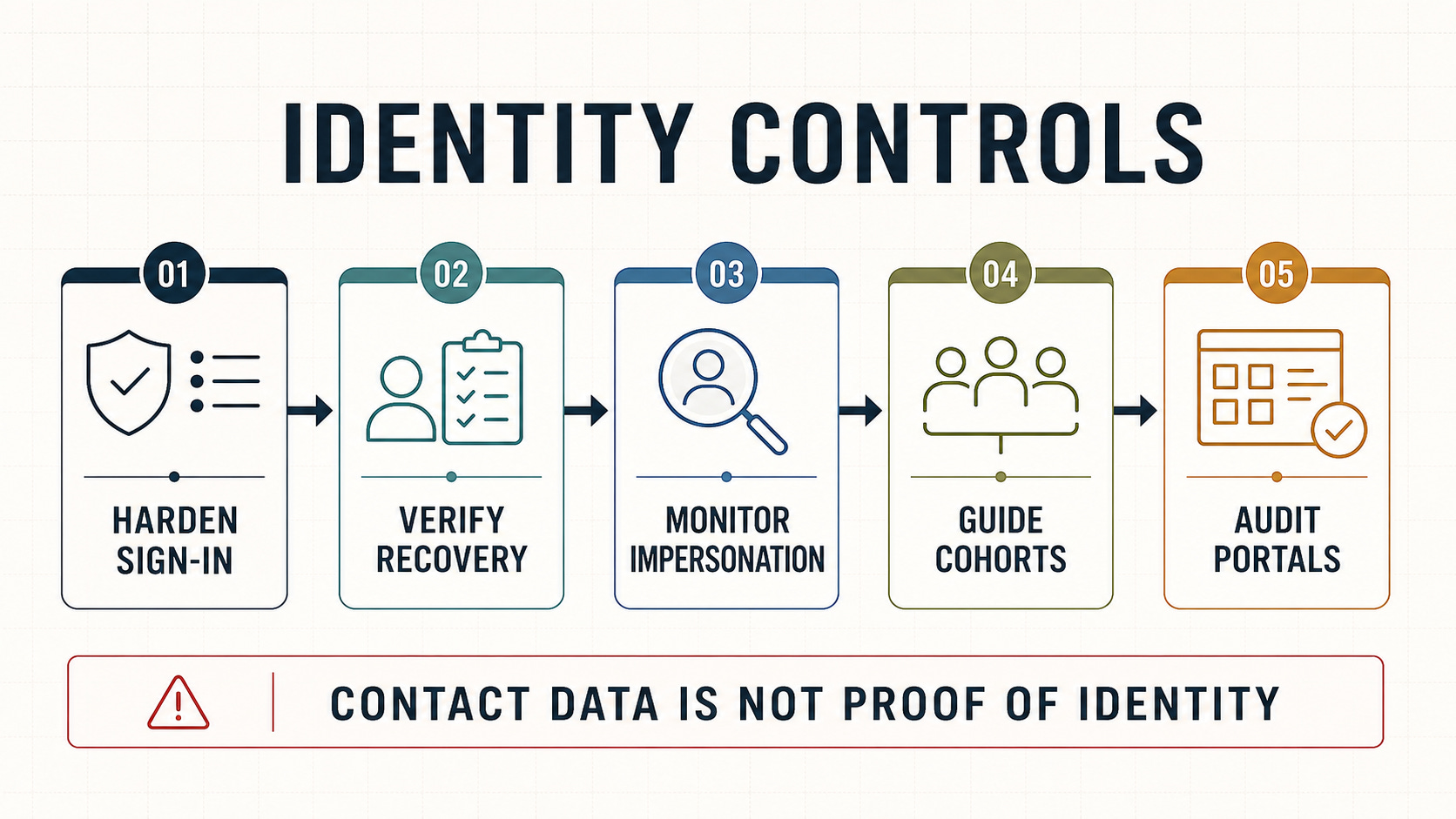
The goal is to stop public contact data from doubling as an authentication or trust signal.
Don't let the credential caveat close the case
The disclosed facts remain bounded. PNLD reports no evidence that credentials were compromised. No victim total or intrusion method is public. No PNLD-specific Power Pages path has been established.
What is confirmed is enough to change defensive posture: named police and justice contacts, organisational affiliations, work email addresses, and some public-service contact records were published where criminals can use them.
Credentials can be replaced. Names, professional relationships, and the fact that someone contacted a public service cannot be rotated on demand. When identity context escapes, verification has to carry more of the security load.