


The email body was almost blank. That was the point.
IRONSCALES reported a credential-harvesting campaign against a freight and logistics company where the message carried almost nothing for a gateway to score: an unusual-sender banner, a company logo, and a calendar attachment. The attack did not need a noisy body, a visible button, or a paragraph of social engineering.
The phishing kit rode inside the calendar invite.
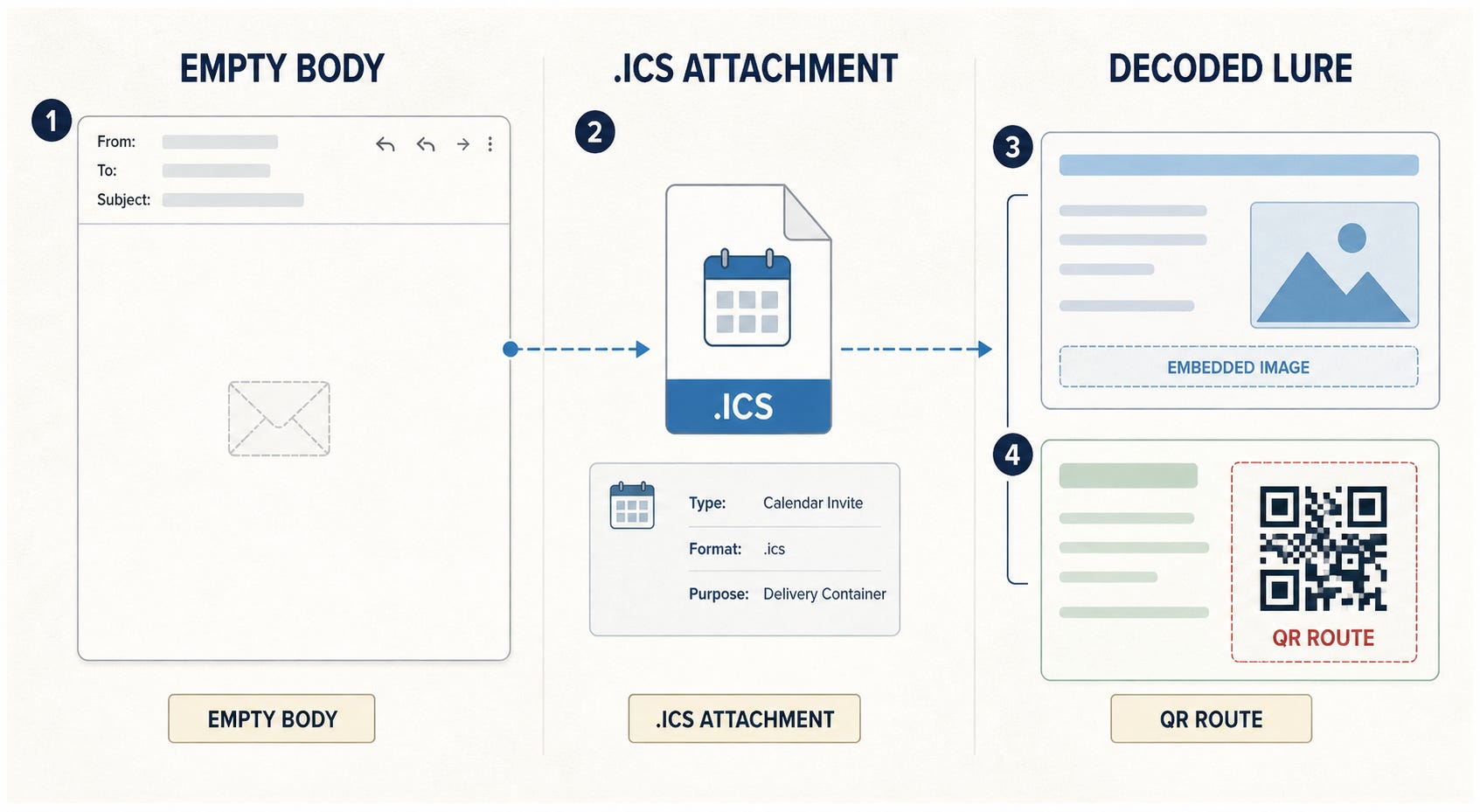
The Body Was the Decoy
Most email defenses still start with the message body. Extract text. Extract links. Score sender reputation. Check attachments for known malware patterns. That logic works when the attacker places the payload where the scanner expects it.
In this case, the body offered very little. The subject referenced a company-specific "Code of Conduct Assessment," but the working parts were folded into an `.ics` calendar file. IRONSCALES says the invite was 87 KB, much larger than a normal scheduling entry, because it carried a two-page internal compliance lure as embedded base64 images.
That matters because images inside a calendar description are not the same inspection target as text in an email body. A control that scans visible message text can return a clean result while the attachment carries the persuasion, the link path, and the QR route.
The lure did not hide by being sophisticated. It hid by being placed in the wrong inspection lane.
The .ics File Became a Container
Inside the calendar attachment, the attack looked like internal process theater: an employee-handbook header, a "workforce assessment" theme, a compliance deadline, and language pushing the recipient toward a secure access step. IRONSCALES mapped the delivery to MITRE ATT&CK spearphishing attachment behavior and noted the internal-process disguise as masquerading.
The file also carried two paths to the same credential page. One was a personalized link with the recipient identity embedded in the path. The other was a QR code encoding the same destination, creating a phone-side route that could move the victim outside managed browser controls.
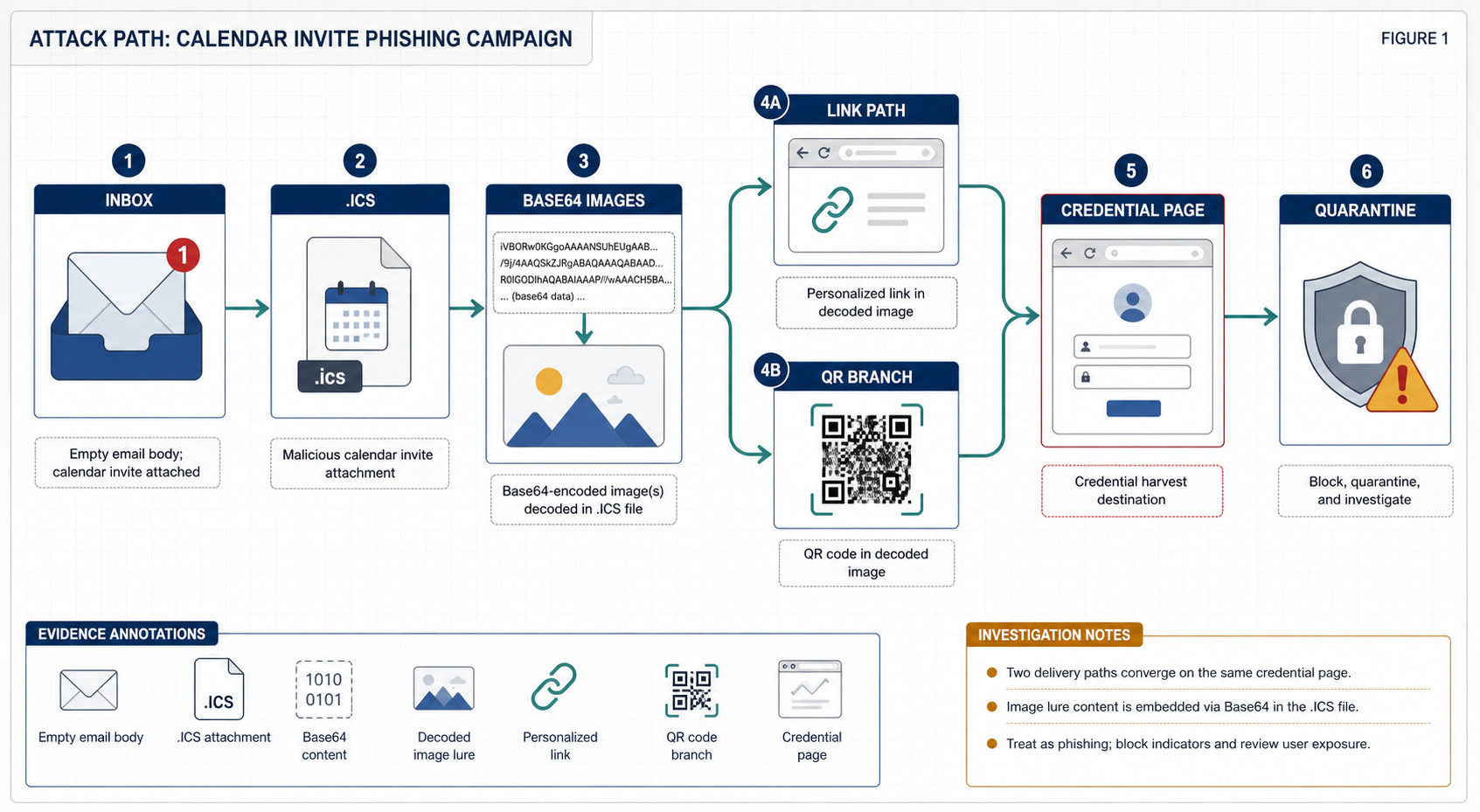
That split route is the important control problem. Desktop link inspection, mobile QR behavior, and calendar attachment parsing often sit in different parts of the security stack. If those signals are not stitched together, the same attack can appear as three harmless fragments.
The Domain Was Quiet, Not Fresh
The destination domain, `mghins[.]net`, was not described as a same-day throwaway. IRONSCALES reported that it had been registered months earlier, sat behind Cloudflare, and had no MX, SPF, or DMARC records. In plain language: it looked like a web host, not a mail domain.
That weakens one of the lazy assumptions defenders sometimes make about phishing infrastructure. Fresh domains are risky, but aged and quiet domains can be useful too. They can sit below reputation thresholds long enough to avoid the obvious-new-domain penalty.
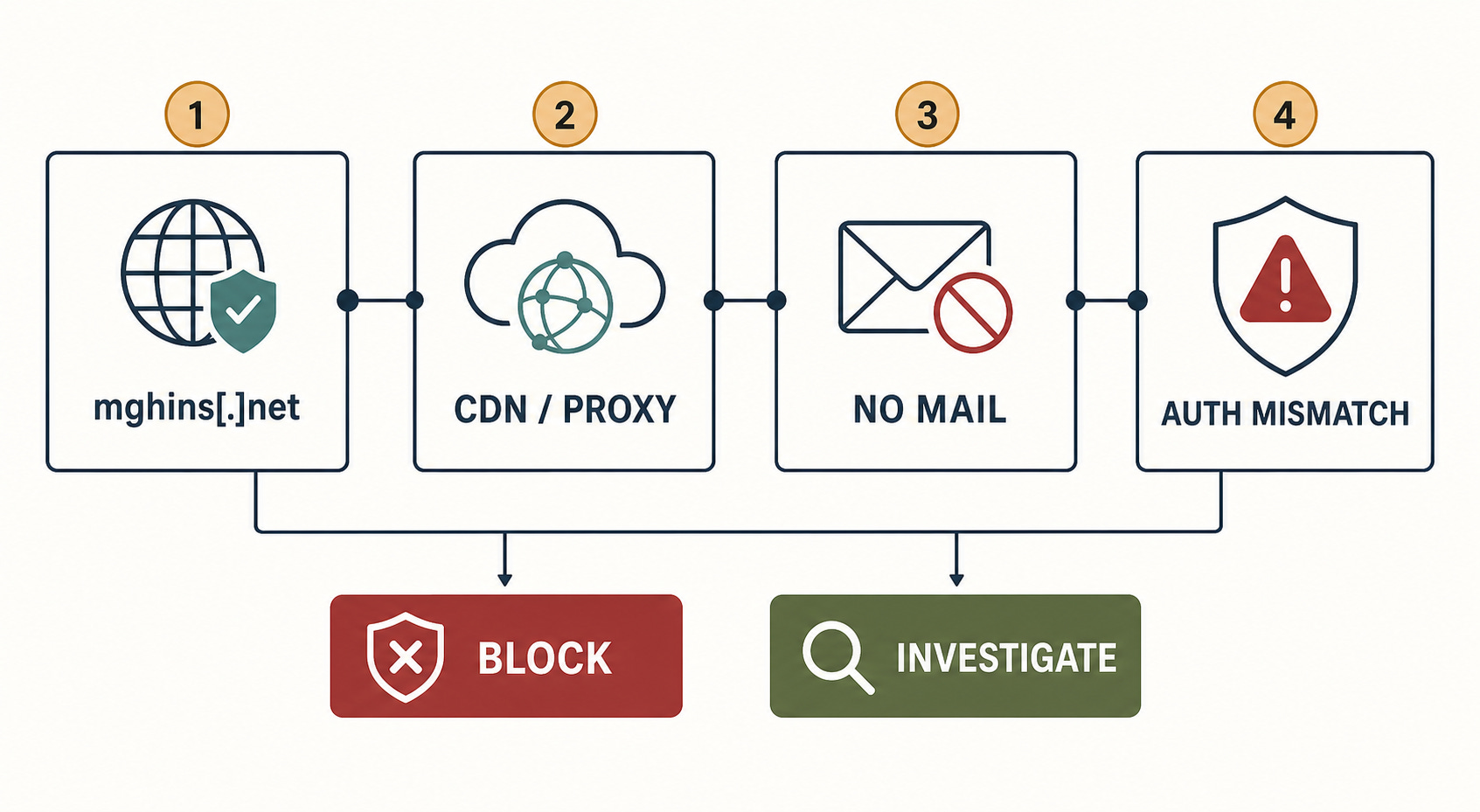
The mail path added another signal. IRONSCALES reported that the message originated from a compromised legitimate mailbox, then moved through relay infrastructure that broke SPF and DKIM alignment while DMARC was set to none. The upstream Barracuda gateway scored it benign, and Microsoft assigned a trusted spam confidence value.
No single signal was enough. Together, the picture was sharper: a mostly empty email, an oversized calendar invite, embedded image content, a QR branch, a personalized credential destination, broken authentication alignment, and a relay path that did not fit.
What Filters Missed
The failure mode is narrow and uncomfortable. A secure email gateway can be competent at body links and malware attachments and still under-read a calendar invite.
An `.ics` file is expected to describe an event. It is not expected to behave like a miniature web page with embedded images, inline HTML, and a credential-harvest route. That expectation gap is what the attacker used.
IRONSCALES says its system rendered and OCR'd the embedded images, decoded the QR code, correlated sender and relay mismatch, and quarantined the message with a 90 percent phishing verdict. The useful part is not the score by itself. The useful part is the inspection sequence.
Calendar content has to be treated as content, not just scheduling metadata.
The Control Question
For security teams, the practical question is simple: when a calendar invite arrives, what exactly gets inspected?
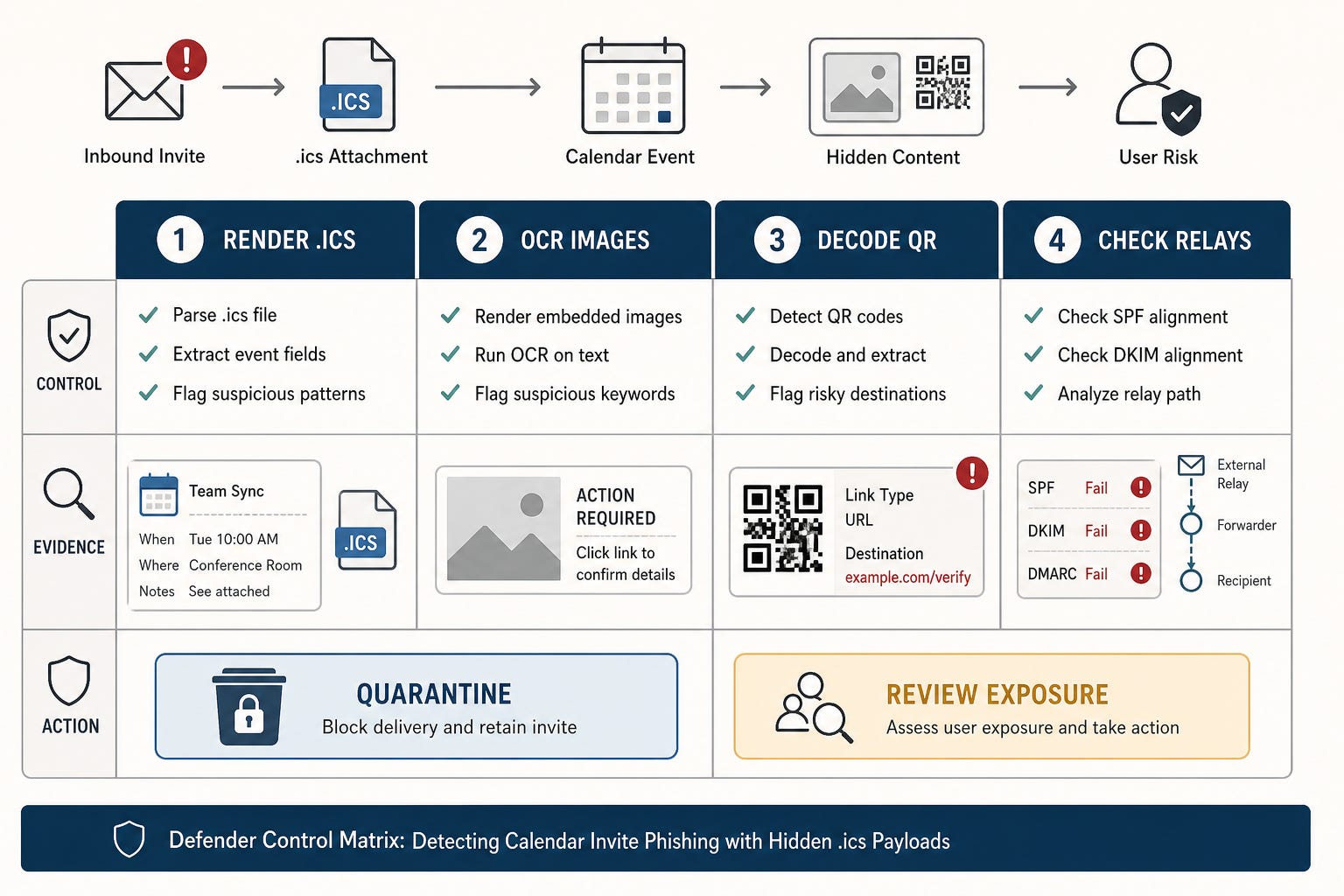
The control stack should be able to answer:
Are `.ics` descriptions parsed for embedded HTML and data URIs?
Are embedded images rendered and OCR'd?
Are QR codes decoded before delivery?
Are links inside calendar content extracted with the same seriousness as body links?
Are sender authentication breaks and relay mismatches correlated with attachment behavior?
None of that requires treating every calendar invite as malicious. It requires treating calendar invites as a real message surface.
The Quiet Road In
This campaign is not a story about one strange file type. It is a reminder that attackers keep moving the decision point away from the scanner's default view.
If the gateway sees an empty body, the analyst should ask what other object is carrying the persuasion. If the link is not in the body, ask whether it is in a rendered image, a QR code, or an attachment field. If authentication passed at one hop but failed by the time it reached the target, treat that as evidence, not noise.
The calendar invite is useful to attackers because it feels administrative, expected, and low-risk.
That is exactly why it needs inspection.