


The system that manages firewall policy exposed a hard-coded account its operators did not provision and may not have known existed.
Cisco's July 29 advisory says CVE-2026-20316 places static credentials for a low-privilege account inside Secure Firewall Management Center. An unauthenticated remote attacker can use that account to log in and reach sensitive data.
Cisco also says the flaw is being actively exploited.
That combination changes the response. This is not only a version-checking exercise. Teams have to close the access path, install the matching hot fix, and determine whether the management plane was already touched.
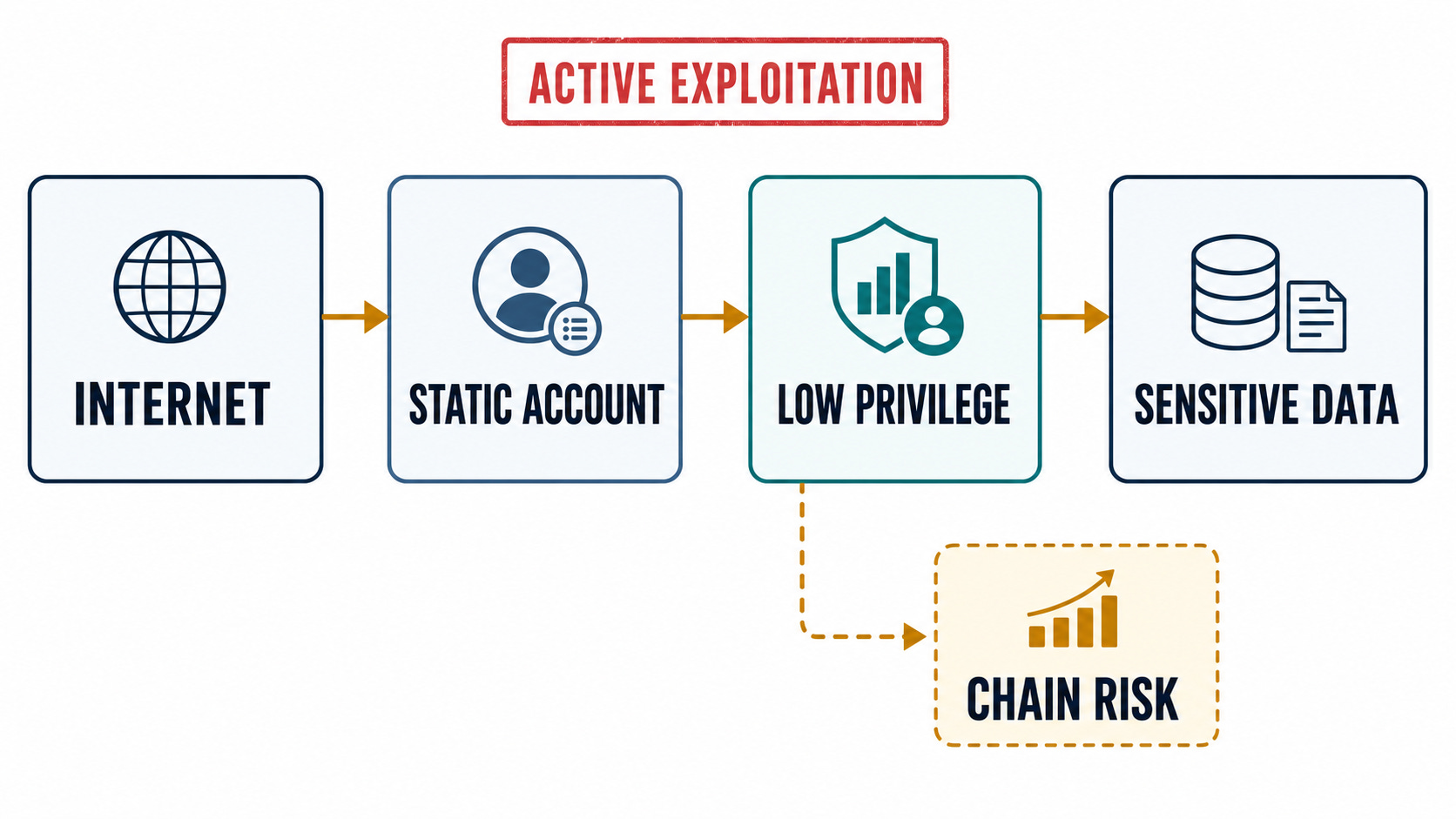
The initial account is low privilege, but Cisco raised the advisory to High because the access can be combined with other FMC vulnerabilities.
A medium score hid a high-risk position
The CVSS base score is 5.3. Read without context, that number can look like routine queue material.
The context is a security control plane.
Secure FMC is used to manage firewall infrastructure. The flaw requires no prior authentication, no user interaction, and no unusual local access. The account is low privilege, so the immediate confidentiality impact is limited in the scoring model. Cisco nevertheless assigned the advisory a High security impact rating because the access can be chained with other Secure FMC vulnerabilities to elevate privileges.
That is a risk statement, not proof that attackers used a particular chain. Cisco has not published an intrusion sequence, actor attribution, victim count, or complete description of the data reached in observed exploitation.
The bounded facts are still serious: a remote login path exists, sensitive data is accessible at that privilege level, and exploitation is active. Keeping the management interface off the public internet reduces the attack surface, but Cisco says the vulnerability affects Secure FMC regardless of device configuration.
The advisory includes a forensic pivot
Many exploited-vulnerability notices arrive with little more than a patch instruction. This one includes a concrete log artifact.
Cisco tells customers to search the system messages log for activity involving a temporary file named license.tmp. Its example shows the www account invoking a package-information script against that file as root on July 23 at 16:16 UTC.
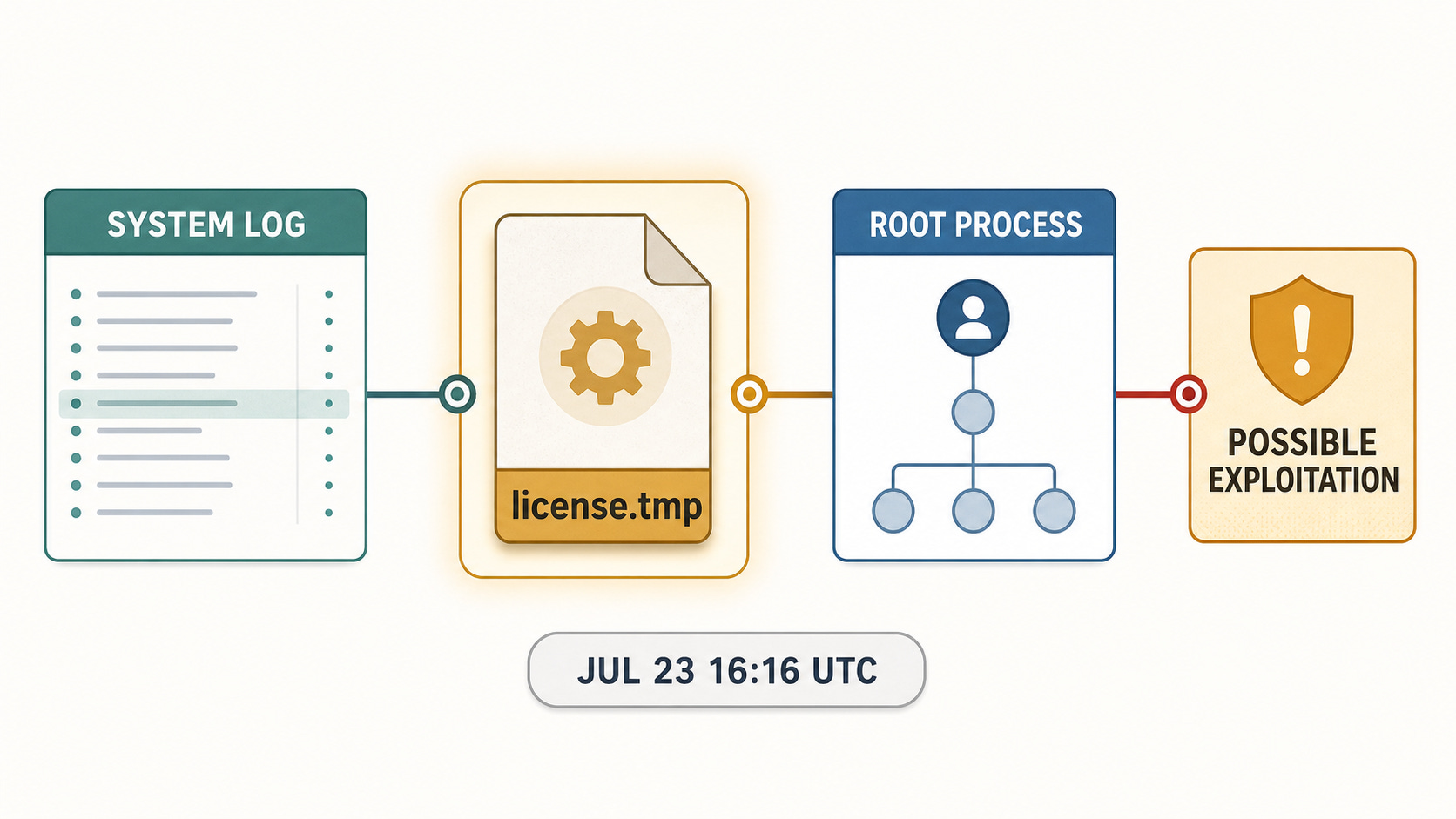
Cisco says the temporary-file entry means the device may have been exploited; it is a triage signal, not a standalone verdict.
The distinction matters. Absence of that single string does not prove a device is clean, and its presence should not be converted into unsupported attribution. It is a starting point for preserving logs, expanding the timeline, and escalating recovery with Cisco TAC.
Cisco's recovery guidance is unusually explicit. If exploitation is suspected, customers should rotate all user credentials, keys, and certificates on the affected FMC device. That work should be planned from a trusted system so a potentially compromised manager does not remain the authority for its own recovery.
The affected surface is specific
The naming can make the blast radius sound broader than Cisco describes.
For CVE-2026-20316, the affected family is Secure FMC. Cisco says the flaw applies regardless of device configuration. It separately confirms that Cloud-Delivered FMC, Firewall Device Manager, ASA Software, FTD Software, and Security Cloud Control are not vulnerable to this issue.
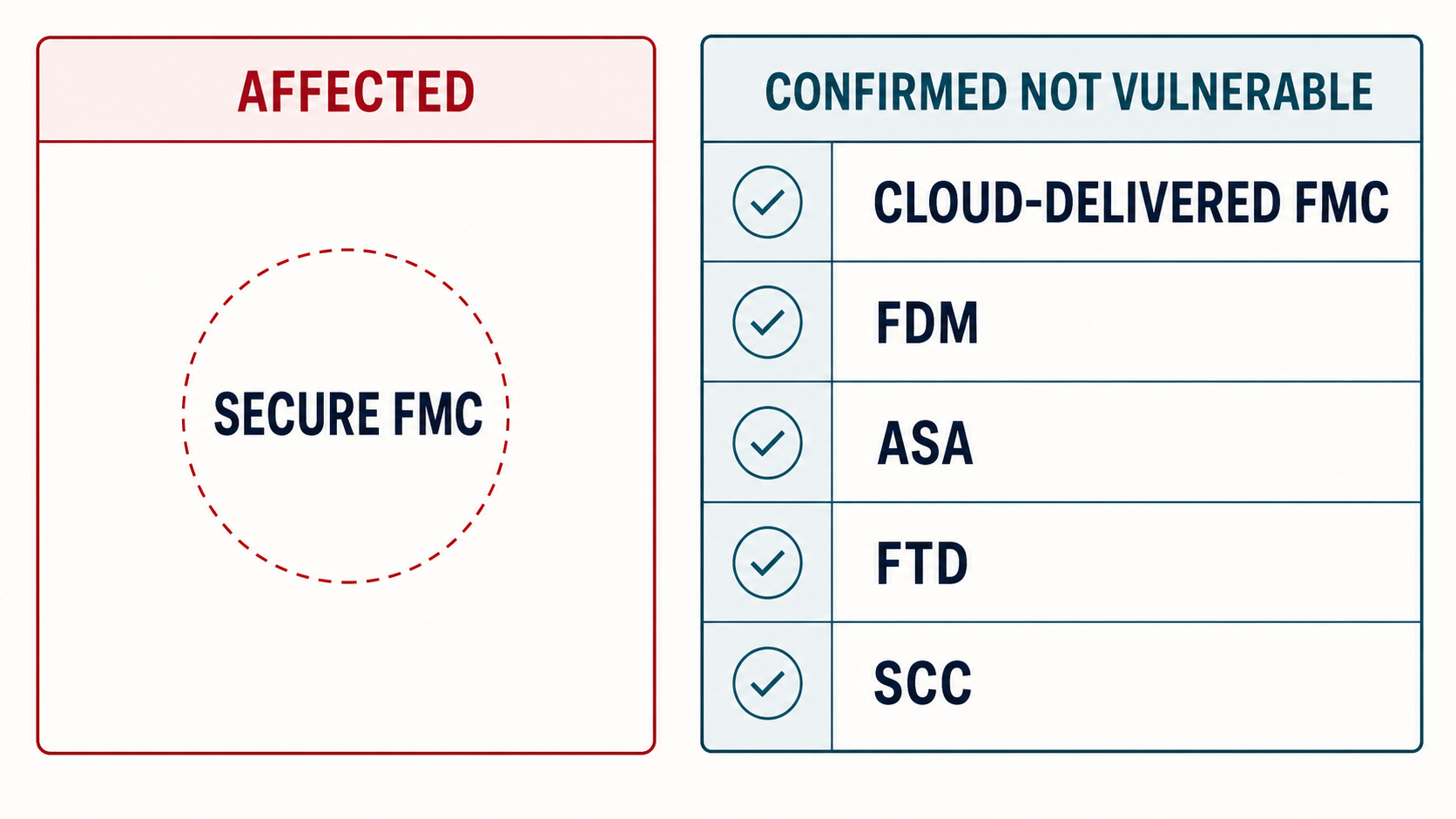
The scope statement applies to CVE-2026-20316, not to every vulnerability affecting the wider firewall portfolio.
That precision should drive inventory. A team should not close the ticket because its firewalls run FTD, nor open an incident for every Cisco firewall product. The relevant question is whether an on-premises Secure FMC instance exists, which release it runs, how its management interface is reachable, and whether the published artifact appears in retained logs.
The issue has no workaround. Cisco released hot fixes for the 7.0, 7.2, 7.4, 7.6, 7.7, and 10.0 release lines. Its machine-readable advisory also identifies 7.3.0 through 7.3.1.2 as affected, but the published hot-fix table does not include a 7.3 package. Operators on 7.3 should use the Cisco Software Checker and Cisco support guidance to move to an appropriate fixed release rather than infer coverage from a nearby package.
Patching and compromise assessment are one job
CISA added CVE-2026-20316 to the Known Exploited Vulnerabilities catalog on July 29. The catalog gives federal civilian agencies an August 1 due date and tells organizations to apply vendor mitigations, account for internet exposure, and follow its forensics triage requirements.
The practical response sequence is compact:
Restrict reachability. Remove public exposure and limit the management interface to the smallest necessary administrative path.
Map the release. Identify each Secure FMC instance and apply the listed hot fix where one exists. Treat affected 7.3 builds as a migration or support-guided remediation case.
Preserve and search evidence. Retain system logs before changes, search for the published temporary-file artifact, and expand around any matching timestamp or related process activity.
Treat a hit as an incident lead. Engage Cisco TAC, preserve the device state required for investigation, and scope access beyond the first log line.
Rotate trust material. If exploitation is suspected, replace credentials, keys, and certificates from a trusted recovery position.
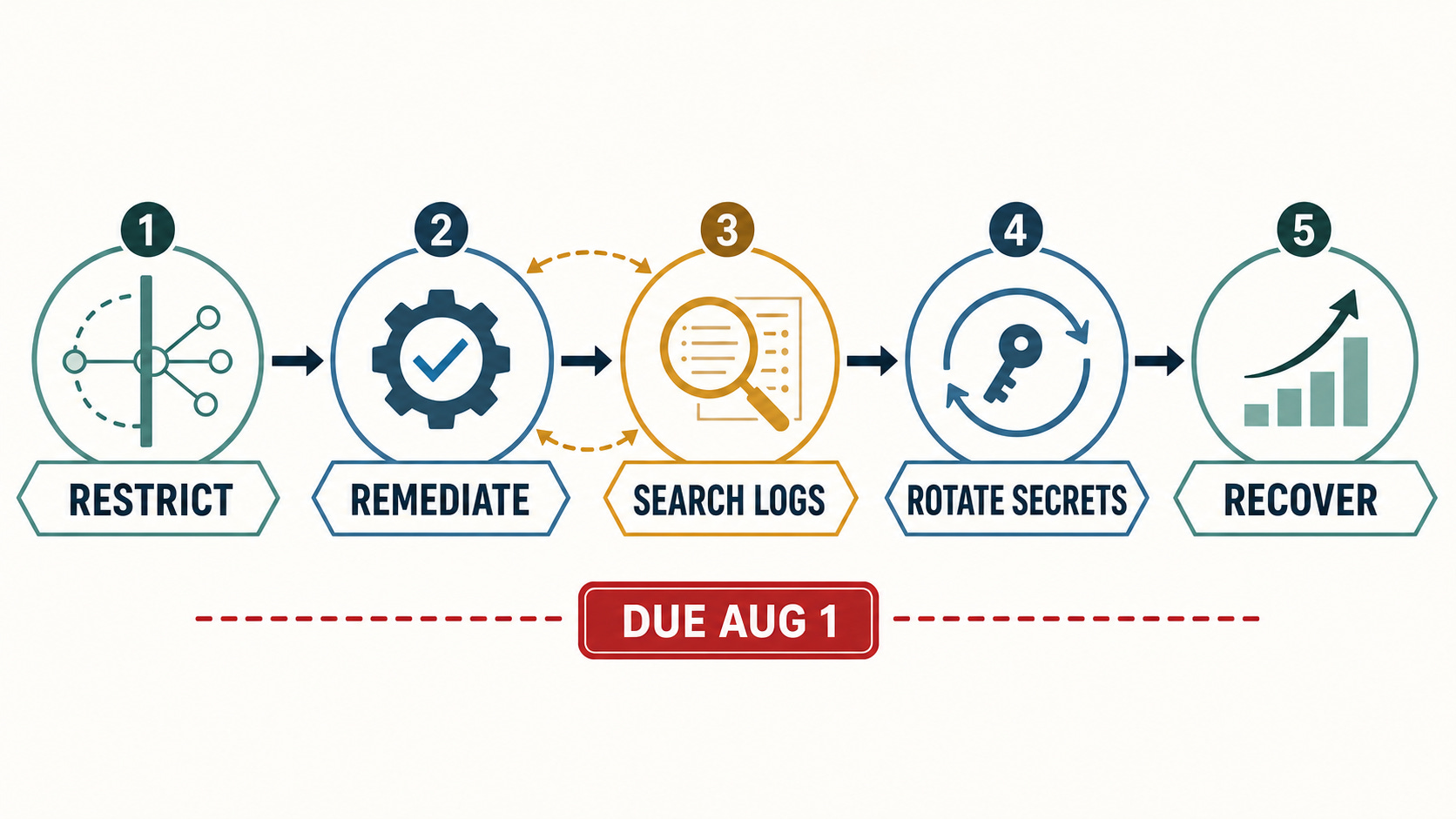
For federal civilian agencies, the remediation deadline is August 1. The log and secret work addresses the possibility that the path was already used.
A related critical flaw needs careful wording
On the same day, Cisco updated its advisory for CVE-2026-20079, a separate critical authentication-bypass vulnerability in Secure FMC. The update added the same temporary-file indicator and the same hot-fix set.
That overlap is operationally important, but it does not establish an observed chain. Cisco says it is not aware of malicious exploitation of CVE-2026-20079. By contrast, active exploitation is confirmed for CVE-2026-20316.
Defenders should keep both facts intact: investigate the shared artifact across the relevant FMC attack surface, and avoid claiming that the critical bypass was used unless device evidence supports it.
A static low-privilege account is not harmless because its initial permissions are limited. On a security management plane, it is an unauthorized foothold with known exploitation, a published forensic pivot, and no workaround. The patch decision and the incident decision now belong in the same room.