Most malicious package stories start in the same place: install scripts.
This one does not.
Security researchers reported that two hijacked npm packages and a related cluster of Go packages were used to deploy a Python-based infostealer across Windows, Linux, and macOS systems. The important part is not only that developers were targeted. That has been true for years.
The important part is where the execution moved.
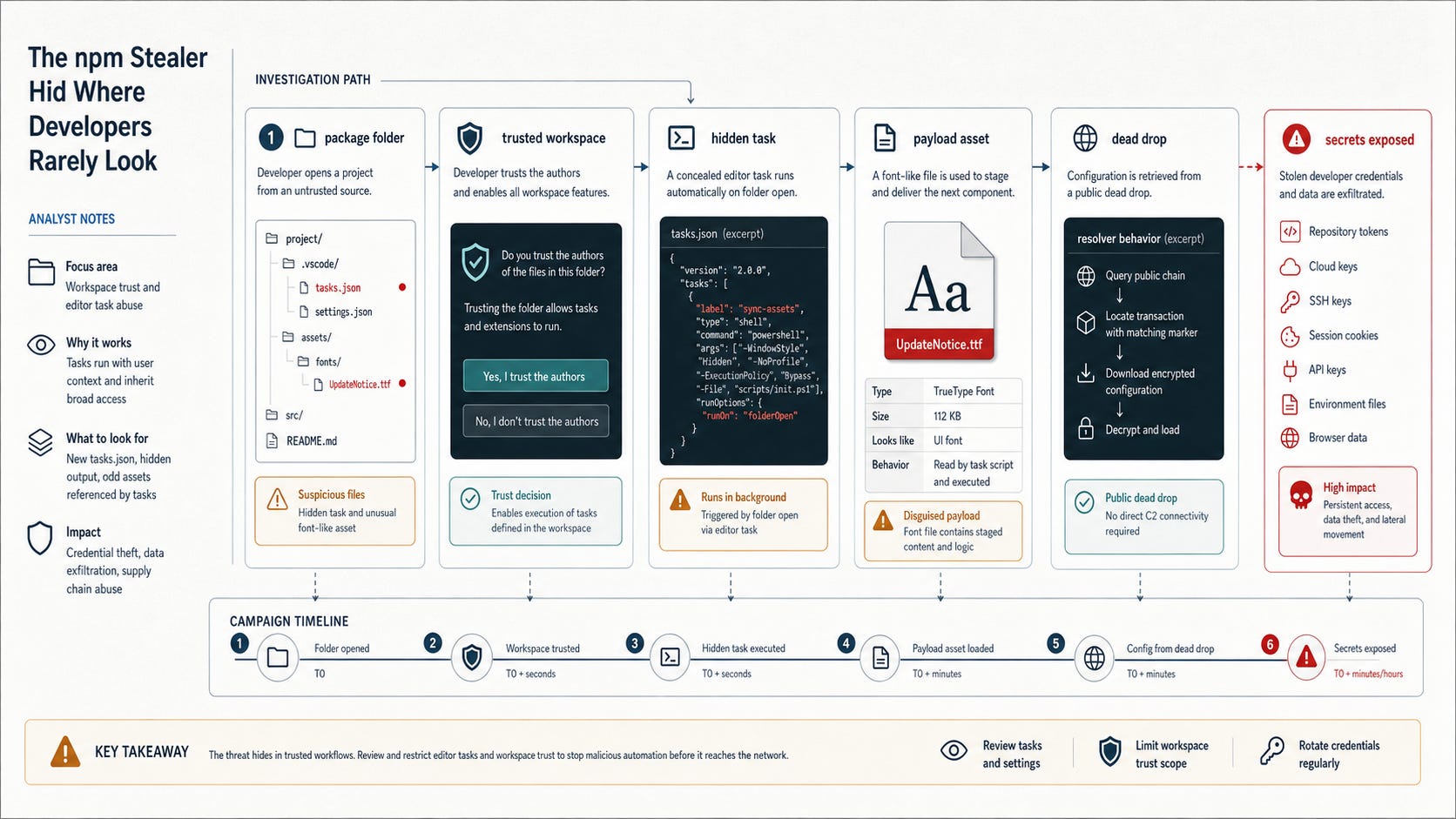
The packages did not lean on the most obvious npm lifecycle hooks. According to JFrog's analysis, the malicious logic hid behind a Visual Studio Code task configured to run when a project folder was opened as a trusted workspace. The payload path was disguised as a font file. The later stages used blockchain transaction data as a dead-drop mechanism before reaching attacker-controlled infrastructure.
The package manager was not the whole battleground. The developer workspace was.
That is the part security teams should sit with.
The Trick Was Not New Malware. It Was New Placement.
The Hacker News reported on June 29, 2026 that researchers had identified two hijacked npm packages, `html-to-gutenberg` and `fetch-page-assets`, along with Go packages carrying the same malware family. JFrog's primary analysis says the affected npm versions were uploaded to npm on May 25, 2026 and later removed from the registry.
The reporting describes a multi-stage chain. At a high level, the malicious package used a hidden VS Code task named `eslint-check`, a fake font asset, blockchain-based retrieval, a Socket.io backdoor, and a Python infostealer.
That sounds complicated, but the strategic idea is simple.
Attackers looked for a path that would feel less suspicious than a package install hook. Many defenders know to watch `postinstall` behavior. Many developers have learned to be wary of packages that execute code during install. VS Code tasks live in a different mental bucket. They feel like project plumbing.
That is why this technique matters.
It moves execution into the developer's daily environment, where convenience features and trust prompts often decide whether code runs.
Trusting The Workspace Became The Decision Point.
JFrog notes an important constraint: this is not a magic trigger that recursively runs every nested task file. The task fires when the malicious package directory itself is opened as the workspace and marked as trusted, or when automatic tasks are explicitly allowed.
That caveat makes the story less sensational and more useful.
This is not "open any repo and instantly lose the machine." It is a reminder that trust decisions inside development tools have become security controls. Workspace trust, automatic tasks, editor extensions, terminal integrations, and AI coding assistants all sit near sensitive material.
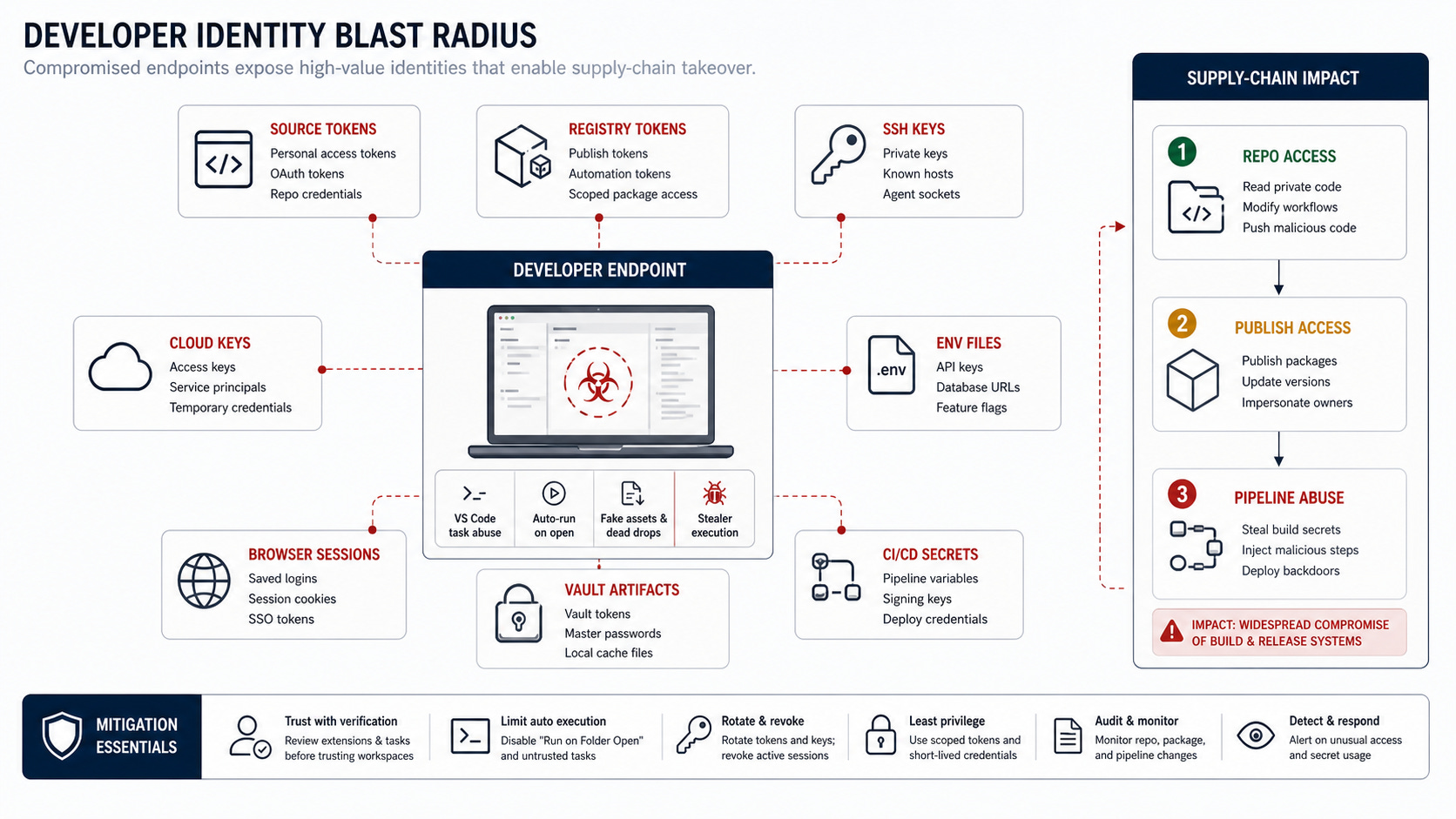
That material includes Git credentials, cloud tokens, package registry sessions, local environment variables, browser data, password manager artifacts, and source code.
An ordinary developer workstation can now be a high-value identity system.
If attackers can reach that workstation through a dependency, an editor task, or a "helpful" project setup path, they are not just stealing a laptop. They may be stealing the keys to build pipelines, private repositories, release tokens, and downstream customers.
The Infostealer Angle Is The Business Angle.
The reported malware targeted browser data, cryptocurrency wallets, password managers, GitHub-related artifacts, VS Code data, OS credential stores, and cloud-storage metadata. Those details should not be read as a shopping list. They should be read as intent.
This was not a noisy commodity nuisance bolted onto a random package.
It was pointed at developer identity.
That is the recurring shape of modern software supply-chain intrusions. The first compromise is often boring: a package, a token, a maintainer account, a build script, a repo setting, a developer endpoint. The second-order effect is not boring at all. It can become source-code access, package publishing access, CI/CD abuse, or credential replay into cloud infrastructure.
The technical novelty here is the VS Code task placement. The operational pattern is older: get close to builders, then use their trust to move.
Developer convenience is becoming attacker infrastructure.
Why Blockchain Dead Drops Keep Showing Up.
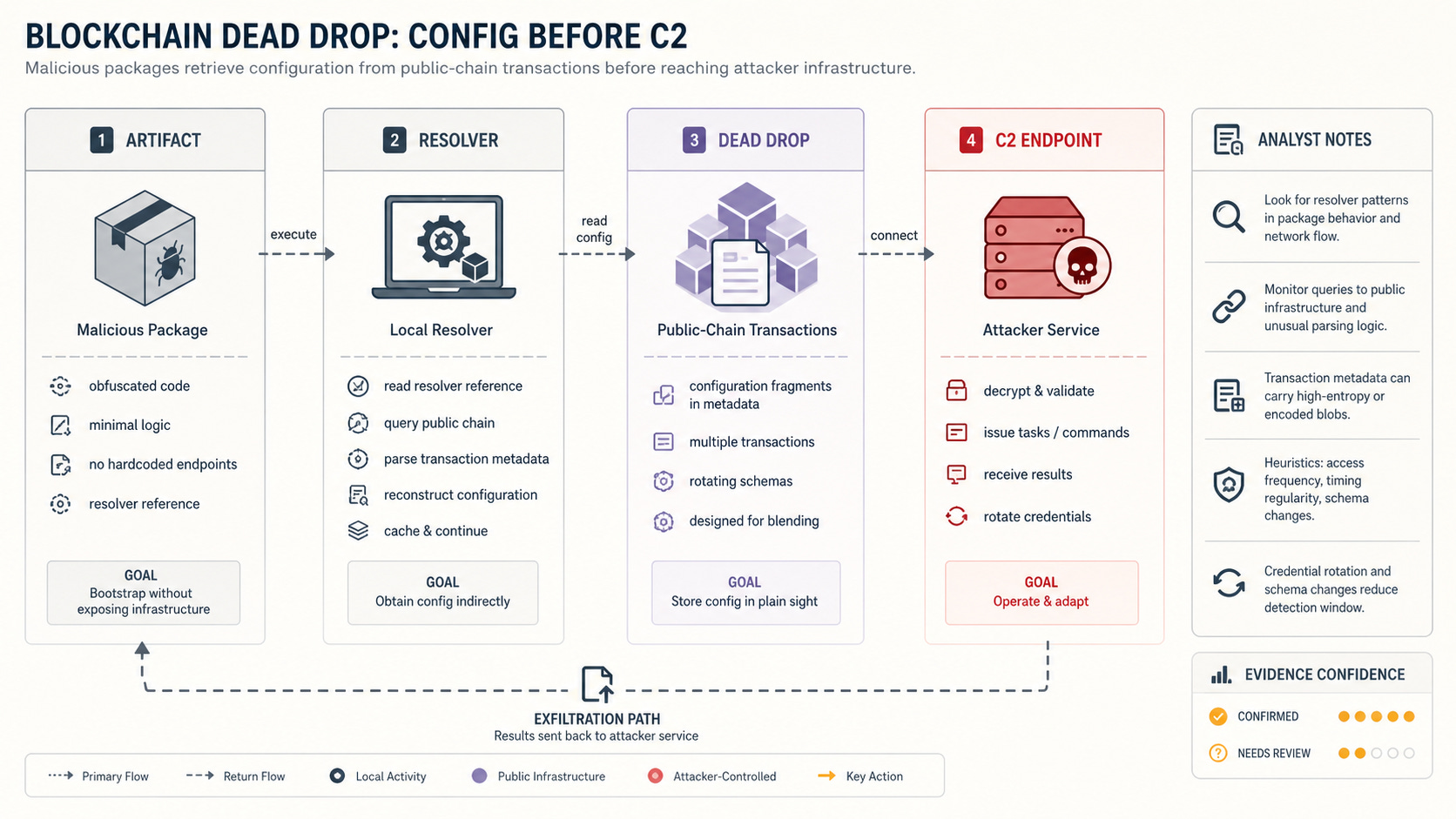
The JFrog analysis says the bogus font file used blockchain infrastructure as a dead-drop resolver, including TronGrid with Aptos as a fallback. The point is not that blockchain makes the malware advanced by default. The point is resilience.
Dead drops let attackers publish small pieces of configuration or routing data in places that are harder to erase quickly than a single domain. The malware can look up where to go next without hard-coding every answer into the package itself.
For defenders, this changes what "removed from npm" means.
Package removal is necessary. It is not a full incident boundary.
If a compromised developer machine already executed a loader, the registry cleanup does not prove the machine is clean. If the later-stage infrastructure is still reachable, or if stolen credentials already left the endpoint, the response has to move beyond package inventory.
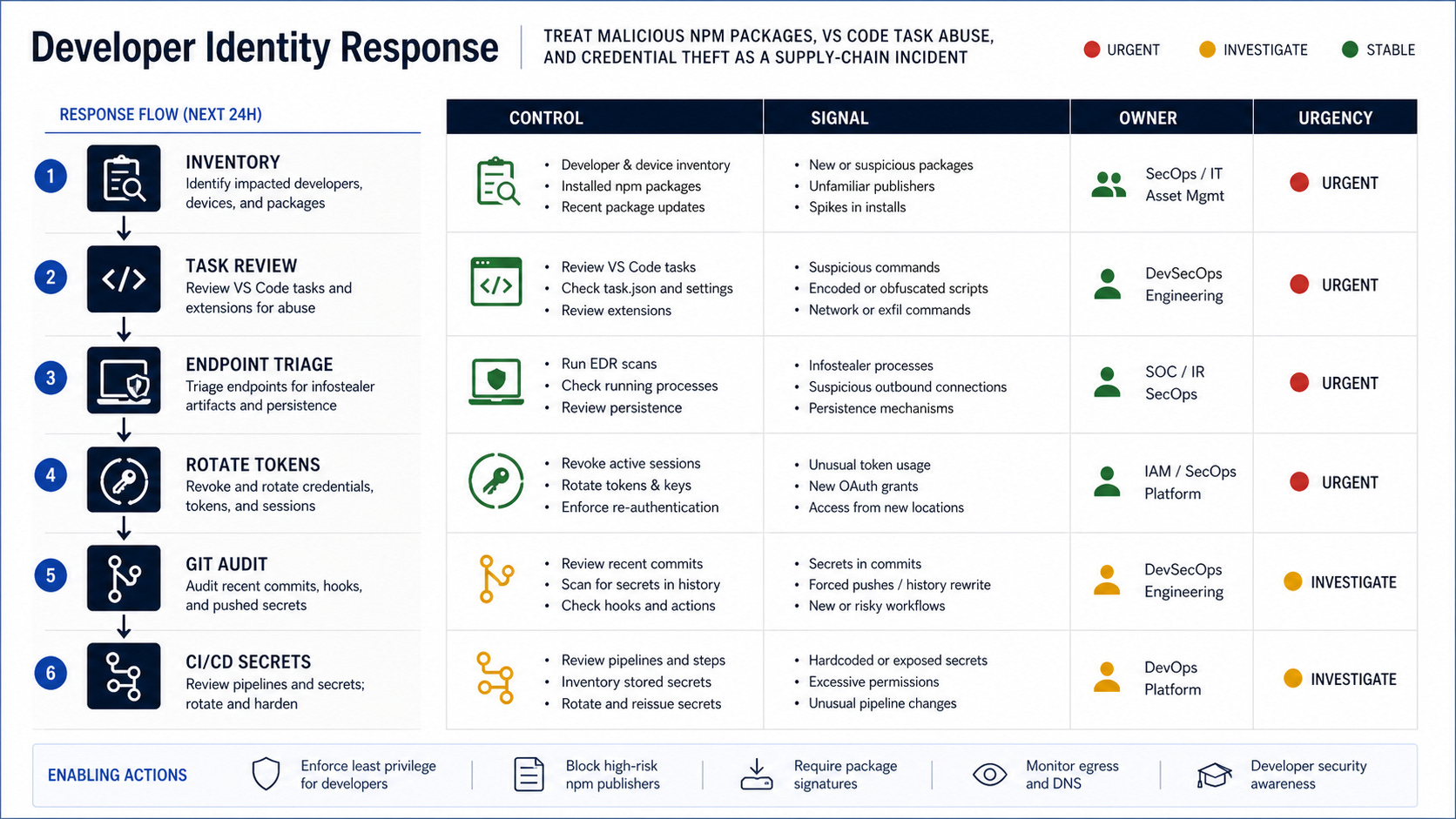
That means endpoint review, token rotation, GitHub and package-registry audit logs, CI/CD secret review, and checking whether the developer's local environment had access that should never have lived on a workstation in the first place.
The North Korea Echo Should Be Handled Carefully.
The Hacker News notes that abuse of VS Code auto-run tasks combined with fake font files has previously been attributed to North Korea-linked activity, and references OpenSourceMalware's tracking of a "Fake Font" variant associated with the long-running Contagious Interview campaign.
That does not automatically prove attribution for every package in this case.
It does tell defenders something practical: developer-targeting campaigns keep reusing the same social and technical pressure points. Fake projects. Trusted tooling. Hidden setup behavior. Credentials and wallets. Backdoors that give the operator time to sort through the machine.
Attribution is useful when it changes the response. Here, the immediate response is already clear without overclaiming who is behind it.
Treat developer endpoints and build identities as production infrastructure.
What I Would Change Before The Next One.
The obvious move is to check whether the named packages or related Go packages were present in your environment. That is table stakes.
The better move is to ask why opening a project folder could ever become a credential-risk event.
Security teams should review where editor tasks are allowed to run automatically, whether developers understand workspace trust prompts, and whether endpoint controls can flag unusual editor-launched interpreters. Package security controls should look beyond install scripts. Repository intake should include hidden editor configuration, not only application code.
For build and platform teams, the goal is sharper:
keep publish tokens short-lived and scoped
separate human development credentials from release automation
monitor package-registry and GitHub activity for impossible or unusual behavior
make local secrets harder to steal and less useful when stolen
treat a developer infostealer as a potential supply-chain incident, not only an endpoint incident
This is the lesson: malicious packages are no longer only packages.
They are delivery vehicles into the entire development environment.
The next defensive boundary is not just npm. It is the editor, the workspace, the identity stack, and the build path behind it.