


CISA added CVE-2026-18577 to its Known Exploited Vulnerabilities Catalog on August 3 based on evidence of active exploitation.
The catalog entry describes an authentication bypass in N-able N-central that can lead to account takeover. It also states that the vulnerability resulted from an incomplete patch for CVE-2026-18556.
That sequence is the important part. The first remediation record can be accurate while the technical closure it implies is not: a second route remained open.
The second identifier is evidence that remediation status and technical closure diverged.
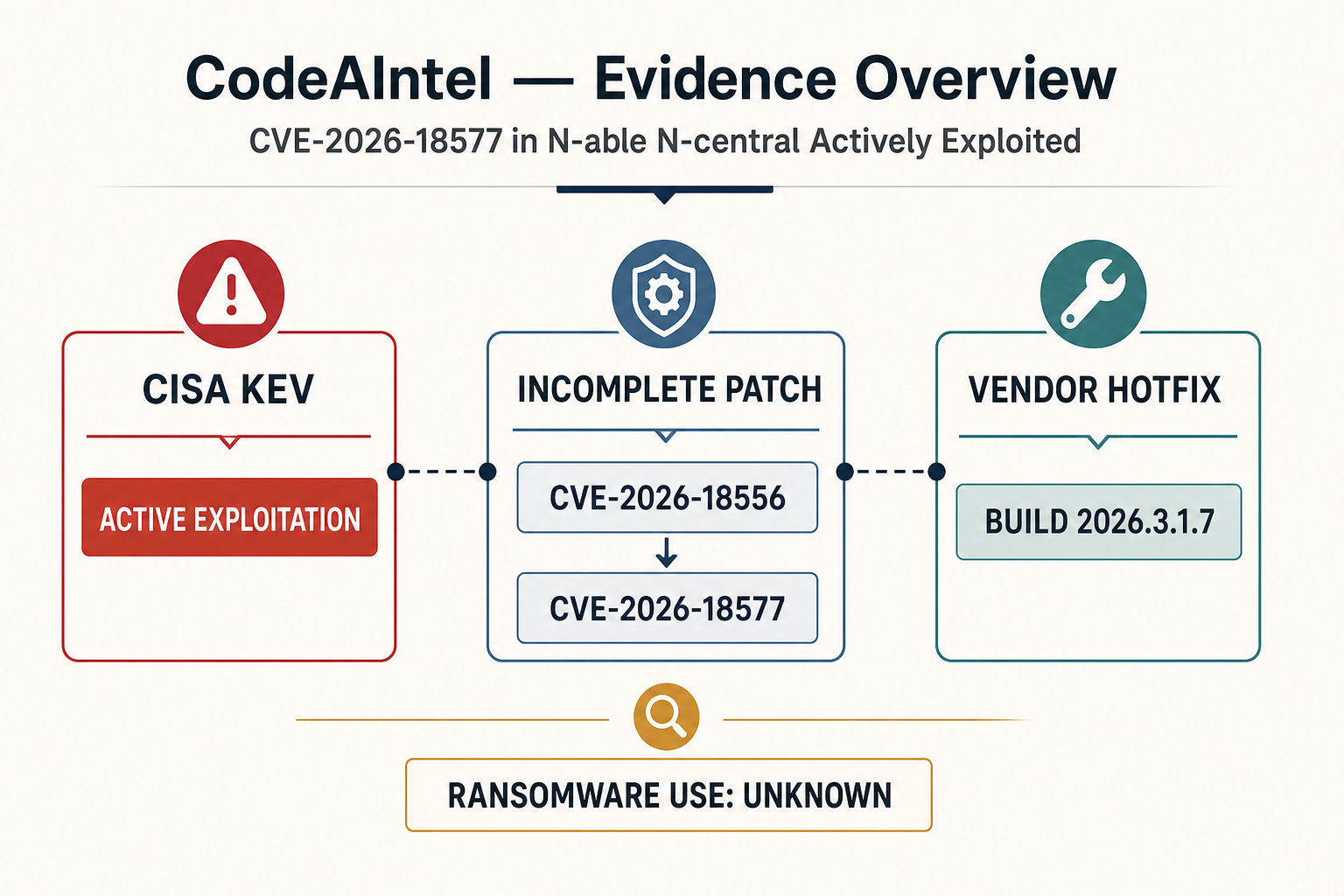
CISA confirms active exploitation. Its KEV entry records ransomware campaign use as unknown, so exploitation should not be inflated into a ransomware attribution.
A second CVE turned "patched" into a question
CISA's KEV entry says CVE-2026-18577 allows authentication bypass and account takeover through an alternate path or channel. It explicitly connects the flaw to an incomplete fix for CVE-2026-18556.
N-able's August 2 status notice says the issue affects N-central instances not running 2026.3.1. The notice identifies N-central 2026.3 Hotfix 1 as build 2026.3.1.7; the separate release notes call that build an important mitigation for CVE-2026-18577.
Hosted N-central upgrades are scheduled by the provider. Self-hosted operators have to perform the upgrade. In both cases, teams still need evidence of the exact build running on each instance rather than relying on an earlier remediation ticket.
Patch state belongs to an asset, a build, and a point in time—not to a remembered CVE number.
Patch lineage is the evidence
At the product level, the incomplete-fix chain records four distinct states that should not be collapsed into one green checkmark: the original flaw; its initial fix; the alternate path that remained in that fix; and the later mitigating hotfix published after CVE-2026-18577 entered the record.
At the asset level, not every instance necessarily passed through all four. For an instance previously remediated for CVE-2026-18556, the earlier ticket can be true and incomplete: it may prove that a package was installed, but not that every authentication route was closed or that the residual route was never used.
For each hosted or self-hosted instance, responders need the exact running build, when it entered that state, and the exposure window that preceded it. A scheduled hosted upgrade is not the same evidence as a verified running build. A completed self-hosted change ticket is not enough without the same verification.
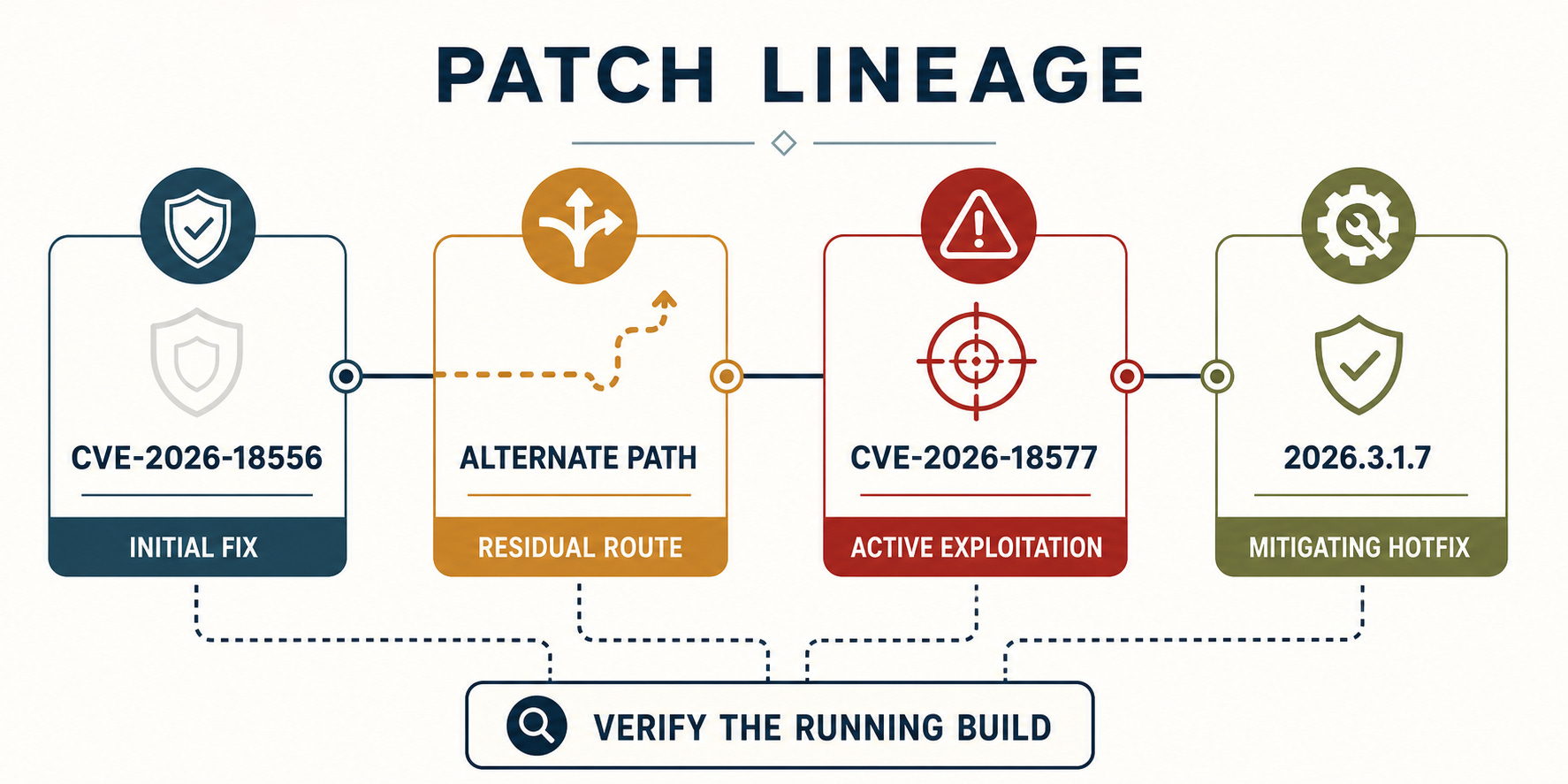
The new hotfix defines the current vendor mitigation. The lineage determines what an earlier record did—and did not—prove.
KEV changes the urgency, not the attribution
CISA's listing is based on evidence of exploitation, not only on theoretical severity. For covered federal agencies, the catalog sets an August 6 due date and calls for vendor mitigation plus forensic triage. CISA also encourages organizations outside the federal mandate to prioritize KEV remediation.
The same entry records known ransomware campaign use as Unknown. That boundary matters. Active exploitation is confirmed; a ransomware connection is not.
That is enough to justify urgent scoping, evidence preservation, mitigation, and investigation. It is not enough to name an actor, infer a campaign, claim downstream compromise, or turn Unknown into a ransomware label. Waiting for a named campaign or public victim list would delay action; inventing one would weaken the evidence.
The vendor published three useful pivots
N-able's notice gives operators concrete places to look. It names a file called svchost.exe in users' Documents folders, a registered service named Cloudflared, and inbound firewall connections from four listed source IP addresses.
The path is part of the signal. A Windows binary name in a Documents directory is more specific than the filename alone. Likewise, a Cloudflared service or a source-IP match should be placed on a timeline with process creation, service installation, authentication, network, and administrative activity.
These indicators are triage pivots, not a complete detection model. A match warrants preservation and investigation. A non-match does not prove the earlier bypass was never used.
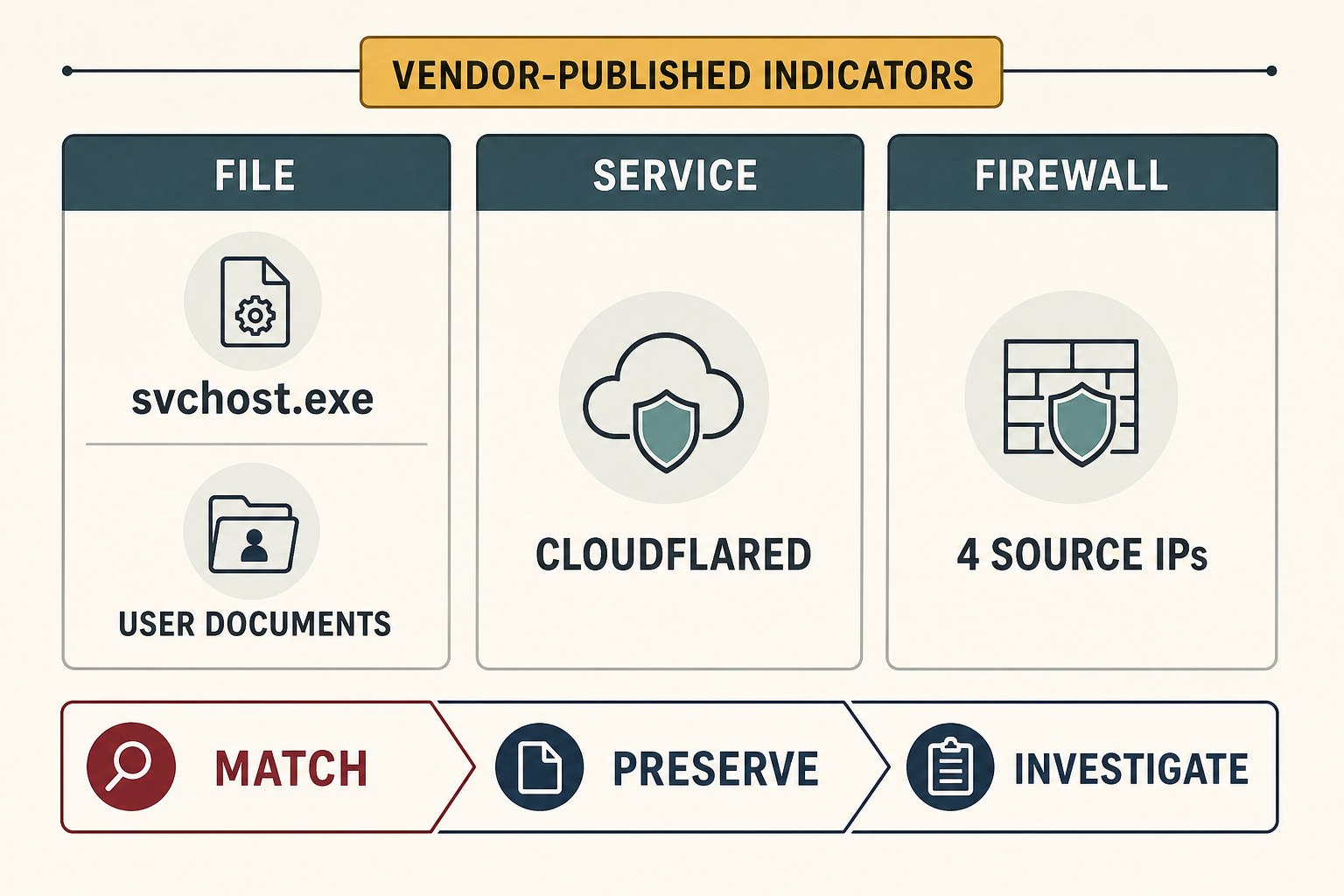
Treat the published artifacts as entry points into the case. Preserve surrounding evidence before containment removes the context.
Closure needs four receipts
CISA's BOD 26-04 implementation guidance provides a useful safety constraint. Its sequence starts with scoping, then preservation and collection. Critical patching and stabilization follow; containment and control should begin as soon as feasible after initial evidence collection, in close coordination with those actions. Triage analysis and escalation come after. The guidance explicitly warns that remediation can jeopardize artifacts.
That order should be adapted to mission risk, but not inverted casually. Preserve the necessary evidence before alteration when possible, and coordinate patching with containment rather than treating either as an isolated ticket.
The closure record should contain four independent receipts:
Scope receipt. Identify affected hosted and self-hosted instances, exact running builds, exposure, privileged entry points, and the time window under review.
Artifact receipt. Preserve the required server, authentication, firewall, service, process, and management-action evidence before remediation when feasible, prioritizing volatile data and recording collection times.
Mitigation receipt. Apply the vendor-designated Hotfix 1 and verify build 2026.3.1.7 is actually running on each in-scope instance.
History receipt. Review accounts, sessions, integrations, administrative actions, and the published pivots; document evidence-led containment and any escalation.
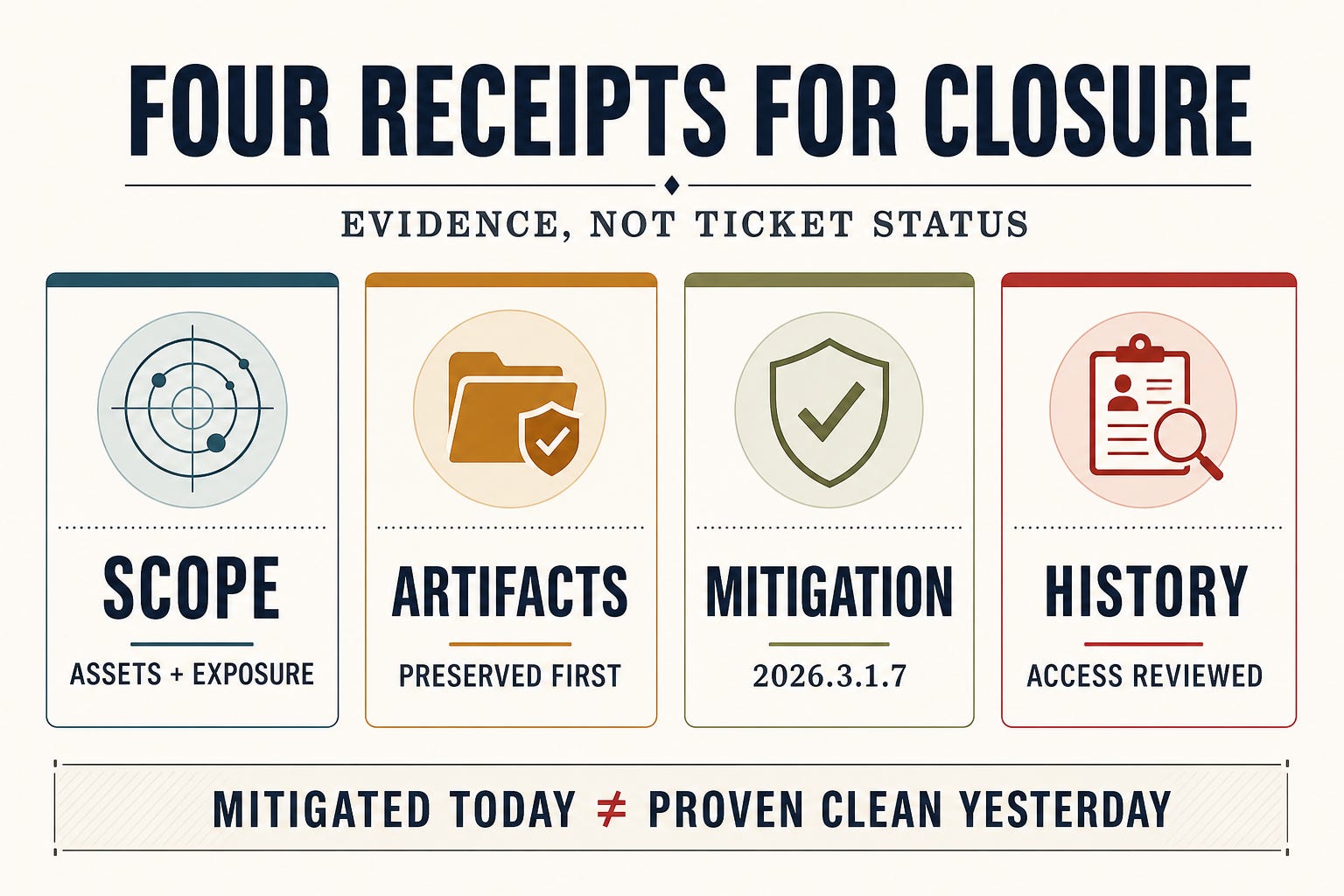
A mitigated instance proves its current state. It does not, by itself, prove a clean pre-mitigation history.
A closed ticket needs a lineage
Incomplete fixes create two records: the remediation record that says work was done, and the technical record that shows what the work actually closed.
CVE-2026-18577 makes the gap visible. CISA has confirmed exploitation. N-able has published the hotfix build and concrete triage pivots. Teams now have enough to act without inventing a campaign, a victim count, or a downstream impact.
Preserve what the next change could erase, verify the mitigating build, and make closure prove both its current state and its history.