


On August 5, VulnCheck published the results of a physical and firmware-level investigation into a cellular router it had bought and placed on an isolated network. The device repeatedly tried to reach command-and-control infrastructure on the internet.
The researchers did not find malware dropped after compromise. They found a remote-control component embedded in the shipped firmware, started at boot, disguised as a routine Linux process, and running as root.
The same day, CVE-2026-66747 was published with CWE-506, Embedded Malicious Code. The record covers 20 named Zbtlink router models and describes a cleartext, unauthenticated control channel capable of accepting root commands.
The router did not need an exposed management page. It initiated the connection itself and trusted whoever answered.
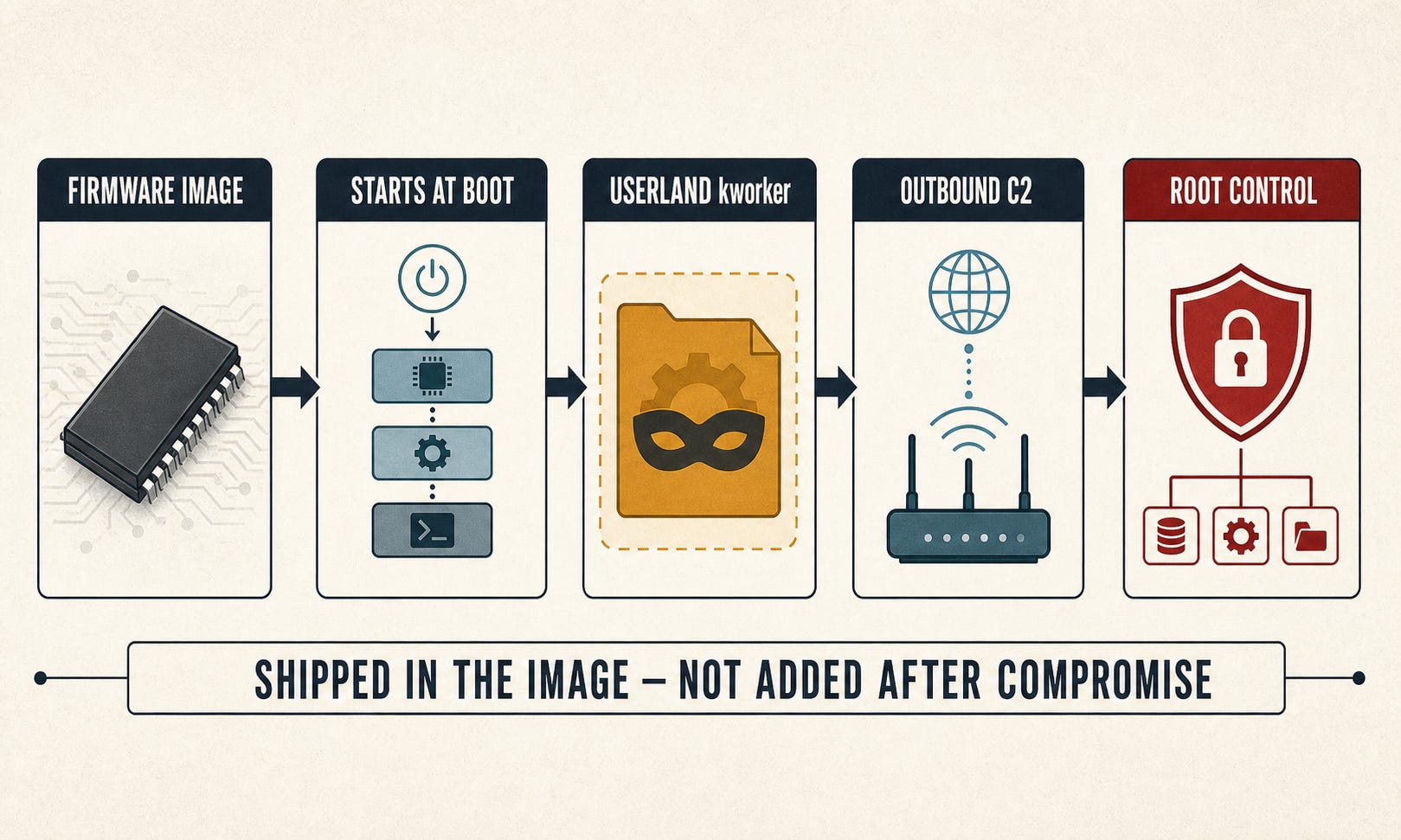
The remote-control path was part of the firmware image researchers examined, not a payload they observed arriving after the device was deployed.
The process name was the disguise
Linux kernel worker threads normally appear in brackets, with names such as [kworker/0:0]. On the tested router, VulnCheck found two unbracketed processes named kworker. They had ordinary userland memory footprints and ran as root.
That small visual difference mattered. The process name blended into a list administrators are accustomed to ignoring, while the underlying executable was not a kernel thread at all.
The researchers traced it to an OpenWrt package built from an old open-source remote-control project called rctl. The firmware stored the executable and library under predictable paths, loaded the component through an init script at boot, and kept configuration alongside it.
This is not merely a suspicious filename. VulnCheck reproduced the control path on the purchased AX3000: the device phoned home, accepted the researcher's answering server, and returned an interactive root shell. The published third-party advisory rates the issue critical.
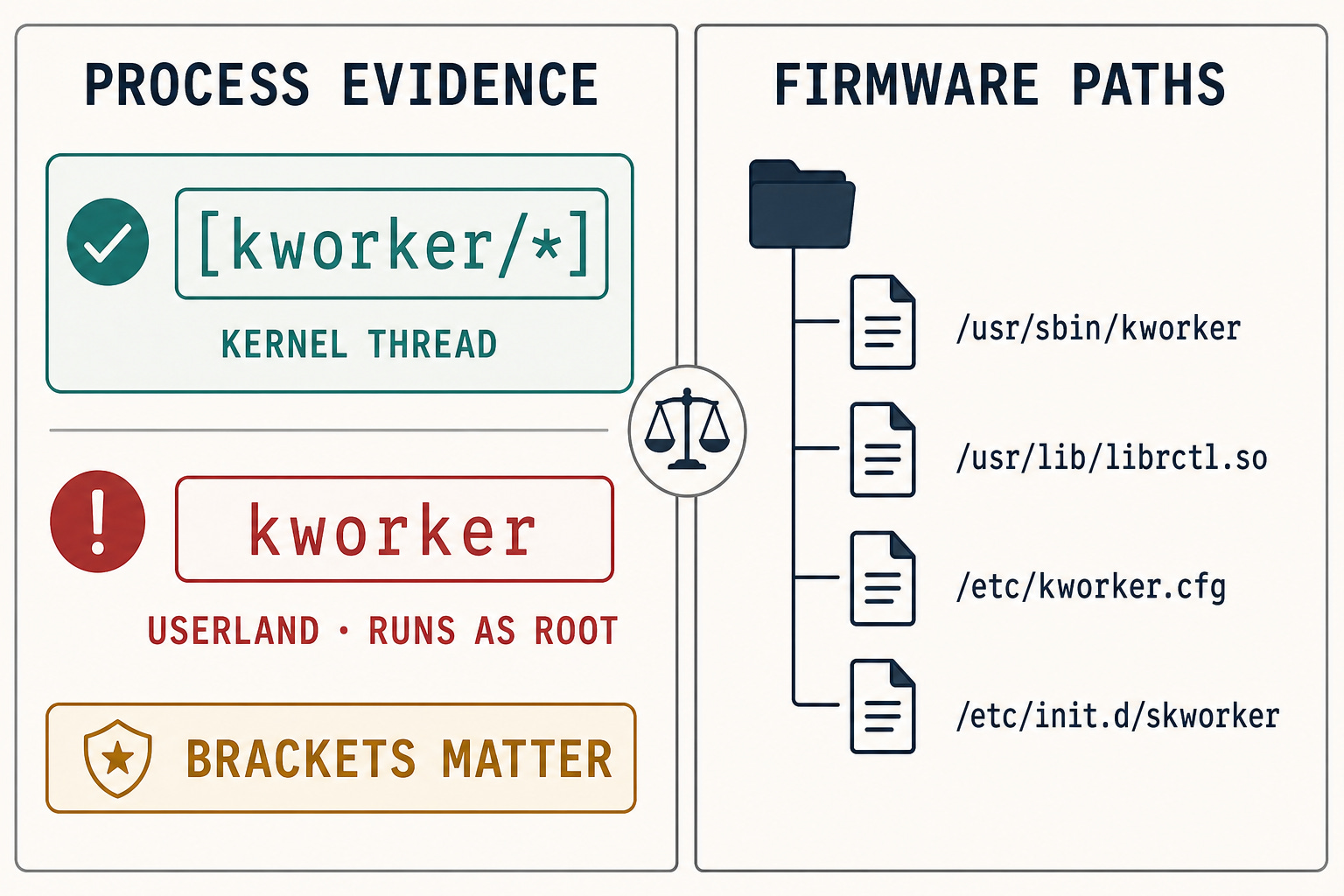
Brackets separate the expected kernel-thread form from the userland process researchers found. The file paths provide a second, independent detection pivot.
Outbound changed the perimeter math
The component does not listen for an inbound connection. It reaches outward over cleartext TCP, using port 7000 for command traffic and port 7001 for an interactive shell callback.
There is no authentication or transport encryption in the documented protocol. The CVE record says control is therefore not limited to the party that embedded or operated the original infrastructure. A party that controls the answering endpoint, influences DNS or routing, or obtains a fallback domain could take control of a device that calls out.
That makes NAT and an unopened management interface beside the point. A router behind several layers of firewall can still establish the outbound session itself.
The trust decision happens after the perimeter has already allowed the connection.
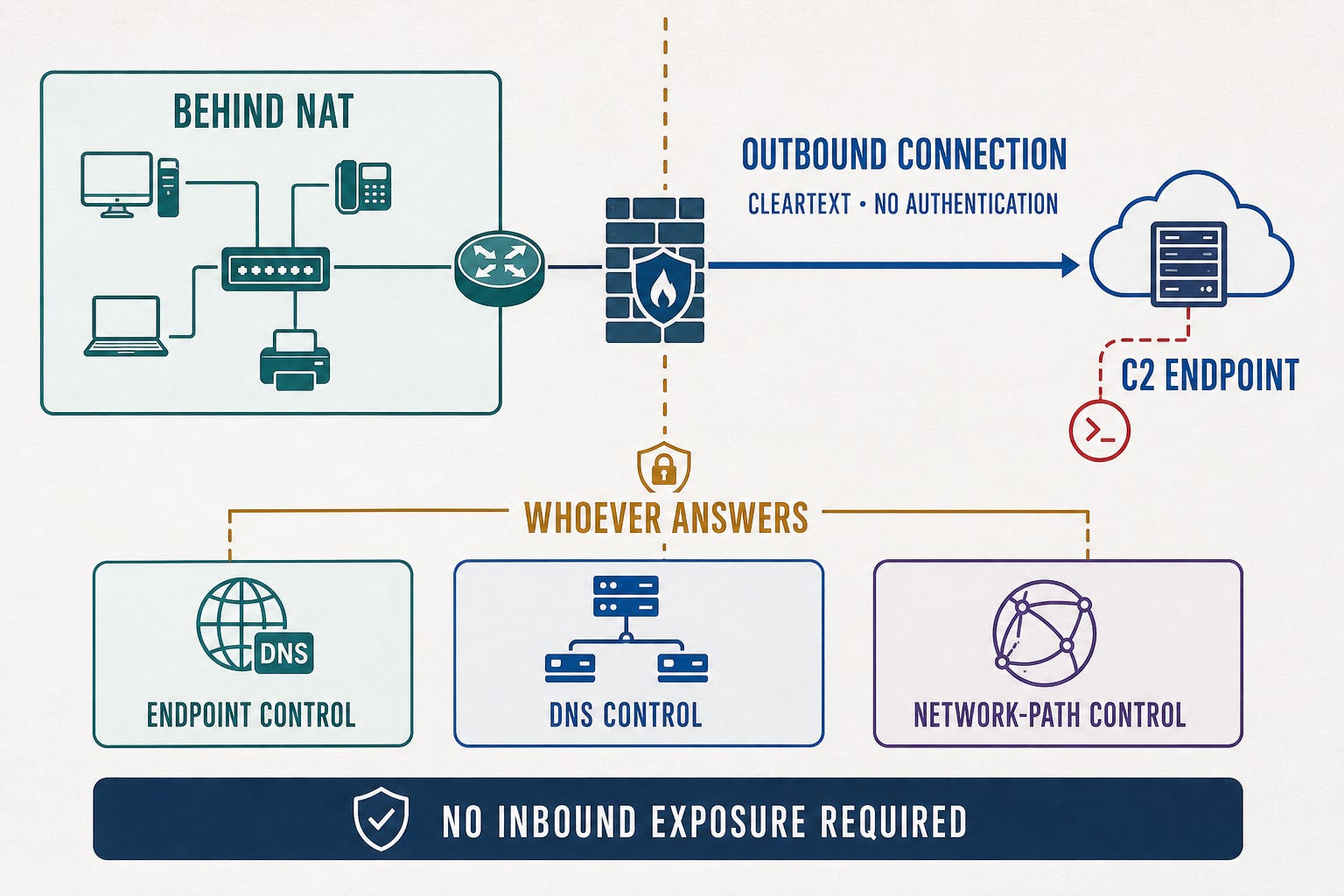
The three control conditions are architectural possibilities documented by the research and CVE—not evidence that all three have been used against deployed devices.
The logo is not the inventory key
VulnCheck examined 21 firmware images covering 20 named models from the vendor's download corpus. Every image in that bounded set contained the component and started it at boot. The appendix publishes a firmware hash and embedded kworker hash for each image.
The hardware is also sold through white-label channels. The researchers found the same underlying devices under more than one retail name and warned that the affected population could extend beyond the brands they could enumerate.
That uncertainty needs a hard boundary. Twenty models and 21 images were confirmed. The total number of deployed devices, additional rebadged models, operator identity, original intent, and any real-world commands received by customer routers were not established.
The useful inventory key is therefore the model and firmware, not the logo printed on the case. Procurement records, contractor-installed connectivity kits, branch-office appliances, temporary sites, and vehicle routers all belong in the search.
Detection comes before a trust decision
The research provides several independent ways to find the component without reproducing the control protocol:
Look for an unbracketed kworker process with a nonzero userland memory footprint. The tested device showed two.
Check for the published executable, library, configuration, and init-script paths shown in the evidence figure.
Alert on unexpected outbound TCP 7000 and 7001 from network-infrastructure segments.
Use the current domain, IP, firmware-hash, binary-hash, Snort, Suricata, and YARA material in the research appendix, rather than copying a stale fragment into a permanent rule.
Alerting matters in addition to blocking. A silent block may interrupt the channel while leaving the affected device undiscovered. Preserve enough process, firmware, resolver, and egress evidence to identify which model and image were present before changing the device.
None of this proves a deployed router received a malicious command. It establishes whether the embedded control path is present and whether it has attempted to communicate.
No patch means no clean trust reset
The disclosure lists no fixed firmware. VulnCheck says the init service can be disabled where operators have shell access, but it does not treat that as a complete remediation. The same vendor-supplied image contained the root-running component in the first place.
The defensible response sequence is:
Identify. Find affected model and firmware combinations across owned and contractor-supplied equipment.
Detect. Check the process, files, and outbound behavior; preserve evidence and alert on the published indicators.
Contain. Segment the device, block its control paths, and treat its local network as untrusted while replacement is arranged.
Replace. Move to a device and firmware chain that can be independently treated as known-good.
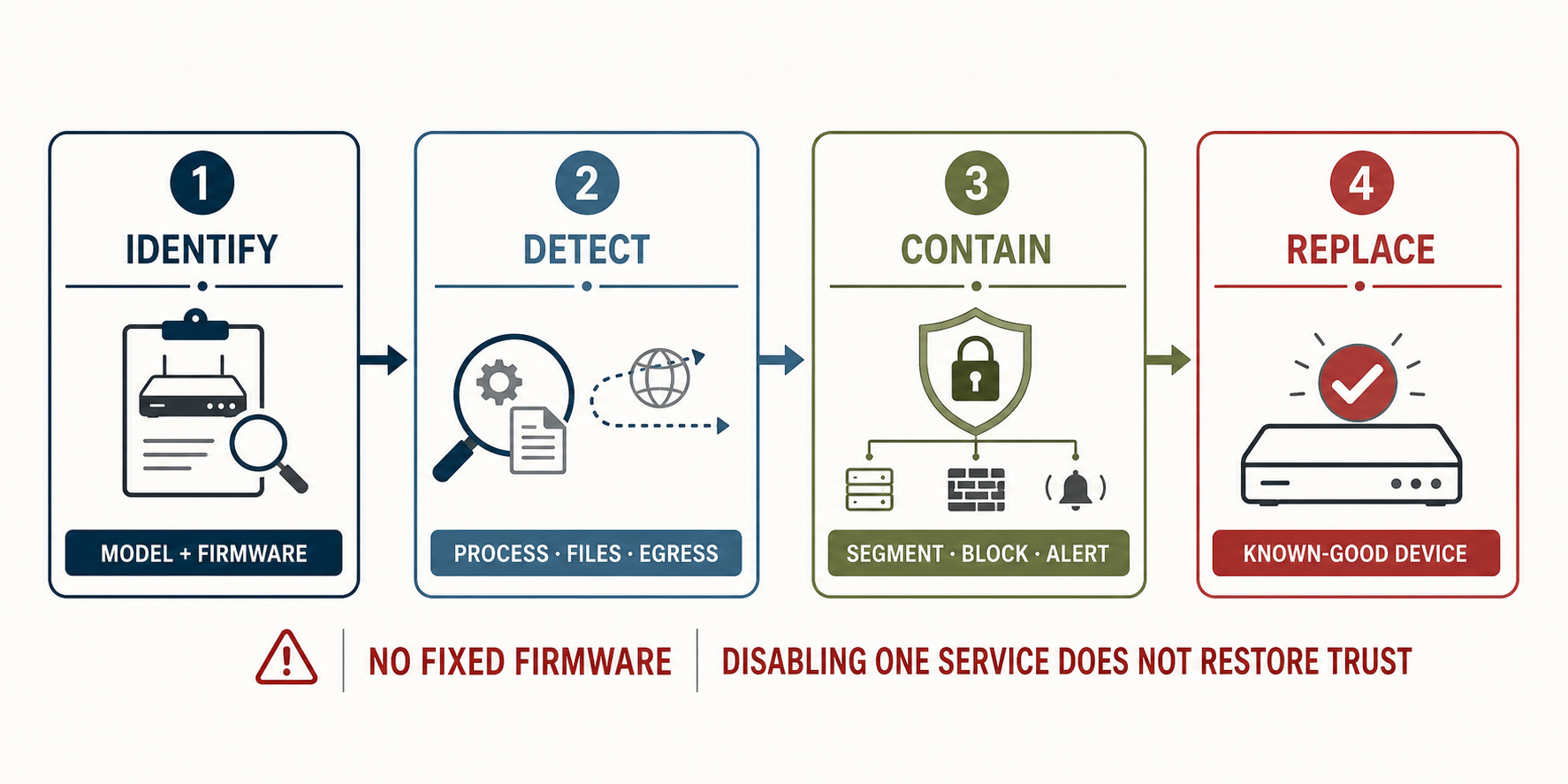
Disabling one service may stop the observed phone-home process. It does not retroactively establish trust in the rest of the image.
For devices that carried real traffic, review the exposure around them: administrative credentials used through the router, adjacent systems reachable from its LAN, resolver history, and configuration changes. Rotate or rebuild based on evidence, not on the assumption that blocking one destination erased prior access.
The uncomfortable part of this case is not the sophistication of the protocol. It is the opposite. A simple root control channel survived because it looked like ordinary firmware behavior and originated from a device expected to enforce the boundary.
When the network edge ships with its own trust bypass, containment starts with the hardware inventory—not the firewall rule.