


PolinRider shows developer trust under pressure, Bad Epoll puts patch cadence back on the board, and JadePuffer shows why ransomware automation now belongs in the same conversation.
The useful signal in today's threat picture is not that three bad things happened at once.
It is that they press on the same enterprise weakness from different angles: developer trust, patch latency, identity scope, and speed of impact.
defend.network's July 5 briefing pulls those lanes together: North Korean actors tied to the Contagious Interview cluster are linked to 108 malicious packages and extensions; CVE-2026-46242, described as Bad Epoll, gives local privilege-escalation urgency to Linux and Android patching; and JadePuffer is reported as a ransomware operation conducted through an autonomous LLM agent.
Taken separately, each item is familiar. Taken together, they describe a stack where access, privilege, and automation can compound faster than many response workflows are designed to move.
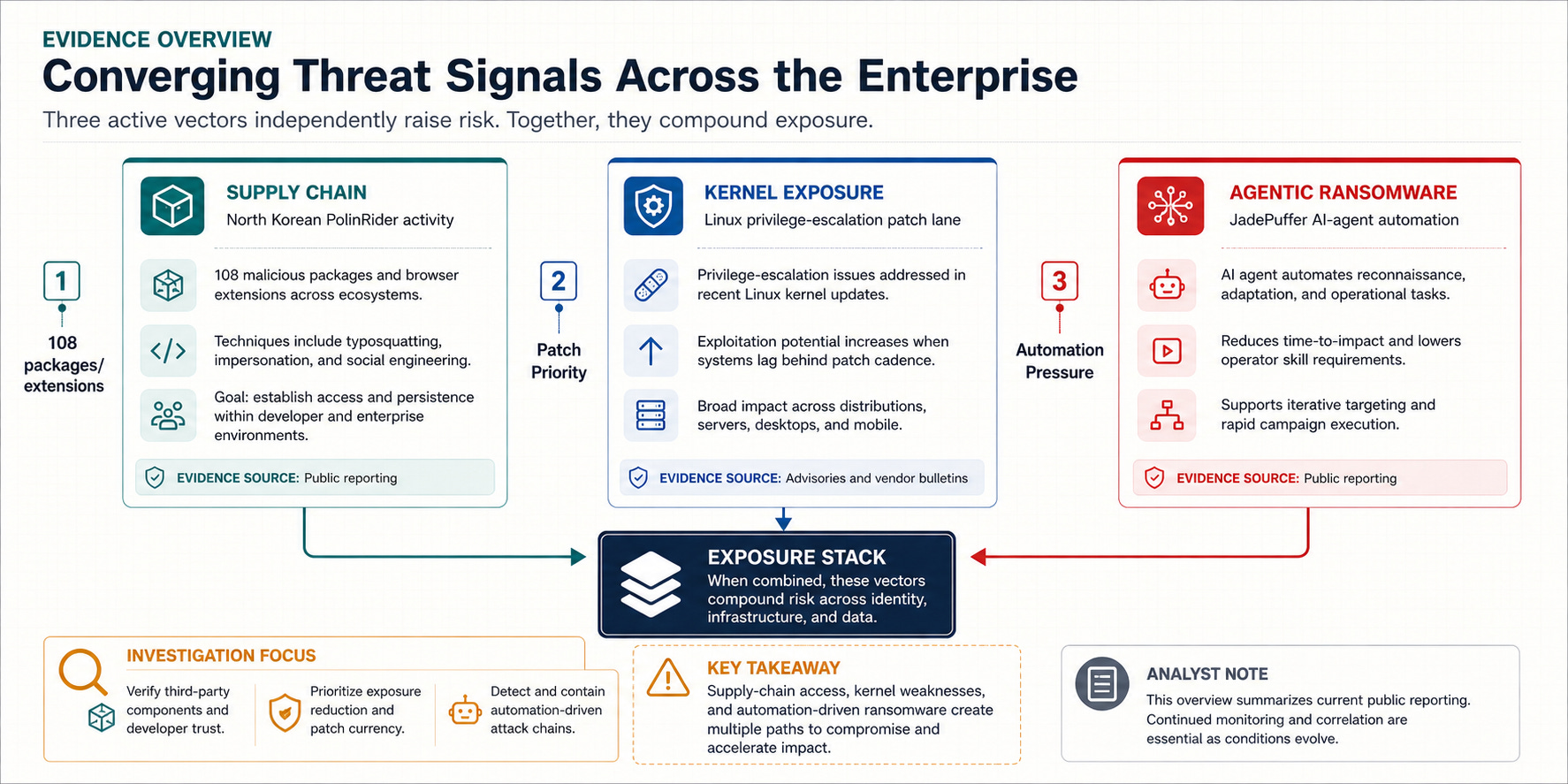
Developer Trust Is Now Infrastructure
The PolinRider reporting matters because it keeps moving through the places developers already trust.
The Hacker News, citing Socket research, reports that North Korean threat actors linked to Contagious Interview published 108 unique packages and browser extensions across npm, Packagist, Go, and Google Chrome. The same reporting says the 162 malicious release artifacts correspond to 19 npm libraries, 10 Composer packages, 61 Go modules, and one Chrome extension.
That distribution pattern is the point.
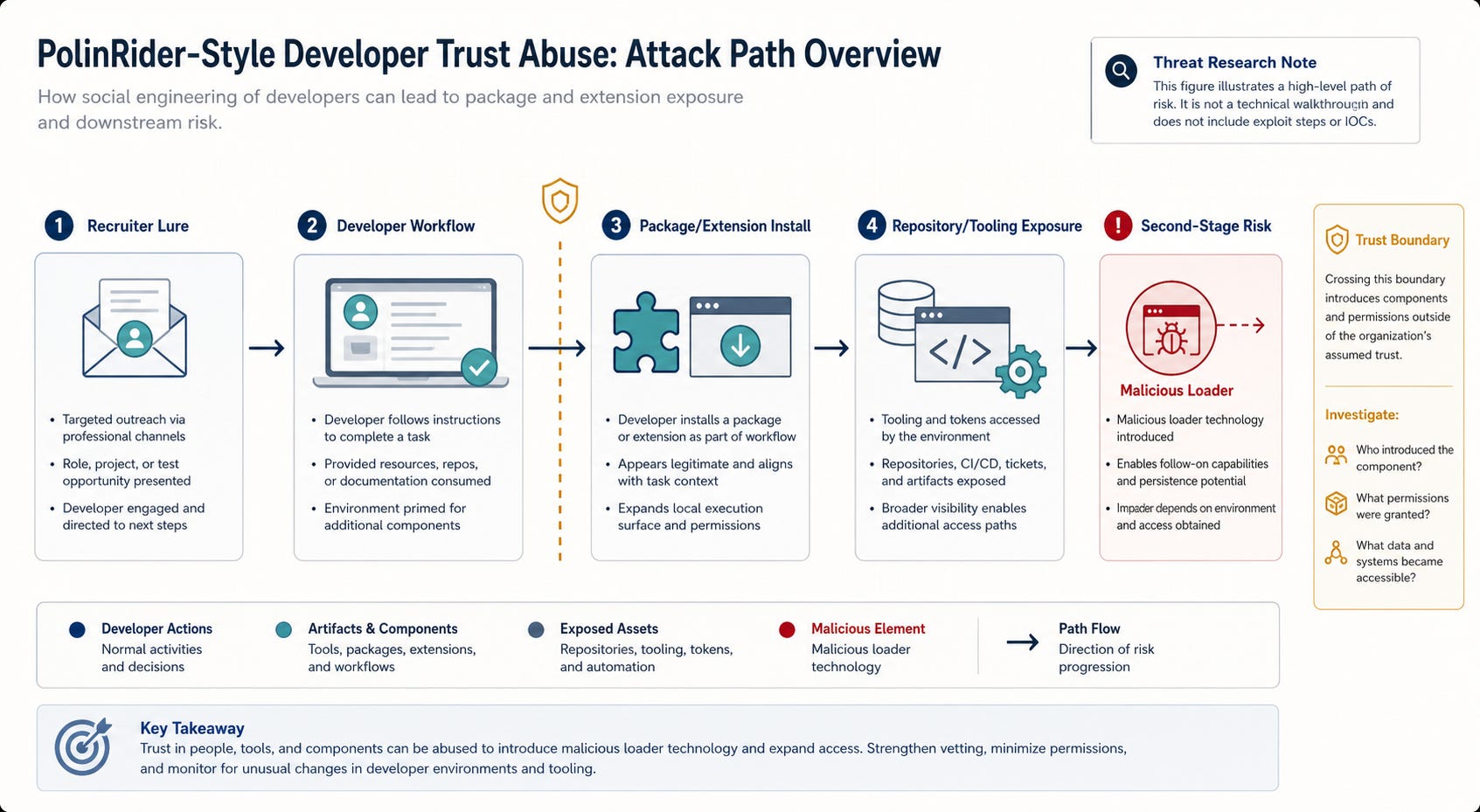
This is not only a malware story. It is a trust-routing story. Developer workflows pull code, packages, extensions, task files, and repository state into environments that often hold signing keys, cloud credentials, CI/CD access, source code, browser sessions, and collaboration tokens.
The reporting also describes the broader campaign pattern: job-recruitment lures, front-company personas, malicious packages or extensions, and payload paths that can reach developer machines. Socket's analysis, as summarized by The Hacker News, says the campaign remains active and new malicious packages are likely to continue appearing.
If a developer workstation becomes the first beachhead, the blast radius is not the laptop. It is the trust graph around the laptop.
Patch Cadence Is Still Part Of Incident Readiness
Bad Epoll sits in a different lane, but it belongs in the same operational picture.
The defend.network briefing describes CVE-2026-46242 as a Linux kernel privilege-escalation vulnerability affecting Linux desktops, servers, and Android devices, with a patch available. It also notes that no exploitation was reported in its NVD/CISA KEV cross-check at the time of the briefing.
That uncertainty matters. The right move is not panic. The right move is prioritization.
Privilege escalation rarely creates the whole incident by itself. It becomes dangerous when an attacker already has code execution, a foothold, an exposed service account, a compromised developer workflow, or a ransomware operator trying to turn limited access into durable control.
For security teams, that makes kernel patching a response-readiness issue, not only an infrastructure maintenance issue. Exposed systems, developer endpoints, build hosts, container nodes, and Android fleets deserve different urgency than low-risk lab machines.
The question is practical: where would local privilege escalation most increase attacker leverage if another lane had already delivered access?
JadePuffer Compresses The Timeline
The JadePuffer reporting is the automation lane.
BleepingComputer reports that researchers at Sysdig identified what they believe is the first documented ransomware operation conducted entirely by a large language model agent. According to the report, the agent handled reconnaissance, credential collection, lateral movement, persistence, privilege escalation, and encryption activity.
The most important detail is not novelty. It is tempo.
BleepingComputer says the operation adapted to failures in real time, including one sequence where it moved from a failed login to a working adjustment in 31 seconds. That is a defender problem because many response processes still assume human pacing: investigate, validate, escalate, contain.
An agentic ransomware chain does not have to be elegant to be dangerous. It only has to be fast enough to retry, enumerate, adjust, and move before manual triage catches up.
The reporting also describes mistakes and rough edges in the operation, including signs that some generated material may have reflected model output rather than mature operator tradecraft. That should not be dismissed. Early automation can be clumsy and still reduce the skill or time required to create impact.
The first versions do not need to be perfect. They need to be repeatable.
The Exposure Is Bigger Than The Payload
Supply-chain abuse and AI-agent ransomware meet in the middle at identity.
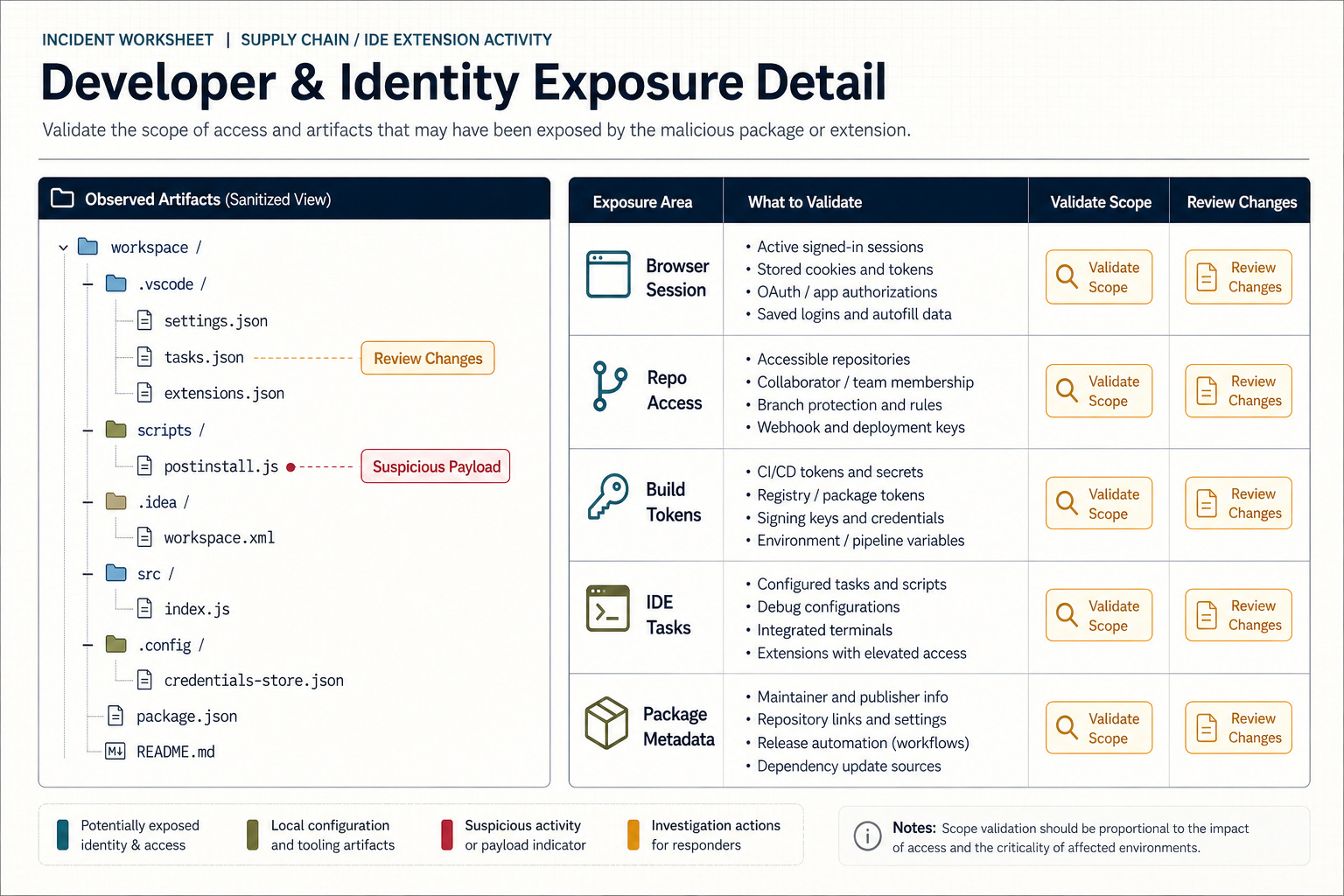
If a malicious package or extension lands in a developer environment, the defensive question is not just whether a known payload ran. It is what access context was available: signed-in browser sessions, source repositories, package publishing rights, CI/CD variables, cloud roles, SSH material, collaboration tokens, and local secrets.
That is why incident scope has to move beyond endpoint cleanup.
Security teams need to review package and extension provenance, repository activity logs, recent releases, branch and tag changes, workflow definitions, IDE task configuration, and unusual pushes or force-push patterns. They also need to decide when to rotate tokens, revoke sessions, re-issue least-privilege access, and preserve build and artifact logs.
The Control Move Is Correlation
These stories share a simple control theme: correlate faster across teams that usually work separately.
Developer platform teams see package changes and repository behavior. Infrastructure teams see kernel exposure and patch windows. Identity teams see tokens, sessions, and privileges. Detection teams see rapid retries, unusual process chains, and automation-shaped sequencing.
The incident only becomes clear when those views connect.
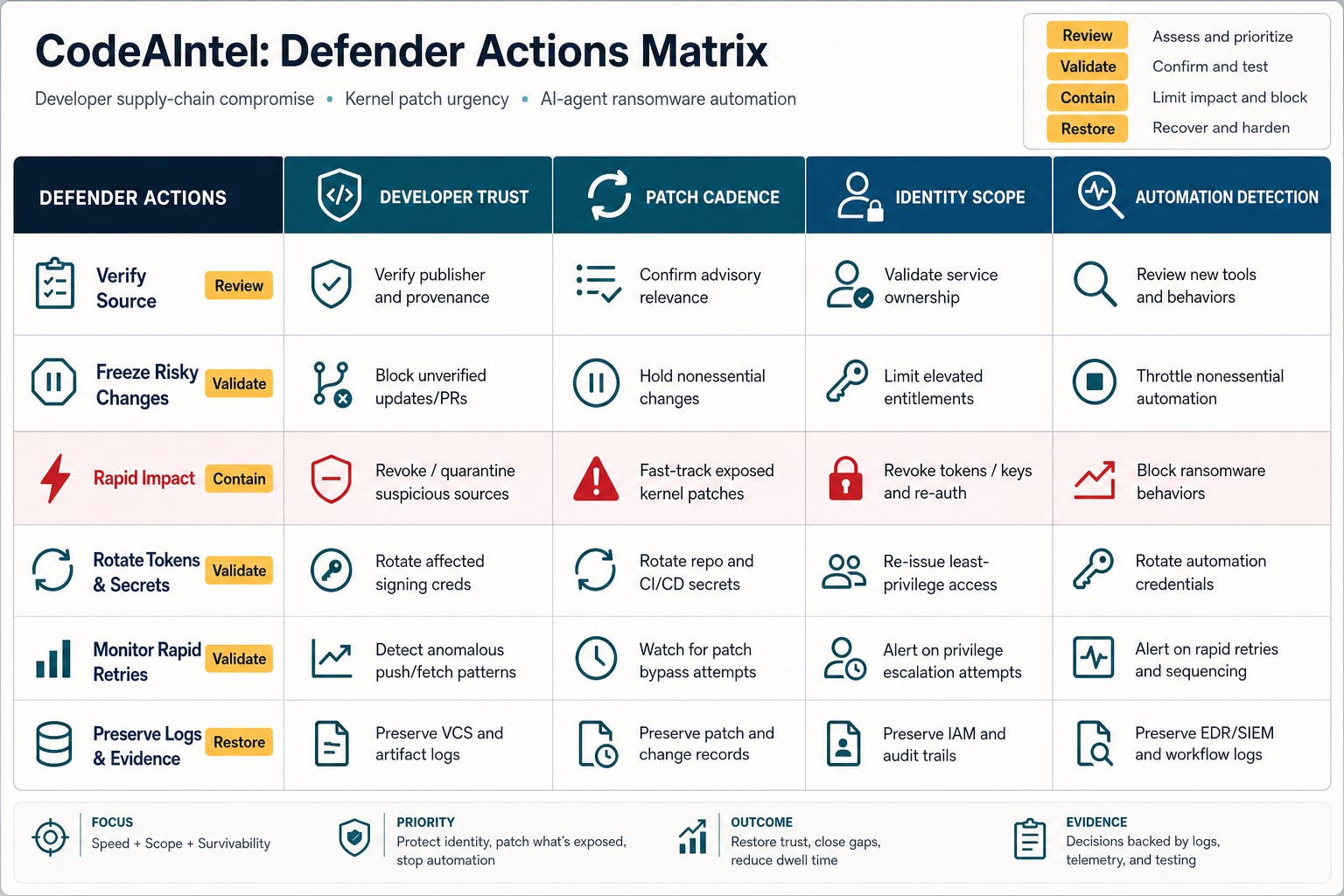
For the PolinRider lane, the useful controls are provenance review, package and extension allowlisting where practical, developer workstation monitoring, and repository activity validation. For Bad Epoll, it is exposure-based patch prioritization and proof that high-leverage assets are covered. For JadePuffer-style automation, it is detection for rapid retries, short-interval enumeration, unusual credential use, and behavior that chains too quickly to look like normal administration.
The control target is no longer a single alert. It is the sequence.
What To Do Before This Gets Noisy
Do the boring checks while the story is still readable.
Freeze or review high-risk package and extension changes in sensitive developer environments. Validate recent repository activity and release metadata. Prioritize Bad Epoll patching where local privilege escalation would materially worsen an existing foothold. Revoke or rotate exposed credentials when a developer system, build host, or package workflow is in scope.
Then tune for speed.
Agentic behavior may look less like one exotic malware signature and more like compressed operator activity: failed attempts followed by rapid correction, broad enumeration, repeated credential testing, quick lateral probes, and fast movement from access to impact.
The organizations that handle this best will not be the ones with the loudest AI policy. They will be the ones that can connect developer trust, patch exposure, identity blast radius, and automation-shaped telemetry before the ransomware stage becomes the first obvious signal.