


South Korea’s Foreign Ministry says an unknown actor exploited a then-undisclosed software flaw and security-configuration weaknesses in the National Diplomatic Academy’s online education system.
The ministry’s investigation found that the attacker gained control of the server around April or May 2025, then retained access until the system was shut down in February 2026. The platform stored training videos—but also names, user IDs, and other enrollment data for ministry personnel.
The incident is concrete. Its final scope is not.
Officials say a significant leak appears to have occurred, but they have not established the exact records taken or the number of people affected. Roughly 10,000 records were stored in the system. Stored records are not the same as confirmed stolen records.
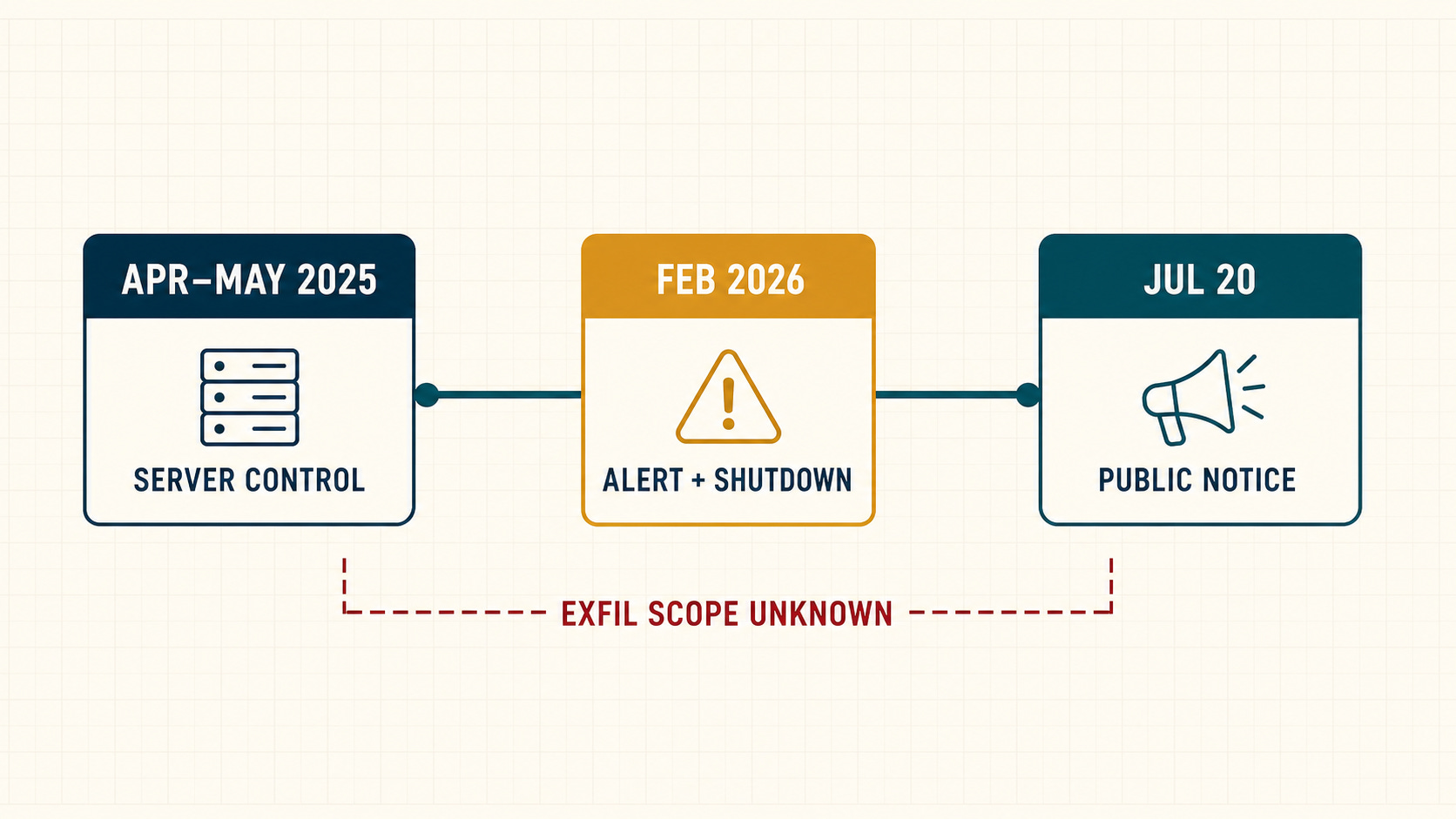
The ministry says server access persisted from around April or May 2025 until February 2026. Public disclosure followed in July; the timing and volume of exfiltration remain unresolved.
A Long Access Window Is Not a Victim Count
The Foreign Ministry’s July 20 incident release says a relevant government agency alerted it to anomalous access in early February. The system was immediately blocked, and the ministry began investigating with other agencies.
Investigators concluded that the actor had used a zero-day in the server software plus weaknesses in the system’s security configuration. After gaining control, the attacker used normal software permissions during subsequent access. The ministry said that combination made the activity difficult to detect with ordinary methods, particularly before a security update existed.
That establishes a long access period. It does not prove continuous hands-on activity, continuous data theft, or compromise of every account stored in the platform.
This distinction is essential because three quantities can diverge sharply:
records stored in the system;
records the attacker could access;
records actually retrieved.
The public record has not reconciled them.
The Portal Held More Than Courseware
Training platforms are often managed as secondary business systems. Their data can still form a useful identity map.
A separate ministry privacy notice says the potentially exposed fields include user IDs, names, email addresses, and encrypted passwords for current and former headquarters staff, overseas-mission personnel, and others enrolled in the platform. The notice says unique identification numbers, sensitive information, mobile numbers, home addresses, and photographs were not included.
That narrower dataset still has operational value. A name, government email address, account ID, and known connection to a diplomatic training platform can support convincing password-reset lures, enrollment notices, video-conference invitations, or messages impersonating internal support.
The ministry’s own warning focused on that risk: affected users were told to be especially cautious with messages from unclear or unknown sources.
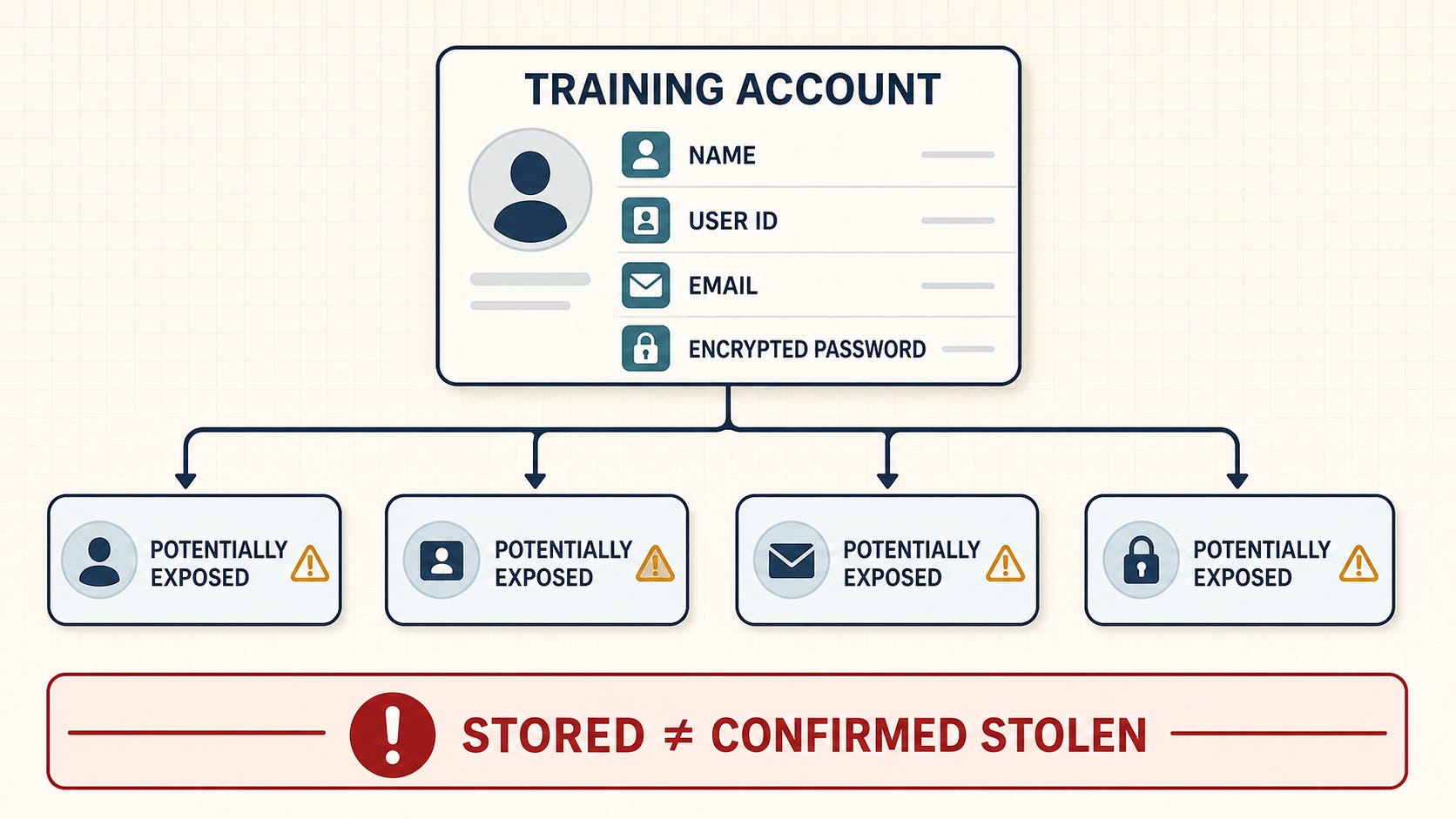
Official notices identify names, user IDs, email addresses, and encrypted passwords as potentially exposed. The exact subset taken remains under investigation.
“Encrypted Password” Is the Start of a Question
Public reporting describes the stored passwords as encrypted. That word alone does not establish how safely they were protected.
Responders need the actual storage design: hashing or reversible encryption, algorithm, work factor, salt behavior, password age, reset status, and whether the same identity was accepted by other ministry systems. Without those details, it is not possible to estimate offline-cracking risk or cross-system exposure.
The safe response is broader than changing one portal password. Accounts should be checked for reuse, relevant sessions should be invalidated, and linked identity systems should be reviewed for suspicious authentication after the earliest confirmed server compromise.
No public source reviewed for this article confirms that the attacker cracked passwords, used stolen accounts, or abused the data after the breach. As of the ministry’s July 21 briefing, officials said no misuse had been confirmed.
The Missing Facts Define the Investigation
Several high-value facts remain undisclosed:
the affected software and vulnerability identifier;
the specific security misconfigurations involved;
the attacker’s initial requests and post-compromise actions;
the precise files or database tables accessed;
the volume and timing of exfiltration;
the complete affected-account population;
the actor’s identity.
In that briefing, the ministry said it did not have enough technical evidence to attribute the attack. Foreign involvement had not been ruled out, but no actor was confirmed.
That makes logs and configuration history the core evidence. Investigators need to join web and application logs, database queries, file access, administrative actions, authentication records, and outbound network activity across the entire access window. If retention does not reach back to spring 2025, the final scope may remain bounded by what the system stored rather than what evidence proves was taken.
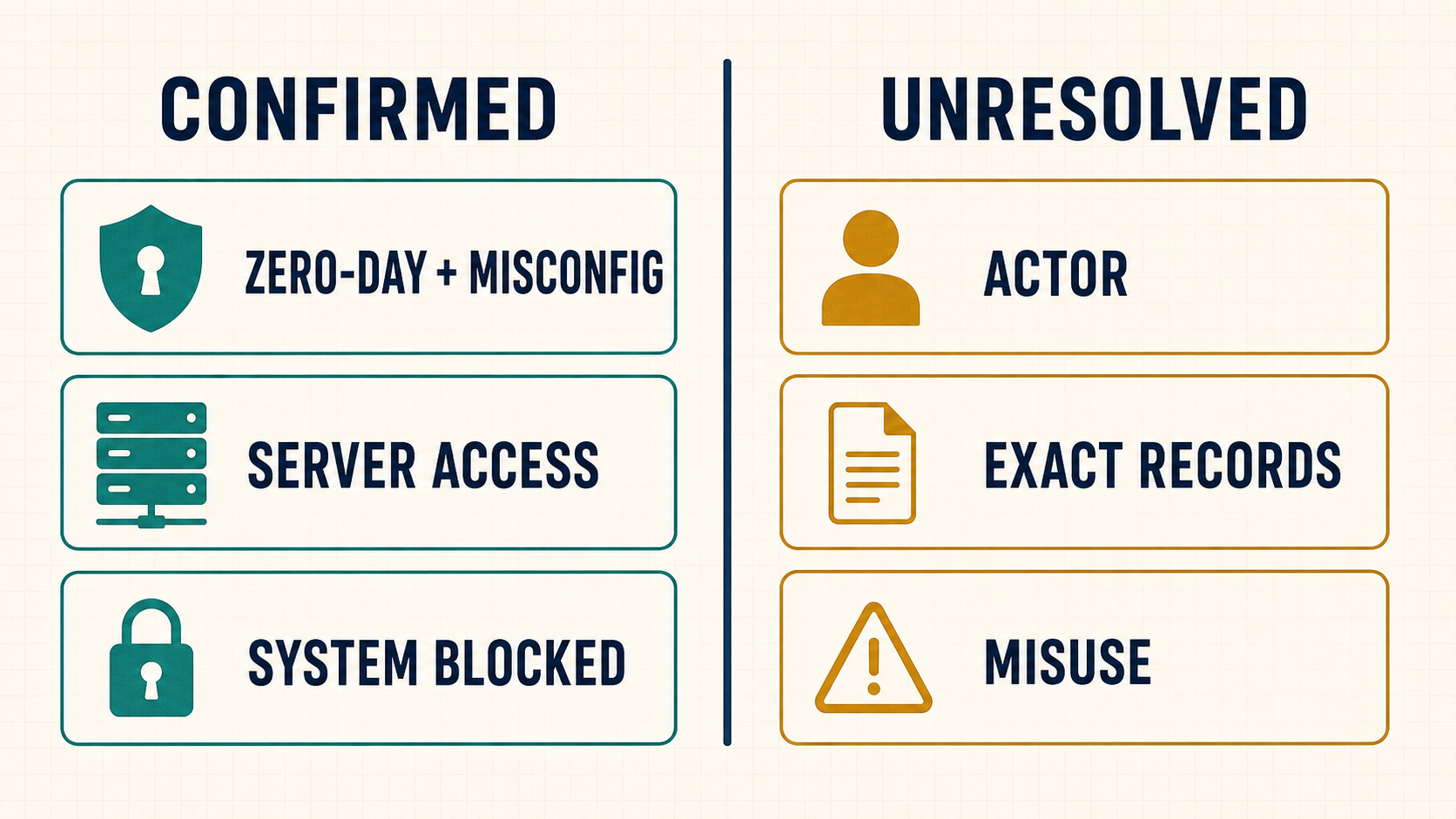
The public record confirms the access mechanism at a high level and the containment date. Attribution, exact exfiltration, and downstream misuse remain unresolved.
Contain Both the Account and the System
The ministry blocked the platform in February and said it was strengthening security. A complete response still has two linked tracks.
The system track preserves forensic evidence, identifies the zero-day and configuration weakness, rebuilds or validates the server, closes unnecessary exposure, rotates service credentials, and tests logging against the path the attacker actually used.
The identity track resets affected credentials, revokes active sessions, checks password reuse, reviews linked applications, monitors unusual authentication, and gives users phishing guidance tied to the specific data exposed.
Those tracks must meet in a person-by-person scope. An account created years ago for training may belong to a former employee, an overseas mission, a contractor, or a current official whose role changed. Lifecycle data determines which identity stores, mailboxes, and applications now matter.
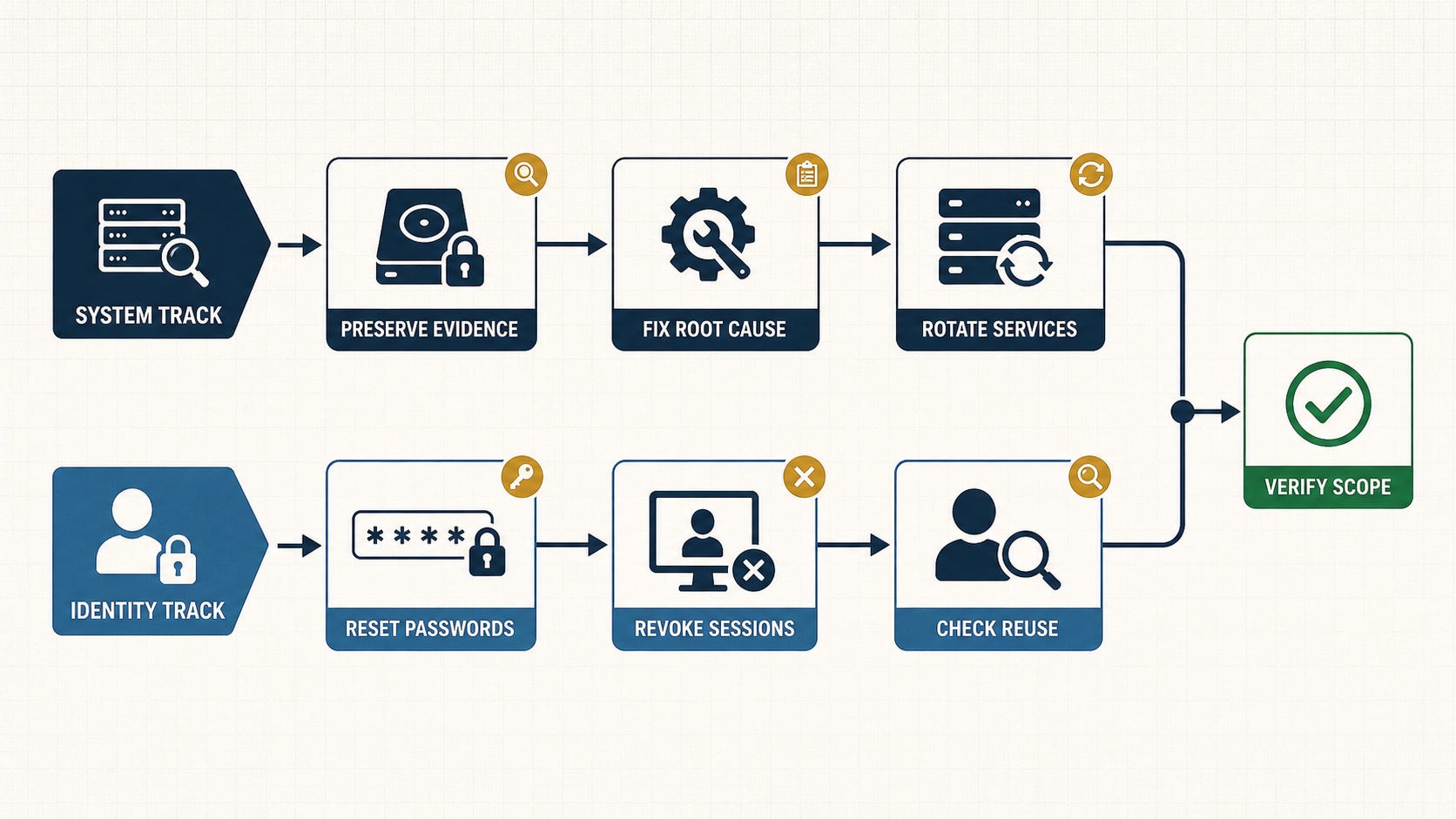
System containment addresses the compromised server. Identity containment follows the accounts, sessions, and linked services that may outlive the platform.
Training Platforms Belong Inside the Identity Boundary
The most important design mistake would be to classify this as “just an education system.”
The platform carried identity data, authenticated government personnel, and sat close enough to normal operations to remain useful for months after initial compromise. Its business label did not reduce its security value.
Systems that enroll employees, send invitations, store password material, or connect people to internal workflows are part of the identity boundary—even when their primary purpose is training. They need vulnerability management, configuration control, strong authentication, evidence retention, and account lifecycle discipline consistent with that role.
Whatever the actor’s objective, the incident shows that defenders should inventory the portal as part of the identity boundary.