


A software release can look stable while the thing users download has changed underneath it.
That is the uncomfortable lesson in the OVHcloud CLI incident disclosed on October 19. The public version tags did not need to move. According to the original GitHub issue, attached binaries for versions 0.13.0 through 0.15.0 were replaced weeks after those releases first appeared. A downstream build caught the change because it expected a specific SHA-256 digest.
The checksum failure was not noise. It was evidence that the artifact no longer matched the one previously trusted.
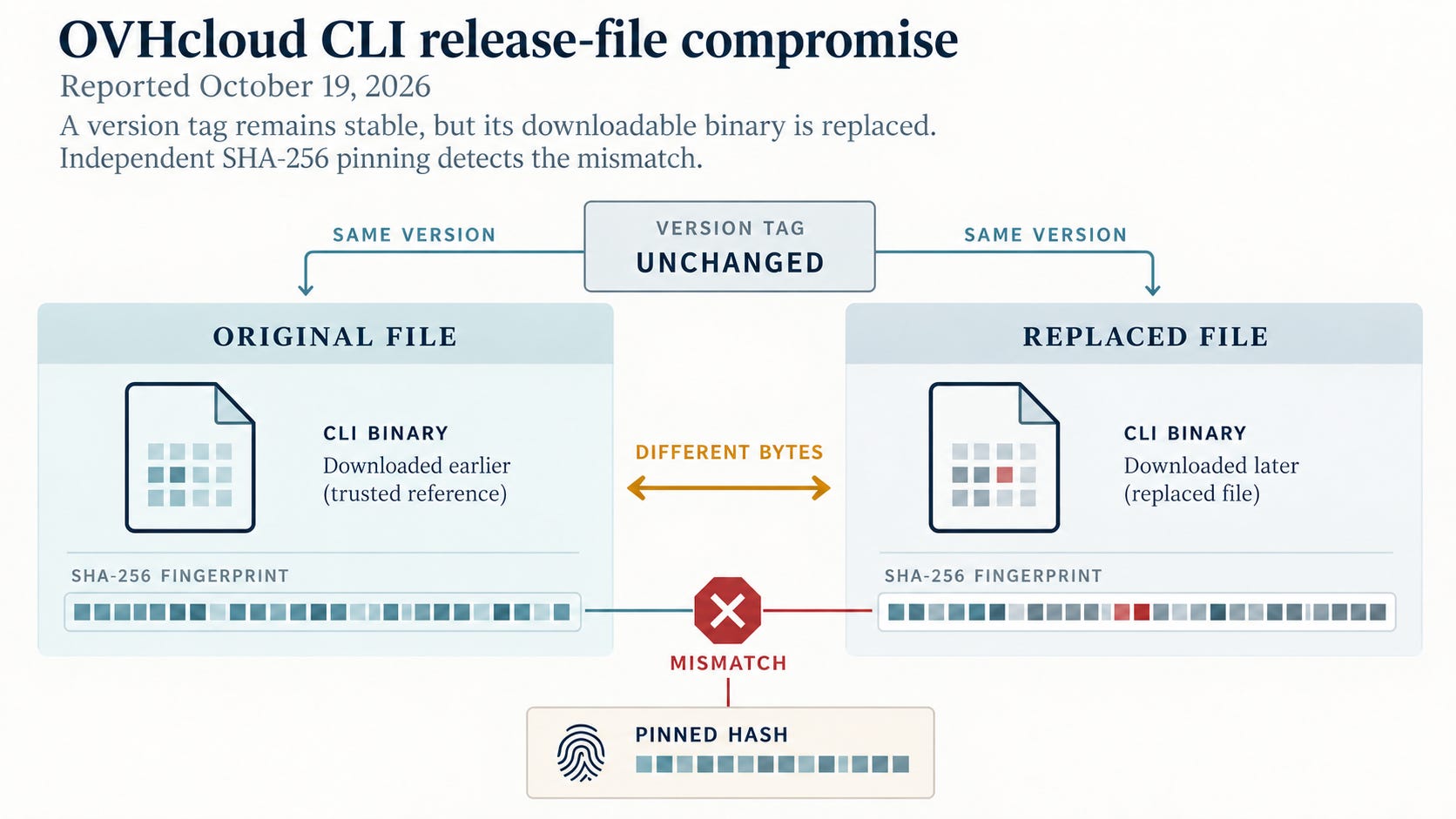
The version label, source tag, and downloadable asset are related trust objects—not the same one.
The hash failed before the story existed
The issue reporter said release assets changed between roughly 12:47 and 13:12 UTC. A continuous-integration job pinned to the earlier Linux ARM64 hash then failed because GitHub served a different file under the same release version.
The reporter inspected build metadata in the replacement binary and found a later revision, a “dirty” build marker, and a version string inconsistent with the normal release process. That led the reporter to infer the files had not come from the expected pipeline. It is an important technical observation, but it remains the reporter’s provenance analysis—not a completed OVHcloud forensic report.
An OVHcloud maintainer later confirmed in the issue that the binaries involved had been deleted at 16:21 GMT+2. The reporter subsequently observed the original assets restored for the affected versions.
A signed tag is not a signed download
This incident exposes a common collapse in software trust: teams see a familiar repository, a familiar version, and a verified tag, then treat the downloaded executable as if all three assurances were interchangeable.
They are not. GitHub’s signature-verification documentation explains how a verified signature can establish confidence in the origin of a commit or tag. That does not, by itself, prove that a separately uploaded binary was built from that commit or remained unchanged.
The issue reporter’s evidence was precisely about that gap: the tag still pointed to its existing commit while the attached file differed. A green badge on source history cannot authenticate a mutable asset that sits beside it.
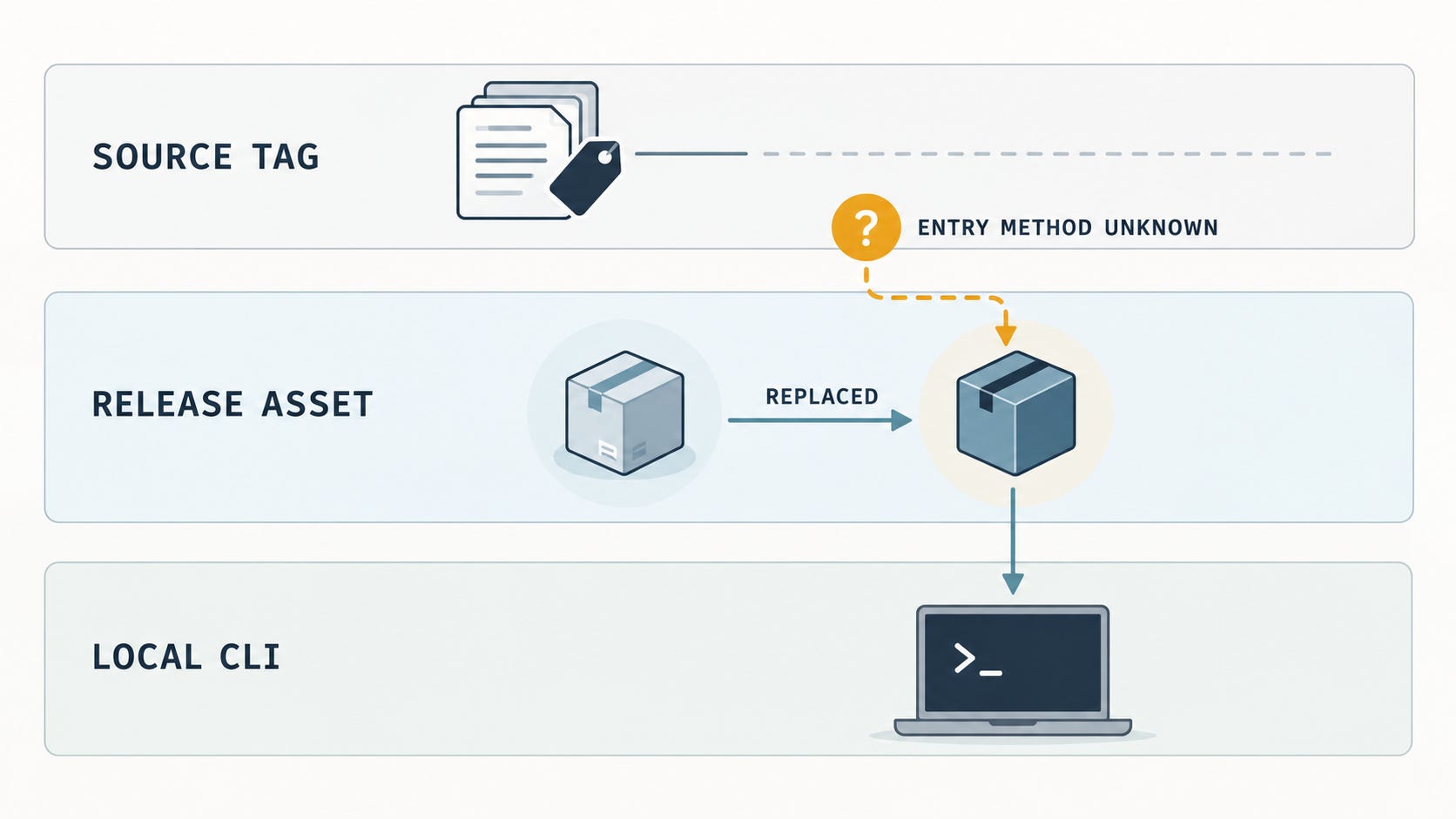
A trusted label can carry an untrusted file when provenance stops before the release asset.
The credential context raises the stakes
The OVHcloud CLI is not merely an informational tool. Its authentication documentation describes credentials supplied through configuration files, environment variables, or an interactive login flow. Depending on configuration, that context can include application secrets, consumer keys, or OAuth client credentials.
That makes execution of an untrusted replacement binary consequential. It does not establish that credentials were collected, transmitted, or successfully used. The public primary record currently supports a release-asset compromise and an urgent recovery; it does not yet provide a complete technical account of payload behavior or confirmed exfiltration.
Recovery changed the control, not just the file
OVHcloud’s response moved beyond re-uploading another binary. The project published version 0.16.0 as an immutable release and used a signed tag. That is a stronger recovery state, with one important wording distinction: the public page establishes a signed tag; it should not be described as proof that every attached binary was individually signed.
GitHub says immutable releases lock the associated tag and assets against later modification or deletion, while still allowing limited changes to release notes and presentation. GitHub also generates a release attestation that binds the tag, commit, and assets. Its separate implementation guidance notes that enabling immutability applies to future releases, not retroactively to old ones.
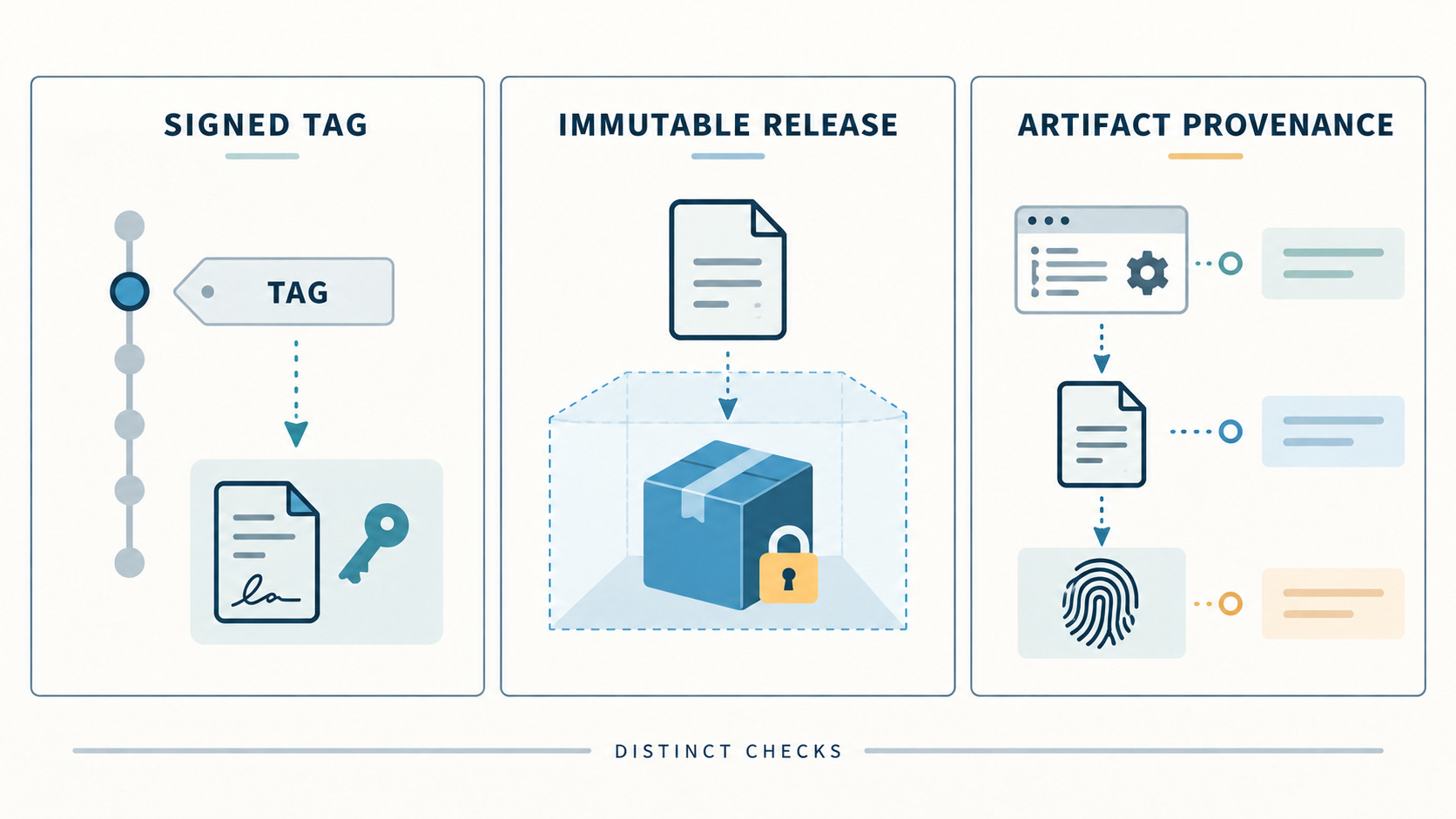
A signed tag, an immutable release, and verified artifact provenance answer different security questions.
Immutability closes the exact post-publication mutation path highlighted here. It does not prove that the first artifact published was safe.
Trust has to reach the artifact
For defenders, the immediate question is not whether a version number appears on an allowlist. It is whether the exact file that ran can be tied to an expected digest and a credible build path.
Inventory first. Identify systems that downloaded or executed the affected releases during the reported window. Preserve the file and hash where policy permits, rather than assuming a redownload represents what ran earlier.
Scope exposure from the process outward. Determine which configuration files, environment variables, tokens, and cloud permissions were available to that execution context. Credential rotation should follow actual accessibility and risk, while recognizing that a fuller incident report may change the assessment.
Verify the asset, not only the tag. GitHub provides commands to verify a release and its assets. Pinned cryptographic digests remain valuable because they turn silent drift into a hard failure, as this incident demonstrated.
Require provenance that survives distribution. GitHub’s artifact-attestation model can link an artifact to a repository, workflow, environment, and commit. An attestation does not guarantee that software is benign, but it makes the build claim testable instead of implied.
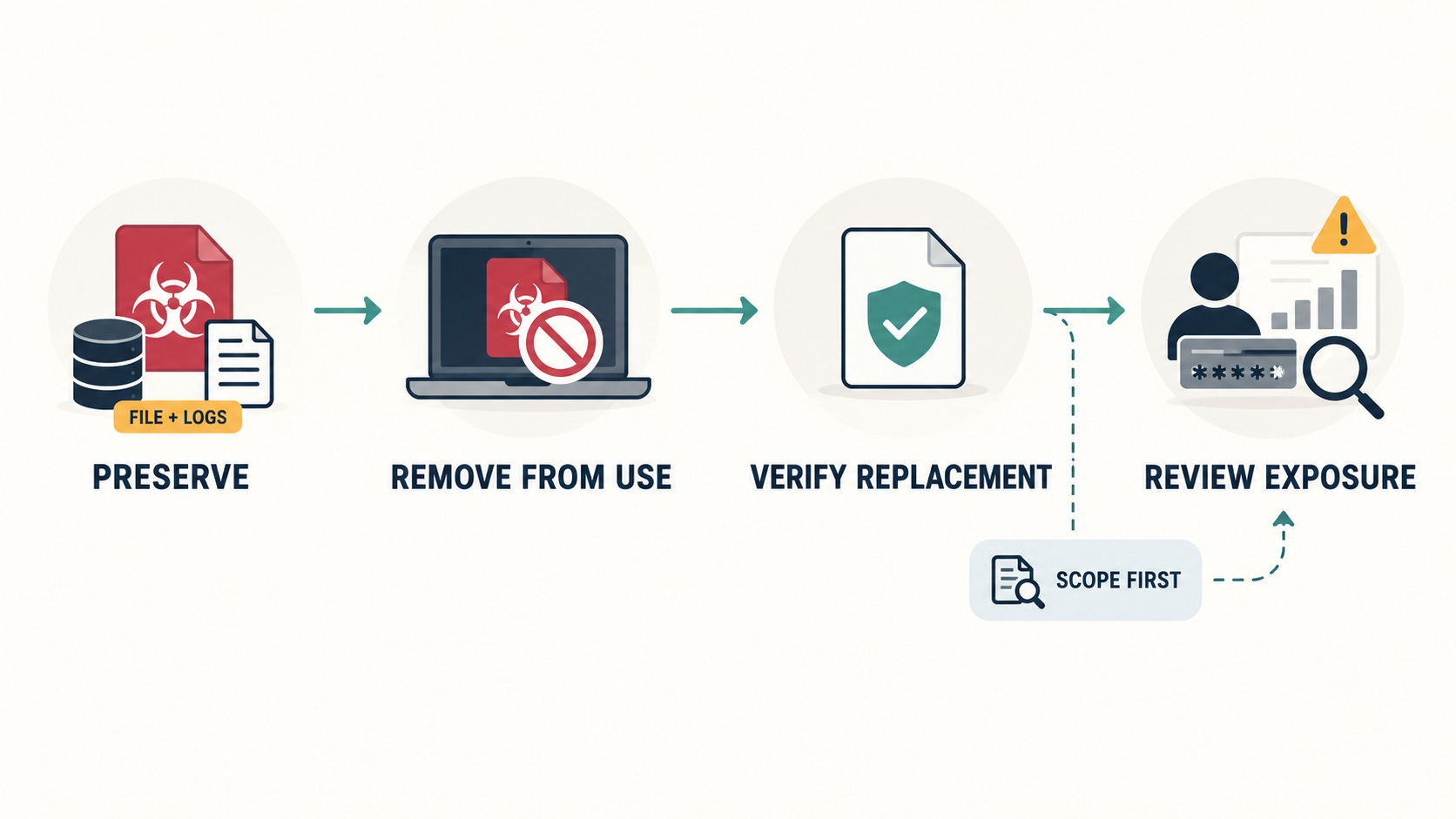
The useful response connects execution history, credential reach, artifact integrity, and build provenance.
The sharpest signal in this case came from a control many teams treat as operational plumbing: a pinned hash. The version stayed. The binary changed. Trust failed at the distance between those two facts.