


Lidl says its online shop was not breached. Its customers still lost a dataset built to make fraudulent messages believable.
The retailer notified online-shop customers in Germany, Belgium, and the Netherlands after unknown actors accessed a separately stored customer file at an external IT service provider. The exposed fields included salutation, first and last name, phone number, email address, date of birth, and customer number.
Passwords, billing and delivery addresses, bank details, and other payment information were not affected, according to Lidl's notices. Customer accounts were not compromised.
The system boundary held. The data boundary did not. That distinction is the operational story: organizations can protect the application a customer sees while identity material leaves through infrastructure the customer never knew existed.
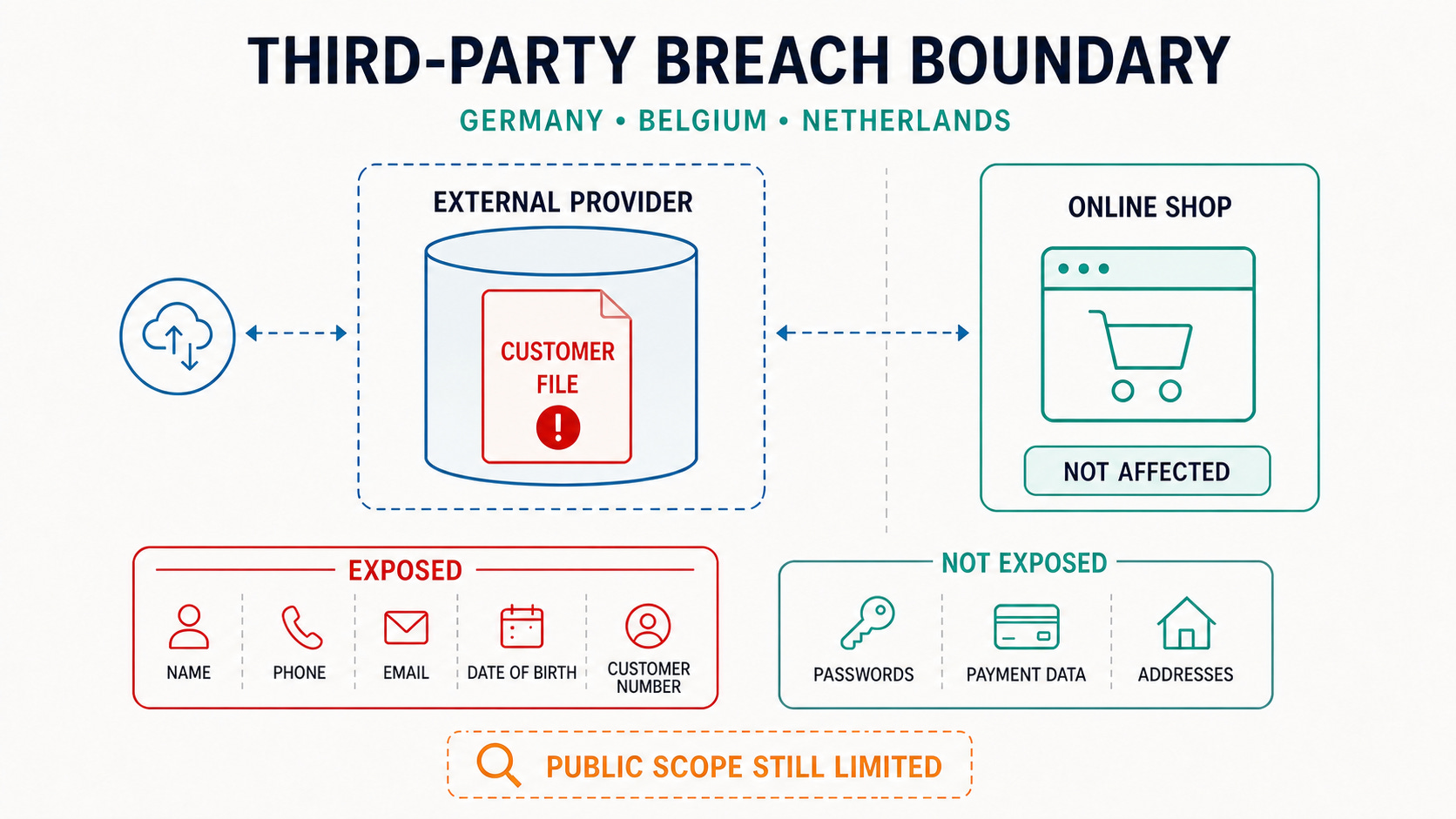
The public notices separate an unaffected online shop from a stolen customer file at an external provider. The exposed fields are confirmed; the incident's total scope and intrusion path are not public.
The Data Left Through a Different Door
Lidl's Belgian notice and Dutch notice describe brief unauthorized access to a separately stored file. Both say the online-shop system itself was not affected.
That is useful scoping evidence, but it is not the same as a complete incident map. The notices do not name the provider, state how many customers were affected, or describe the initial access method, quantify the access duration, or explain the exfiltration path. They say the provider filed a police report and brought in forensic specialists. Lidl also reported the incident to the relevant data-protection authority.
The known boundary is therefore narrow: a third party, a specific file, and a defined set of fields. Everything beyond it should remain marked as unknown until the investigation produces evidence.
A Small Record Can Carry a Strong Pretext
This was not a password or payment-card disclosure. It still creates usable context for social engineering.
A name, email address, phone number, date of birth, and retailer customer number can make a message feel specific. A criminal could use those attributes to frame a plausible account alert, delivery problem, refund, identity check, or security follow-up. That is a risk scenario, not evidence that Lidl customers are currently being targeted.
The distinction matters. Security teams should neither minimize the incident because credentials were excluded nor inflate it into an account takeover that has not been observed.
No password exposure does not mean no identity risk. The value of the record is its ability to lower a recipient's suspicion before the attacker asks for something more sensitive.
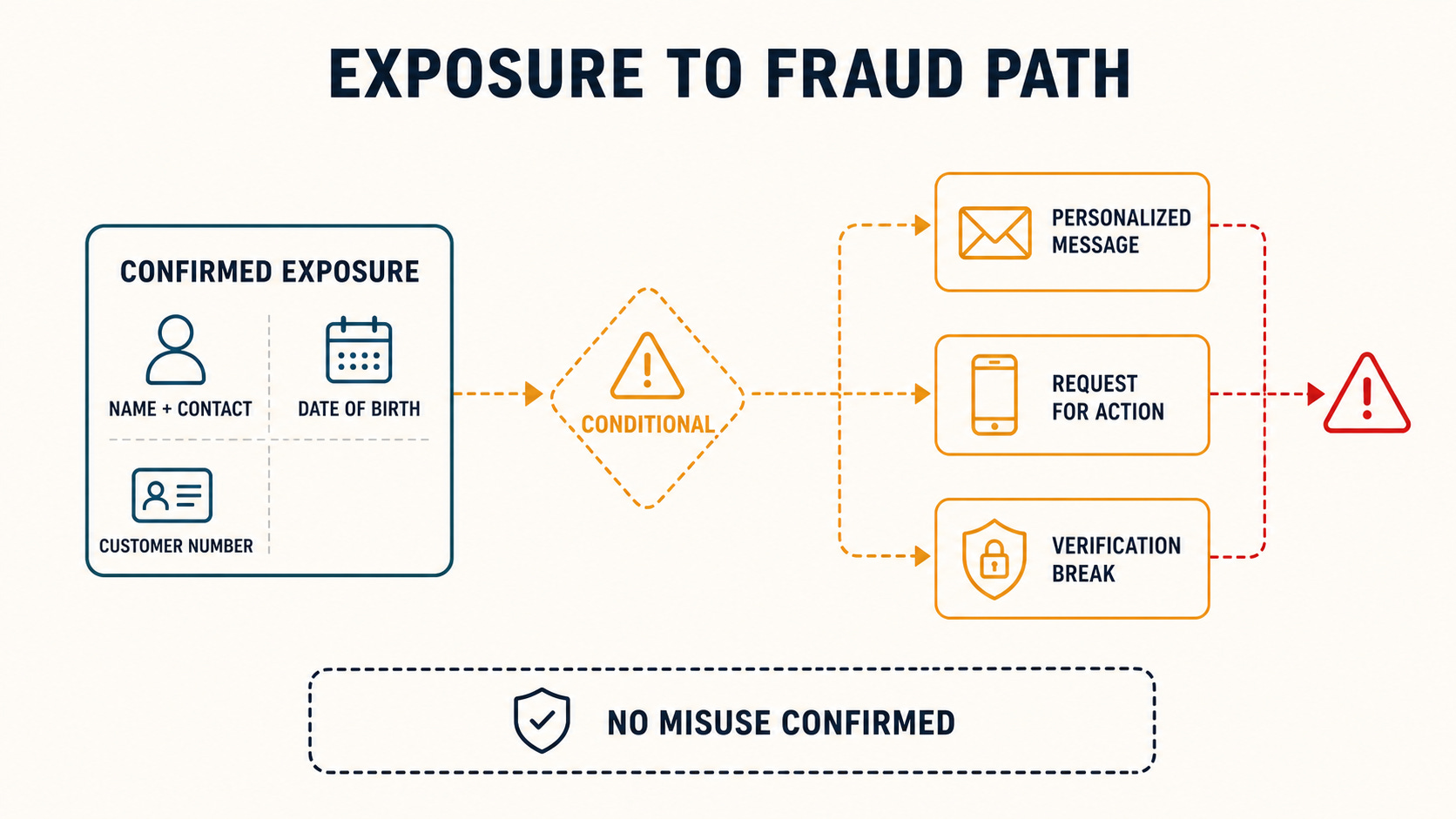
The first step is confirmed data exposure. Personalization, a fraudulent request, and victim action are conditional follow-on risks, not observed outcomes of this incident.
Read the Exclusions Precisely
The notices rule out several high-impact categories: passwords, billing and delivery addresses, bank data, payment information, and compromise of customer accounts. Lidl also says it has no concrete evidence that the stolen data has been misused.
Those statements reduce the known blast radius. They do not close the case.
"No evidence of misuse" means the investigation has not established misuse at the time of the notice. It does not show that every copy was recovered, that future fraud is impossible, or that all downstream exposure is already visible. Independent reporting from BleepingComputer records the same boundary and Lidl's warning about phishing and identity abuse.
Good incident communication separates three things: confirmed exposure, explicitly excluded data, and facts still under investigation. Collapsing them into a single word such as "limited" makes both response and customer guidance weaker.
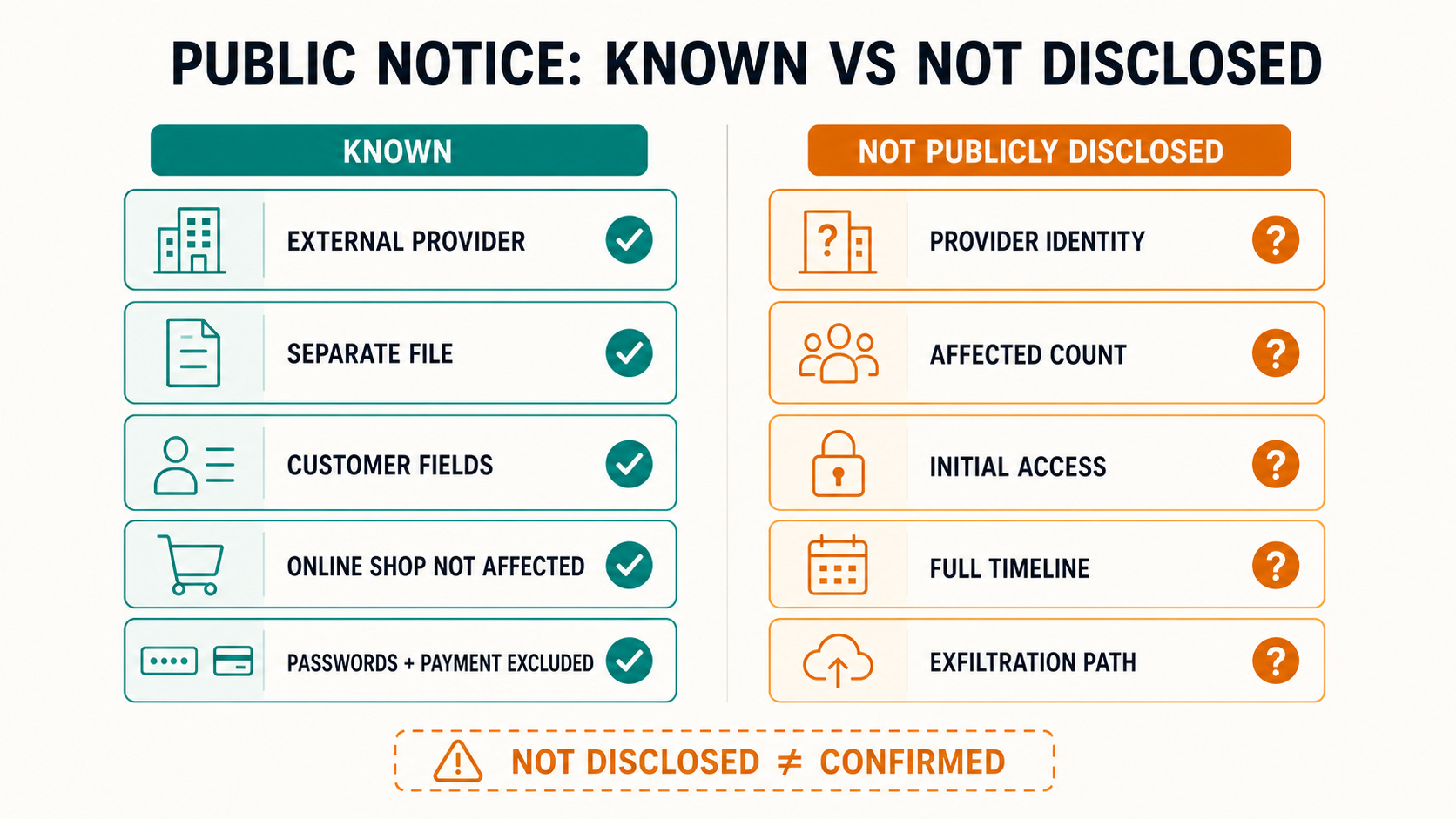
The figure distinguishes confirmed facts from details not stated publicly. "Not disclosed" is not evidence of a particular cause or scope.
Vendor Risk Becomes Customer Trust Risk
The customer relationship belongs to the retailer even when the compromised storage belongs to a provider. That makes third-party data handling part of the incident surface, not a procurement footnote.
The practical inventory is not just a list of vendors. It is a map of which customer fields each provider holds, where copies are stored, how long they remain, which identities can export them, and what logs survive after an incident. A provider that can only say its systems are secure is less useful than one that can quickly show the access path, affected object, export activity, and containment timeline.
The same discipline applies before an incident. If a provider does not need dates of birth or phone numbers for a process, removing those fields shrinks the future pretext. If it does need them, segmentation, short retention, narrowly scoped service identities, export monitoring, and preserved audit evidence become part of the control design.
Make Follow-On Fraud Expensive
For organizations handling similar incidents, the next steps should connect technical evidence to customer protection:
Reconcile the provider's affected file against the authoritative data inventory, including backups and derived exports.
Search identity, storage, and egress logs for access outside the stated window; record where visibility is missing.
Increase monitoring around account recovery, customer-support verification, and changes to contact details without assuming compromise has already occurred.
Give customers a verification path that does not depend on links or phone numbers inside an unexpected message.
Track phishing reports for themes that use the exposed fields, then update customer-service scripts and fraud controls with observed patterns.
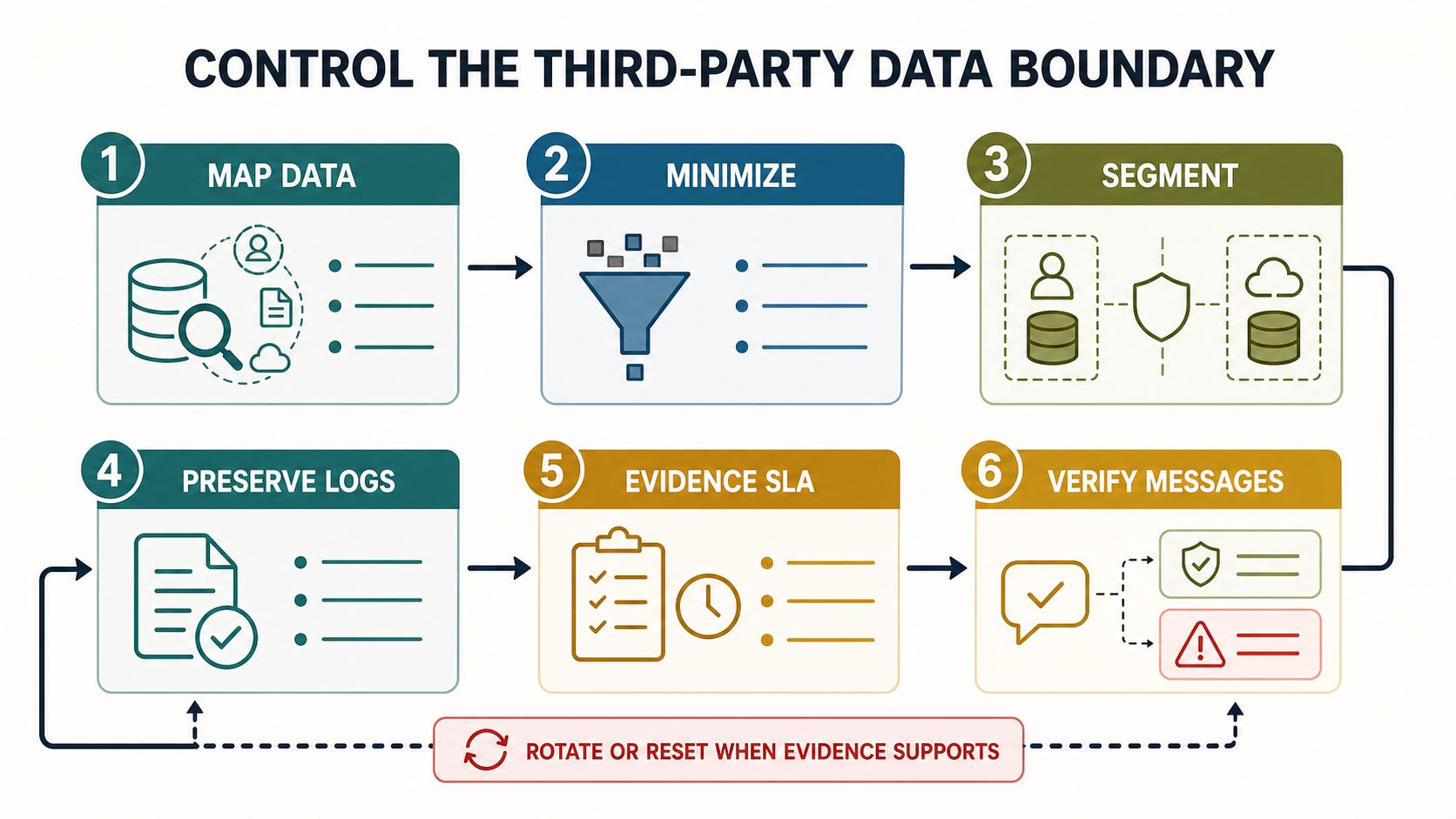
Map the data, minimize what leaves the primary system, preserve provider evidence, and give customers an independent verification route.
The Boundary That Matters
An unaffected storefront is good news. It is not the final measure of impact.
Customer data often exists in support systems, export files, analytics pipelines, fulfillment workflows, and vendor platforms. Attackers only need one reachable copy. Response teams need to know every copy, every access path, and every evidence owner.
Lidl's public notices provide a disciplined starting point: what was stolen, what was excluded, and what customers should watch for. The remaining work is proving the third-party boundary in enough detail to contain the incident and make the next convincing message fail.